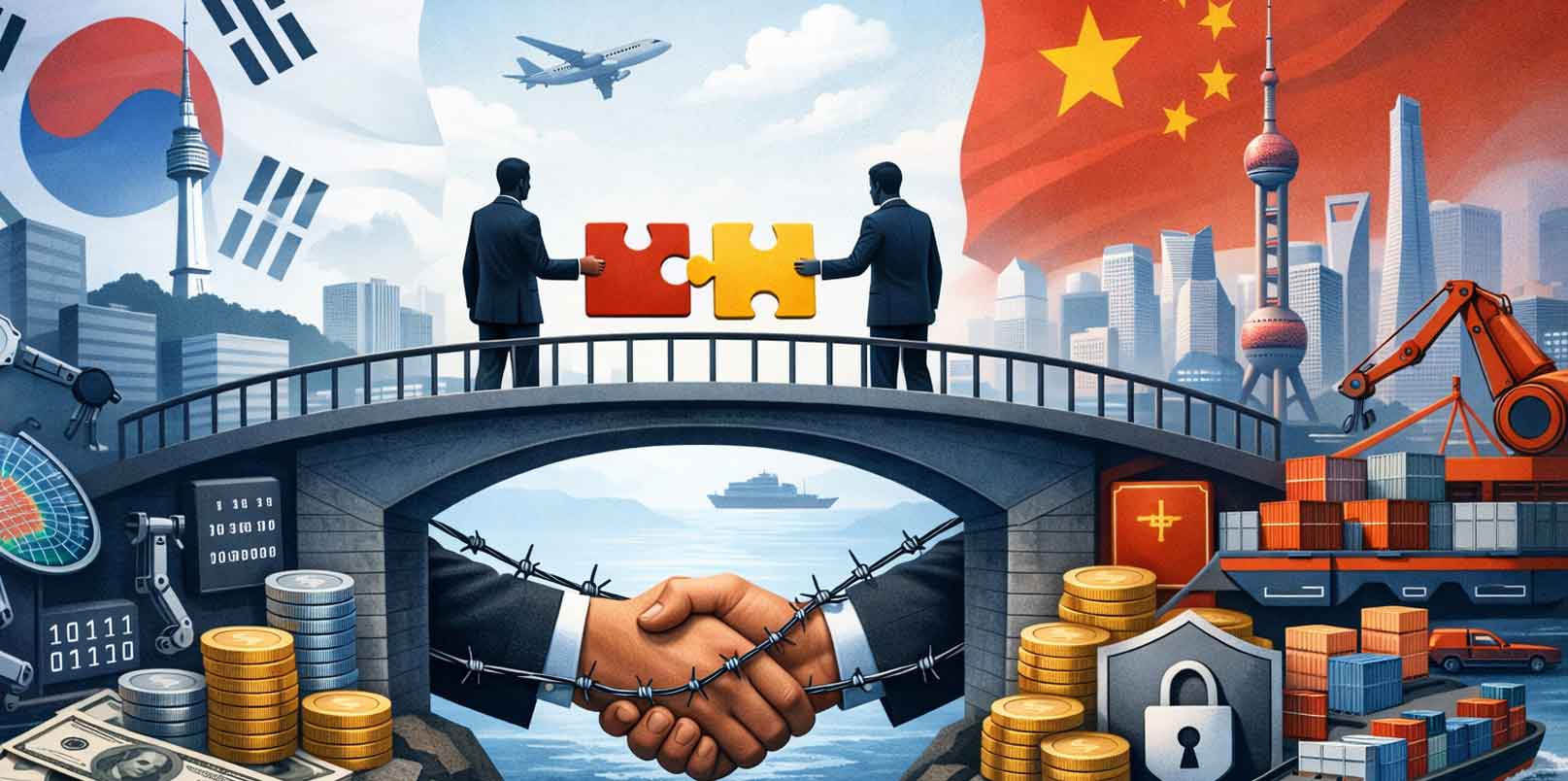
Capital moves faster than trust. The Korea – China Venture Startup Summit in Shanghai proved that diplomacy could reopen markets but not rebuild confidence overnight. As founders and investors remember how policy shifts once froze entire cross-border pipelines, the new pledges do matter, but only if the institutions behind them can hold the weight of execution.
Korea – China Venture Summit 2026: Policy Signals Are Back, But Proof Must Follow
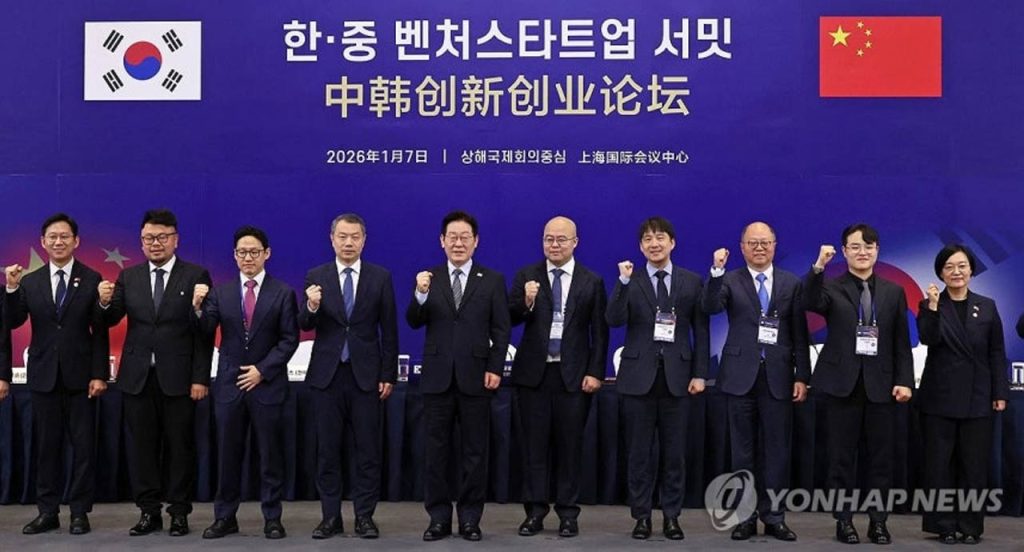
At the Korea – China Venture Startup Summit held on January 7 in Shanghai, both governments reaffirmed their intent to restore startup and venture investment cooperation.
Hosted by Korea’s Ministry of SMEs and Startups (MSS), the event coincided with President Lee Jae-myung’s state visit to China, drawing around 400 participants from startups, investors, and ministries of both countries.
Key outcomes included:
- The creation of a $25 million Korea–China Global Fund, co-managed by Korea Venture Investment Corp (KVIC) and CMB International, with $10 million contributed from Korea’s Fund of Funds.
- A commitment to deepen startup ecosystem collaboration through regular ministerial dialogue and joint business matching programs.
- The introduction of new startup exchange mechanisms covering AI, robotics, and supply-chain technologies.
These outcomes followed earlier policy agreements between Korea’s MSS and China’s MIIT, establishing a framework for joint innovation governance and venture ecosystem integration.
The Real Shift: Governance Becomes the Growth Engine
Behind the renewed optimism lies a shift in regional startup diplomacy. For over a decade, Korea’s startup outreach leaned on Western markets and policy-driven capital structures. The Shanghai summit marks the first attempt to institutionalize venture trust in the East—where capital is abundant but credibility is contested.
This reorientation gives Korean founders new access to China’s vast industrial networks and manufacturing depth—resources that extend far beyond Korea’s domestic capacity. It also pushes policymakers into unfamiliar terrain, navigating two opposing systems: Korea’s rule-based transparency and China’s state-coordinated flexibility. Investors are reading the same signal differently; transparent governance, not just available capital, has become the real determinant of scalable value.
The summit’s tone—measured, procedural, and policy-heavy—reflected this recognition. Korea is not exporting capital this time; it is exporting rules, frameworks, and startup governance standards, seeking parity rather than dependence.
Friction Points: Cooperation Without Clarity
The success of this renewed partnership depends on something no MOU can guarantee: institutional credibility.
China’s capital markets still operate under discretionary policy adjustments, while Korea’s startup environment remains tightly regulated by procedural oversight. Bridging these two systems requires not enthusiasm but compliance clarity—a factor absent from summit deliverables.
Another friction lies in founder-level asymmetry. Korean startups entering China face IP risk, data compliance uncertainty, and complex local partnership obligations. Meanwhile, Chinese investors entering Korea often cite regulatory opacity and limited local co-GP channels as barriers.
The Shanghai summit acknowledged cooperation but avoided these operational realities, suggesting that policy-level optimism may still outpace private-sector readiness.
Korea – China Venture Summit 2026 as Asia’s First Trust-Based Innovation Corridor
If executed faithfully, the Korea–China venture partnership could become Asia’s first trust-based innovation corridor—a network not built on subsidies or one-off deals but on aligned governance standards.
The KVIC – CMBI Global Fund will test this alignment. Its performance will reveal whether both sides can honor commitments in due diligence, reporting, and capital repatriation—areas where credibility, not liquidity, defines endurance.
Startups positioned in AI, robotics, and advanced manufacturing stand to gain early access to China’s scale while leveraging Korea’s R&D precision. Yet the advantage will tilt toward companies fluent in compliance and able to navigate two administrative languages—legal and political.
For policymakers, the summit’s true outcome will not be measured in funding volume but in the consistency of rule enforcement that follows. Without it, every future collaboration risks being perceived as provisional, not structural.
The Next Benchmark? Credibility
The Shanghai summit reopened the corridor between two of Asia’s most ambitious startup nations, but the next phase will not be built on capital announcements. It will depend on institutional behavior under pressure—how regulators, investors, and founders act when market optimism meets procedural reality.
In Asia’s venture landscape, money builds bridges, but only credibility keeps them standing.
– Stay Ahead in Korea’s Startup Scene –
Get real-time insights, funding updates, and policy shifts shaping Korea’s innovation ecosystem.
➡️ Follow KoreaTechDesk on LinkedIn, X (Twitter), Threads, Bluesky, Telegram, Facebook, and WhatsApp Channel.
🤝 Looking to connect with verified Korean companies building globally?
Explore curated company profiles and request direct introductions through beSUCCESS Connect.