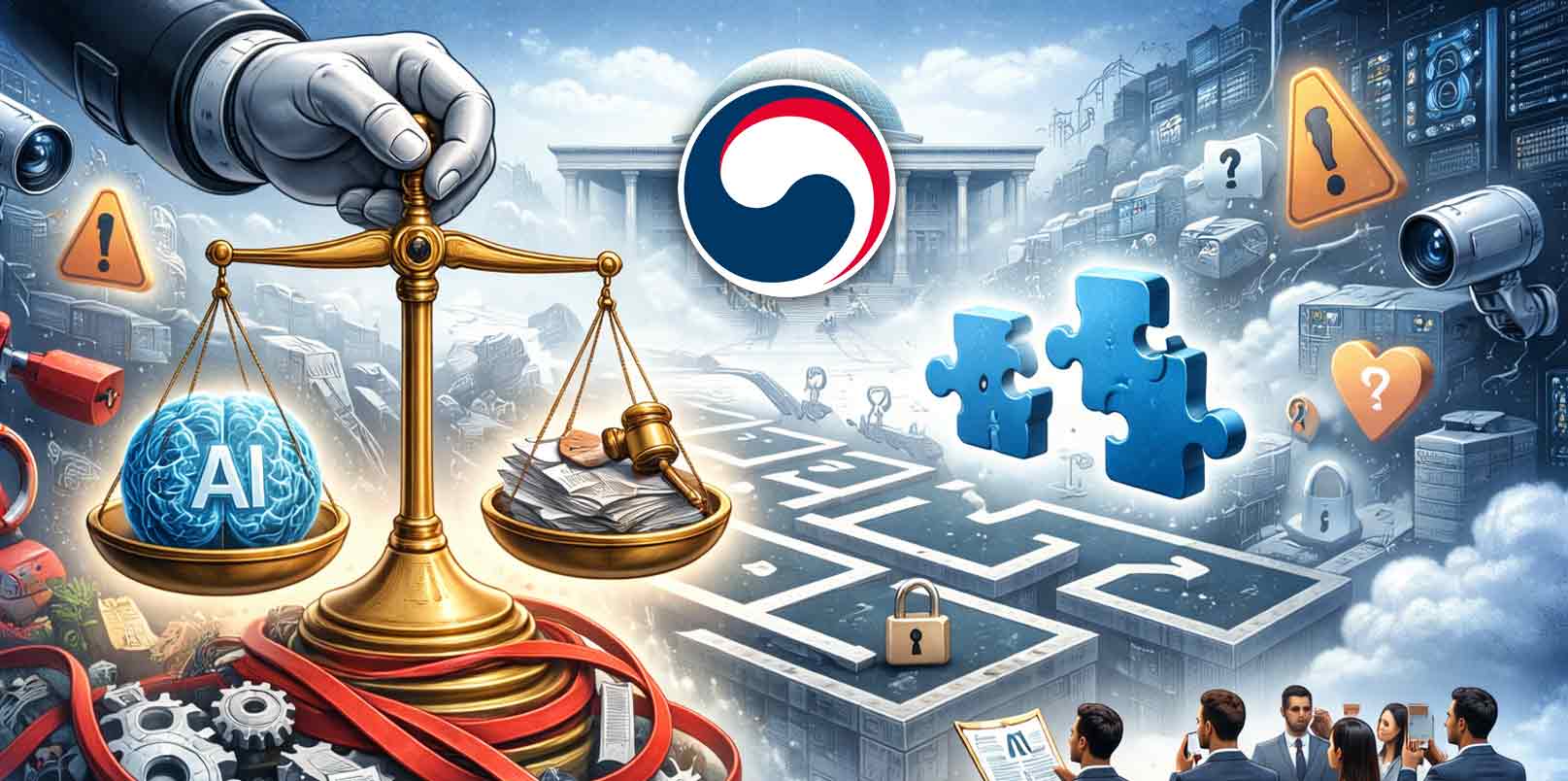
South Korea’s new AI Basic Act has entered the implementation phase with high expectations and mounting anxiety. Behind the global praise for being first lies a deeper test — whether the country’s institutions, not its algorithms, can adapt fast enough to govern an industry that changes every week. The applause is over. What comes next is credibility.
Korea Enforces the World’s First AI Basic Act
On January 22, 2026, South Korea will formally enforce the world’s first AI Basic Act, a law designed to regulate artificial intelligence development and use across both public and private sectors. The legislation sets obligations for safety, transparency, and user protection, particularly for “high-impact” and “generative” AI systems.
The Ministry of Science and ICT (MSIT) has confirmed that penalties will be delayed under a grace period while regulators focus on helping companies interpret and apply the law.
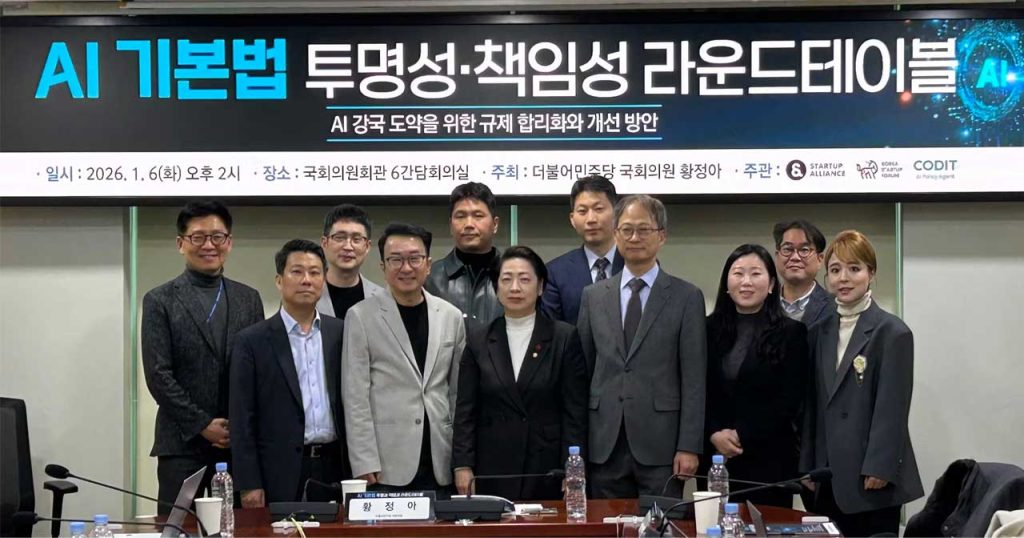
A public roundtable held at the National Assembly on January 6 revealed widespread concern from startups and policymakers about the law’s readiness, enforcement mechanisms, and clarity.
A Turning Point in Korea’s Innovation Governance
The law marks a turning point in Korea’s innovation governance. For decades, policy design preceded market reality — now, market complexity has overtaken the law. Startups and investors are no longer questioning intent but capability: can the state regulate AI at the speed it evolves?
Unlike the semiconductor or biotech frameworks Korea mastered in earlier decades, AI governance requires continual feedback, technical agility, and adaptive oversight.
Hence, the challenge isn’t really the law’s ambition but more on the system’s ability to enforce it intelligently. Every uncertainty, from how to label AI-generated content to how to define “high impact,” now exposes a governance gap — not a policy flaw.
Friction at the Core of Regulation
The friction begins where ambition meets infrastructure. Startups point to inconsistent definitions, unclear obligations, and costly compliance demands. Even industry leaders agree that the new system asks companies to interpret legal thresholds that regulators themselves are still defining.
According to a survey by the Startup Alliance, only two percent of Korean AI startups have prepared for the law. Many cite confusion over labeling rules that require both machine-readable and human-visible markings for AI-generated outputs — an approach experts say could backfire by increasing costs without guaranteeing safety.
For small firms building services on open-source or foreign APIs, compliance becomes nearly impossible. They cannot verify the full training data or computing footprint behind large models, yet the law holds them accountable for results.
And so the tension here is not just ideological but more in operational instead. Because now, governance has collided with capability.
What the Law Unlocks — and Where the System Still Locks Itself
Korea’s AI Basic Act establishes something no other country has yet: a legal architecture that treats AI as a public safety issue, not merely an industrial one. It offers a foundation for long-term trust and may eventually position Korea as a model for responsible AI development in Asia.
Yet trust cannot be legislated. Without predictable interpretation and enforcement, even well-intentioned rules can paralyze innovation. The law enables dialogue but not yet confidence. It protects consumers but strains early-stage developers. It builds accountability but risks slowing experimentation — the very source of Korea’s recent AI progress.
Officials from the Ministry of Science and ICT acknowledge this risk and have promised an extended guidance period and case-by-case flexibility. But that itself reveals the contradiction: the law designed to clarify behavior now depends on discretionary interpretation.
The World Is Watching Korea’s Next Move
And so, global founders see both promise and warning in Korea’s approach. The country shows a level of regulatory foresight rare in Asia, yet its ecosystem is still learning to balance speed with safety.
Meanwhile, investors can read Korea’s AI landscape as an early governance experiment—one where readiness for compliance will separate ventures built for longevity from those chasing momentum. International AI companies entering the market will need to manage dual accountability: meeting Korea’s transparency rules while staying aligned with global frameworks such as the EU AI Act.
As for policymakers abroad, Korea’s experience offers a preview of what unfolds when ambition races ahead of preparation—a reflection of how nations pursuing “ethical AI” must first ensure their institutions are ready to uphold it.
AI Basic Act Korea: A Law That Tests More Than Technology
In the end, the AI Basic Act was meant to prove Korea’s readiness for the future. Instead, it has exposed how fragile innovation governance can be when ambition moves faster than understanding.
Now, the real test ahead is not whether the law works, but whether the people and systems enforcing it can learn as quickly as the technology they seek to control. Only then will Korea’s leadership in AI regulation mean more than being first.
– Stay Ahead in Korea’s Startup Scene –
Get real-time insights, funding updates, and policy shifts shaping Korea’s innovation ecosystem.
➡️ Follow KoreaTechDesk on LinkedIn, X (Twitter), Threads, Bluesky, Telegram, Facebook, and WhatsApp Channel.
🤝 Looking to connect with verified Korean companies building globally?
Explore curated company profiles and request direct introductions through beSUCCESS Connect.