

In Korea, public funding has long powered early-stage innovation—but also fractured it. Startups learned to depend, corporates learned to wait, and policymakers learned to measure success in numbers, not networks. The new Deep Tech Challenge Project (DCP), offering up to KRW 20 billion per project, represents something larger than fiscal ambition. It’s an attempt to repair the broken social contract between innovation and policy.
Korea’s Largest Deep Tech R&D Initiative Yet
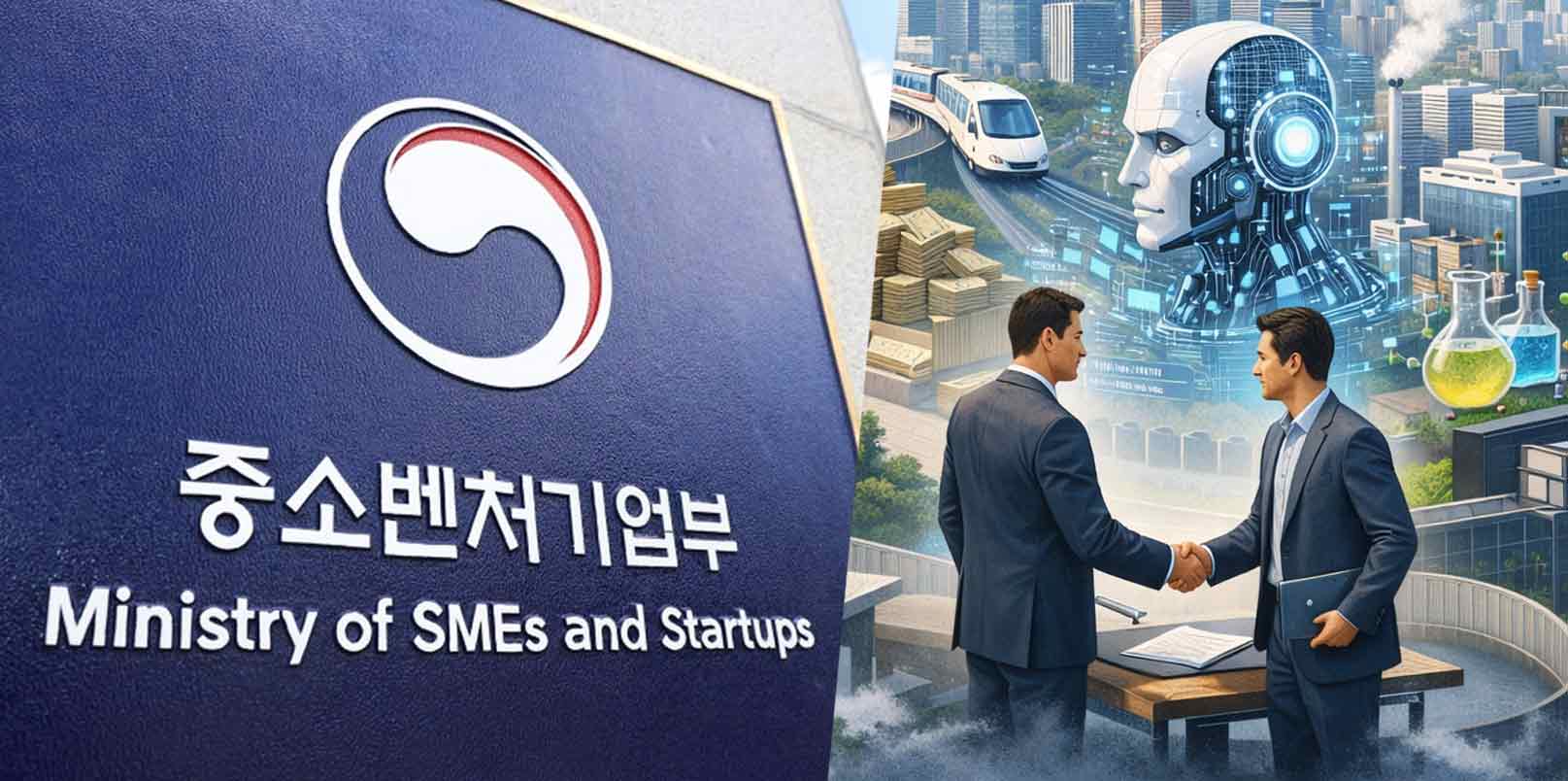
On January 7, the Ministry of SMEs and Startups (MSS) announced the launch of the “Ecosystem Innovation Type” under its Deep Tech Challenge Project, a national R&D framework supporting multi-stakeholder collaboration between startups, investors, research institutions, and large corporations.
Each selected project team—spanning from supply to demand companies—will receive up to KRW 20 billion (~ USD 15 million) over four years to co-develop and commercialize interdependent technologies in five strategic areas:
- AI and digital,
- advanced robotics and manufacturing,
- bio-health and pharmaceuticals,
- advanced materials and components, and
- carbon and energy.
The initiative will select five projects through a two-phase process: an initial pool of eight will be shortlisted, followed by a six-month validation period that includes proof-of-market testing and private capital matching exceeding ₩3 billion per team.
According to Hwang Young-ho, Director of Technology Innovation Policy,
“Providing ₩20 billion to a single project is unprecedented in Korea’s SME R&D history. This goes beyond firm-level support—it’s about solving ecosystem-level challenges and changing the industrial landscape.”
The Policy Rebuild Beneath the Numbers
The announcement is not just about capital allocation—it’s about rebuilding institutional credibility in innovation policy.
Over the past decade, Korea’s R&D system has produced technical depth but little structural coherence. Fragmented funding created islands of progress, often detached from market dynamics or industry demand. The Deep Tech Challenge Project flips that design: startups no longer operate alone. Instead, they must co-develop technologies with investors, universities, and manufacturers from the outset, with performance measured not by patent counts but by verified market validation and private sector investment.
This is also a test of Korea’s third venture boom narrative—a national ambition to become one of the world’s top four venture powerhouses by turning government funding into long-cycle innovation infrastructure.
When Ecosystem Design Meets Execution Reality
Yet collaboration, by design, is slow. Korean startups often operate on survival timelines measured in months, not four-year R&D cycles. Coordinating large consortia across universities, corporates, and investors introduces the same bureaucracy the policy aims to escape.
The “Moving Target” model, which allows goals to shift mid-project, acknowledges that innovation rarely follows a linear path. But it also introduces a new risk: policy fatigue. Without strong project managers and agile governance, flexibility can quickly resemble drift.
Moreover, the requirement for KRW 3 billion in private investment during the preparatory stage could unintentionally narrow access, filtering out earlier-stage founders who lack financial networks but possess breakthrough potential.
What Shifts, What Stays Stuck
If executed well, the DCP could rebuild connective tissue across Korea’s fragmented innovation system. It forces investors to participate earlier, research institutions to validate commercially, and policymakers to measure success through shared accountability rather than subsidy volume.
But the model does not directly address capital concentration in Seoul or the talent bottleneck in deep tech commercialization. Even with government continous funding and their relentless regional development mission, scaling cross-sector collaboration outside metropolitan regions remains an uphill climb.
Still, the shift is unmistakable: deep tech is no longer peripheral. It’s becoming the testing ground for Korea’s next phase of industrial policy—where fiscal power, institutional trust, and entrepreneurial risk must finally converge.
Deep Tech Challenge Project: A New Currency for Innovation
Korea’s R&D reform is not just about spending bigger—it’s about spending smarter, and together. The KRW 20 billion figure captures headlines, but the deeper question is whether collaboration can be engineered as effectively as technology itself.
The Deep Tech Challenge Project may prove that rebuilding innovation trust is not about more funding or faster growth, but about restoring confidence in the system that connects all three—startups, corporates, and the state. The next four years will show whether Korea’s innovation economy can turn that trust into tangible progress.
🤝 Looking to connect with verified Korean companies building globally?
Explore curated company profiles and request direct introductions through beSUCCESS Connect.
– Stay Ahead in Korea’s Startup Scene –
Get real-time insights, funding updates, and policy shifts shaping Korea’s innovation ecosystem.
➡️ Follow KoreaTechDesk on LinkedIn, X (Twitter), Threads, Bluesky, Telegram, Facebook, and WhatsApp Channel.


