The global AI race is usually measured in GPUs, model capabilities, and billion-dollar infrastructure announcements. Yet a quieter constraint is beginning to emerge beneath those headlines. Even as governments and technology companies invest heavily in computing capacity, the ability to deliver electricity, expand transmission networks, and support increasingly power-hungry data centers may become one of the defining factors shaping AI competitiveness in the years ahead.
The AI Bottleneck Debate Is Expanding Beyond GPUs
For much of the past two years, AI infrastructure discussions have centered on semiconductor supply. Governments launched national GPU programs, cloud providers expanded capacity, and startups competed for access to advanced computing resources.
That conversation remains important. However, growing evidence suggests that compute availability is only one part of a much larger infrastructure challenge.
In previous conversations with KoreaTechDesk, Greg Osuri, founder of Akash Network and CEO of Overclock Labs, argued that AI infrastructure competitiveness may depend less on GPU ownership and more on how effectively compute resources are utilized. He also warned that infrastructure economics are becoming a growing challenge for startups as AI adoption scales.
Those concerns echo a broader theme that has emerged across KoreaTechDesk’s AI infrastructure coverage. Earlier discussions with investor and former AI operator Steve Shwartz highlighted how power supply, grid capacity, and data center expansion could become critical constraints as governments and technology companies accelerate AI infrastructure investment.
Now, Osuri points to another emerging constraint that receives far less attention: the physical energy systems required to power the next generation of AI infrastructure.
“The AI industry keeps framing the boom as a chip shortage, but if you observe the entire supply chain, from GPUs through memory and into the underlying energy infrastructure, such as transformers, turbines, and grid capacity, and you factor in growing public resistance to new data center construction, the picture is one of a broader infrastructure crisis for AI.”
His observation aligns with concerns increasingly raised by energy agencies, infrastructure planners, and data center operators worldwide.
More Data Centers: Energy Infrastructure Challenge
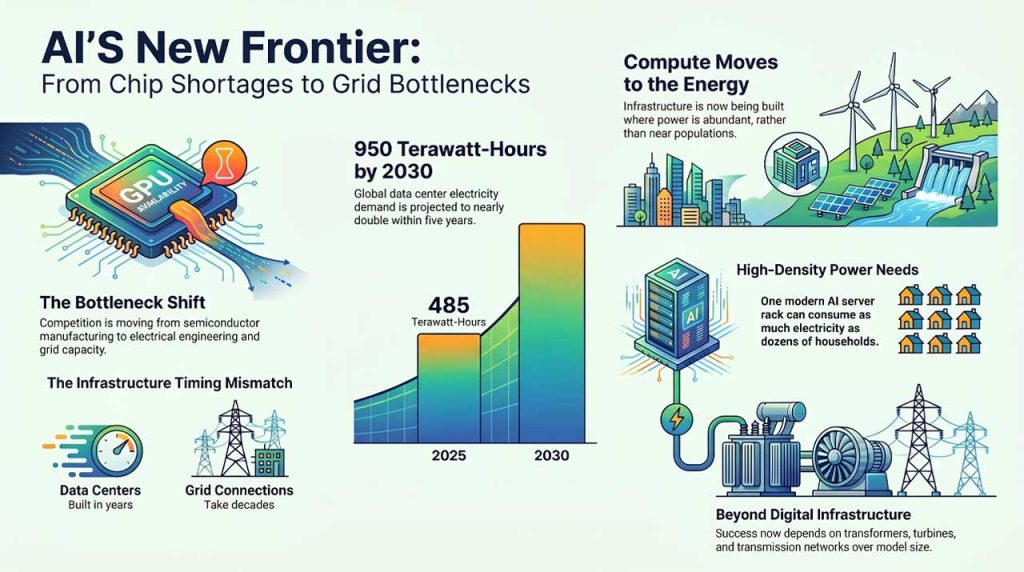
According to the International Energy Agency (IEA), global data center electricity consumption reached approximately 485 terawatt-hours in 2025 and could approach 950 terawatt-hours by 2030. The agency expects electricity demand associated with AI-focused data centers to grow particularly rapidly during that period.
The challenge is not simply that more facilities are being built.
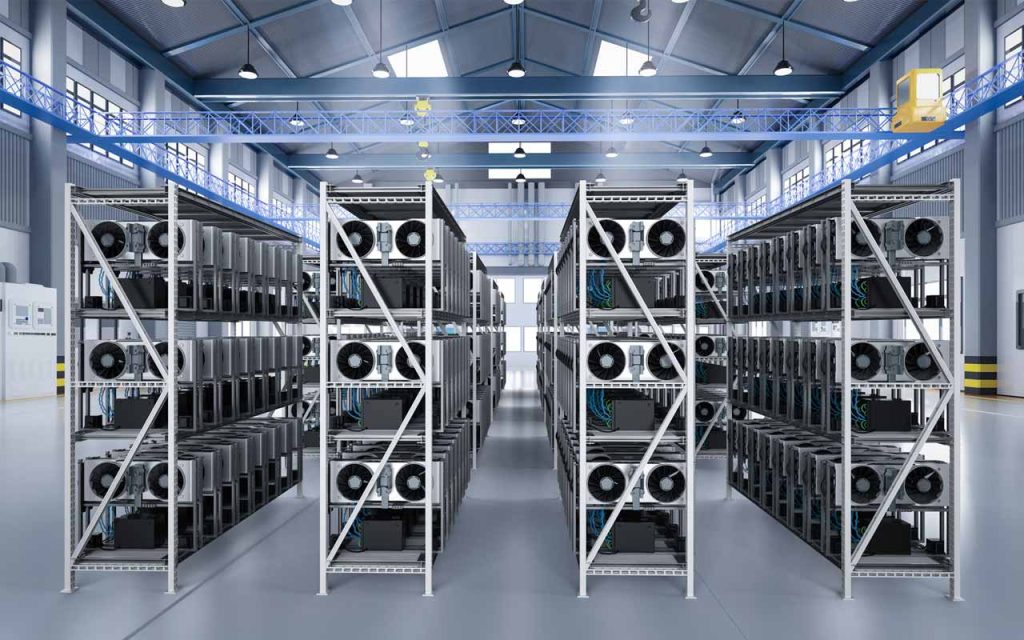
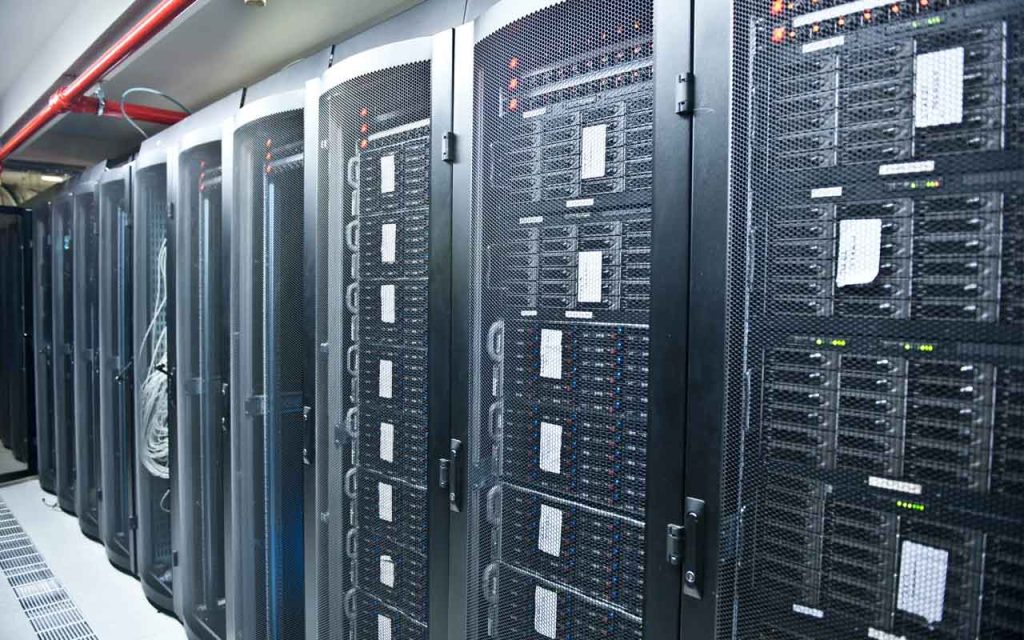
Modern AI infrastructure is becoming significantly more power-intensive. The IEA estimates that advanced AI server racks could consume electricity comparable to dozens of households, while power density within AI facilities continues increasing as operators deploy more powerful hardware.
As a result, infrastructure planning is becoming increasingly tied to questions involving energy availability, transmission capacity, cooling systems, and grid readiness.
This changes the nature of AI competition.
A company may have access to capital, land, and GPUs. Yet without sufficient electrical infrastructure, those resources cannot easily be transformed into operational computing capacity.
Why Grid Capacity Matters More Than Many Realize
The physical infrastructure required to support AI growth often develops much more slowly than computing technology.
Recent reporting by Reuters highlighted how some energy markets are experiencing lengthy grid connection queues even as AI development of data centers accelerates. Industry experts cited in the report noted that data centers can often be constructed within a few years, while connecting large facilities to power networks may take considerably longer.
This timing mismatch is becoming an increasingly important strategic issue.
Adding more GPUs can happen relatively quickly once supply becomes available. Expanding transmission networks, building substations, upgrading transformers, and increasing grid capacity often requires long-term planning, regulatory approvals, and substantial capital investment.
In other words, the next phase of AI infrastructure competition may depend as much on electrical engineering as semiconductor manufacturing.
Why Compute May Start Moving Toward Energy
One of Osuri’s more interesting observations concerns how infrastructure location decisions may evolve.
“We are seeing more cases where compute is moved to where the energy is, instead of energy being moved to where the compute sits.”
Historically, data centers were often built near major population centers because proximity improved connectivity and customer access.
Today, AI is creating different incentives.
Large-scale AI facilities increasingly require access to abundant, reliable, and affordable electricity. This has encouraged infrastructure developers to evaluate locations based not only on connectivity but also on long-term energy availability.
Recent examples illustrate this shift. SoftBank announced plans to invest tens of billions of euros in AI data center infrastructure in France, citing the country’s energy capabilities as part of the broader strategic opportunity.
The implication is significant.
Future AI infrastructure decisions may increasingly be shaped by geography, energy production, transmission networks, and power resilience rather than by digital infrastructure considerations alone.
What This Means for South Korea’s AI Ambitions
The discussion carries important implications for South Korea.
The country has aggressively expanded its AI infrastructure strategy through national GPU acquisition initiatives, public-private investment programs, and the National AI Computing Center project. These efforts are designed to strengthen Korea’s position as the country aims to become one of the top 3 global AI powerhouses.
However, Korea’s long-term AI competitiveness will depend on more than merely securing advanced hardware.
Industry reports have highlighted growing concentration of data center capacity within the Seoul metropolitan area, where power demand, land availability, and infrastructure constraints are becoming increasingly important planning considerations.
According to industry data cited by ETNews, a large majority of private-sector data centers remain concentrated in Seoul, Gyeonggi Province, and Incheon. At the same time, experts have warned that major transmission and substation projects can require many years to complete.
This creates a strategic question for policymakers.
If AI demand continues accelerating, the challenge may shift from acquiring computing equipment to ensuring that infrastructure expansion remains aligned with long-term energy planning.
That issue affects startups, enterprises, cloud providers, investors, and public institutions alike.
The Next Infrastructure Race May Be Physical, Not Digital
The first phase of the AI boom focused on model development.
Then, the second phase focused on securing GPUs.
Now, the next phase may be shaped by something far less visible but equally important: the ability to deliver power where compute needs to operate.
The organizations and countries that succeed in AI will still need advanced chips, talented engineers, and innovative models. Yet those assets increasingly depend on underlying systems that receive far less attention, including transmission networks, substations, cooling infrastructure, and reliable electricity supply.
As AI becomes a larger part of economic and industrial activity, infrastructure competitiveness may increasingly be determined by decisions that happen long before a server is ever switched on.
Beyond the GPU Conversation
The AI industry has spent years asking how many GPUs are needed to support future growth.
That remains a relevant question.
But the emerging challenge is broader. Computing power cannot be separated from the physical systems that support it.
That is why for startup founders, investors, and policymakers watching Korea’s AI ecosystem, the next major infrastructure debate may not focus on chip availability alone. It may focus on whether power systems, transmission networks, and energy infrastructure can expand quickly enough to support the ambitions that AI has already created.
Key Takeaway
- AI infrastructure growth is increasingly becoming an energy infrastructure challenge, not solely a GPU procurement challenge.
- Transformers, turbines, grid capacity, and transmission systems are emerging constraints alongside semiconductor supply.
- The International Energy Agency projects global data center electricity demand could approach 950 TWh by 2030, driven in part by AI expansion.
- Grid connection timelines, transmission capacity, and power delivery systems are becoming critical factors in AI infrastructure deployment.
- Infrastructure developers are increasingly evaluating locations based on energy availability, so compute may increasingly move toward available power resources.
- Korea’s AI strategy will require alignment between computing infrastructure and long-term energy planning, particularly as data center demand continues to grow.
- The next phase of AI competitiveness may depend on how effectively countries connect compute capacity with physical energy infrastructure.
– Stay Ahead in Korea’s Startup Scene –
Get real-time insights, funding updates, and policy shifts shaping Korea’s innovation ecosystem.
➡️ Follow KoreaTechDesk on LinkedIn, X (Twitter), Threads, Bluesky, Telegram, Facebook, and WhatsApp Channel.
🤝 Looking to connect with verified Korean companies building globally?
Explore curated company profiles and request direct introductions through beSUCCESS Connect.