
Generative AI made powerful models widely accessible faster than many startups expected. That created a new problem inside the global AI market. If foundational capabilities are increasingly available to everyone, then what actually remains defensible? South Korea’s emerging vertical AI startups are now testing one possible answer through domain-specific workflows, proprietary operational data, and marketplace-level execution knowledge that general-purpose AI systems still struggle to replicate.
As AI Models Become Easier to Access, Startups Need a Different Defense Layer
The rapid improvement of frontier AI models has created enormous opportunities for software startups globally.
At the same time, it has also intensified pressure on companies building thin application layers around broadly available models.
Stanford University’s 2026 AI Index Report showed that performance gaps between leading AI models continue narrowing rapidly. The report noted that the gap between the top U.S. model and the leading Chinese model had narrowed to only 2.7% by March 2026, while the difference between leading closed and open models also continued shrinking.
That trend means model capability alone is becoming harder to defend commercially over time.
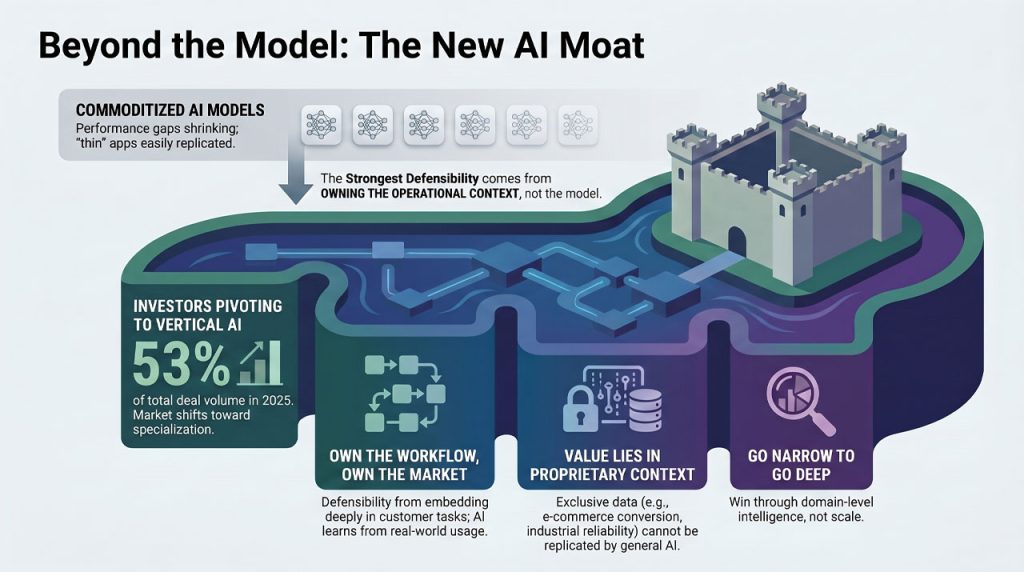
As foundation models commoditize, investors and operators are increasingly shifting attention toward a different question: which companies actually own operational context deep enough to generate durable advantages beyond raw model access?
Investors Are Increasingly Looking at Workflow Ownership, Not Just AI Features
The funding environment already reflects this transition.
Euclid Ventures’ 2026 Vertical Report, which analyzed more than 4,000 venture financings, found that vertical startups captured 53% of total deal volume during 2025 while accounting for 30% of deployed capital. The report also showed that vertical companies represented 56% of total exit value across the same period.
The significance of those numbers extends beyond investment momentum itself.
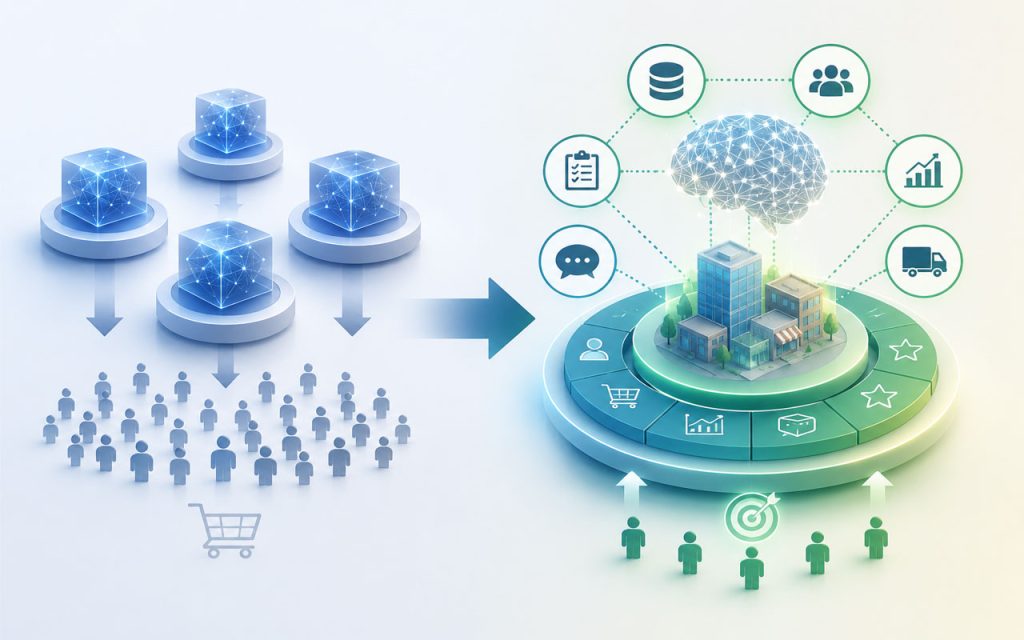
Many investors increasingly view vertical AI companies differently from generic AI productivity tools because vertical operators tend to accumulate domain-specific data, workflow integrations, customer behavior patterns, and operational feedback loops that become harder to replicate over time.
Menlo Ventures described this dynamic as one of the defining characteristics of durable vertical AI businesses. In its 2026 vertical AI analysis, the firm argued that defensibility increasingly comes from systems embedded deeply inside customer workflows where real operational usage continuously improves the product itself.
That distinction is especially important in Korea, where startups often cannot compete directly against global frontier-model companies on computational scale alone.
Instead, many Korean AI startups are increasingly competing through narrower but deeper operational specialization.
Korea’s Vertical AI Push Is Closely Tied to Workflow Complexity
South Korea’s own software policy research increasingly reflects this direction.
The Software Policy & Research Institute (SPRI) stated in its 2026 vertical SaaS analysis that industry-specific software platforms are becoming strategically important because they reflect sector-specific workflows, regulatory structures, and proprietary operational data environments.
SPRI also projected the global vertical SaaS market would grow from approximately USD 90.1 billion in 2024 to USD 205.6 billion by 2030.
That structural specialization appears increasingly relevant in Korea’s marketplace-driven digital economy.
E-commerce remains one of the clearest examples because Korean online marketplaces operate through highly specific operational systems involving listing structures, metadata requirements, search optimization, image standards, category attributes, and platform-specific compliance logic.
Those conditions create large volumes of workflow-specific operational data that general-purpose AI systems often lack.
Woobin Koh, CEO of Fulcrum Technologies, believes that difference is becoming commercially significant as AI application markets mature.
“Features are not a moat, and that is true in any category, but especially in AI, where foundation model capabilities are commoditizing rapidly,”
Koh told KoreaTechDesk during discussions on Korea’s evolving vertical AI and e-commerce infrastructure landscape.
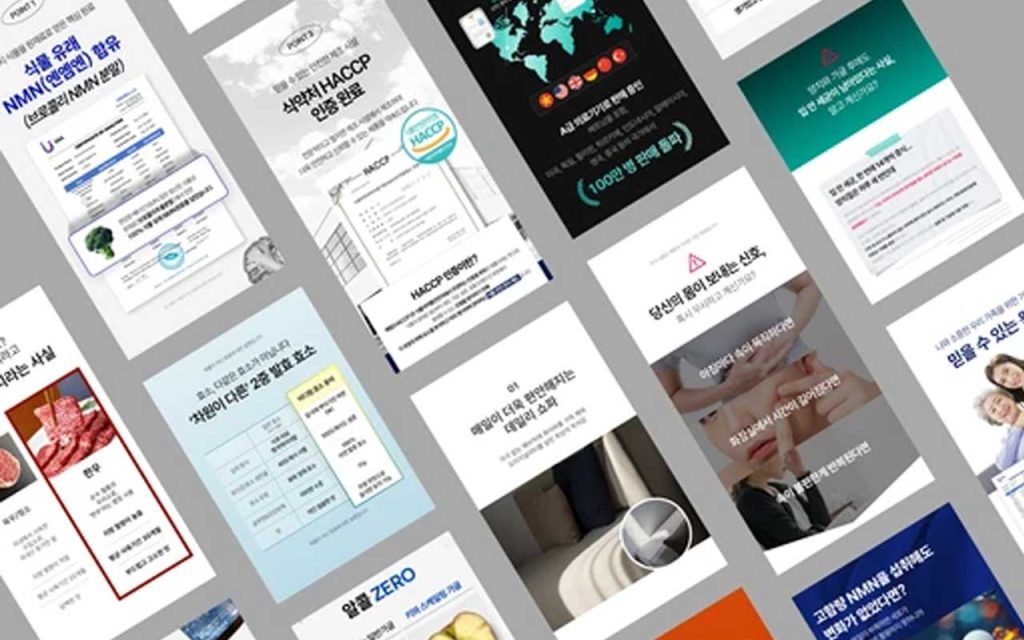
His company, which develops AI-driven product-page generation platform Hookable AI, believes long-term defensibility increasingly comes from proprietary operational intelligence, marketplace-specific workflow knowledge, and accumulated customer usage data rather than AI content generation capability alone.
“Our dataset on what drives conversion in Korean e-commerce product pages does not exist anywhere else,”
That claim reflects a broader pattern emerging across vertical AI categories globally.
The companies attempting to build long-term defensibility are increasingly trying to accumulate proprietary operational environments where customer interactions continuously improve system performance in commercially specific contexts.
Proprietary Workflow Intelligence Is Becoming More Valuable Than Generic AI Output
The strategic value of vertical AI may therefore depend less on model ownership itself and more on accumulated workflow knowledge.
Koh argues that workflow-specific operational intelligence creates advantages that are difficult for general-purpose systems to reproduce quickly.
“The vertical workflow encodes operational knowledge from senior designers in a way that a general-purpose model cannot replicate or access.”
That distinction matters because many enterprise environments involve more than content generation alone.
In practice, operational systems contain years of accumulated judgment around customer behavior, edge cases, workflow sequencing, approval logic, formatting standards, conversion patterns, and organizational decision-making structures.
Once AI systems become embedded deeply enough inside those workflows, switching costs may gradually rise beyond simple feature comparison.
Menlo Ventures described this phenomenon as workflow depth compounding over time through customer corrections, edge-case handling, and real operational feedback.
In other words, the system improves not simply because the model becomes smarter, but because the workflow itself continuously trains the organization-specific operating layer around the model.
That dynamic may help explain why vertical AI startups increasingly emphasize integration depth, operational embedding, and proprietary data accumulation rather than standalone AI functionality.
Korean AI Startups May Need Narrower but Deeper Strategic Positioning
The broader competitive environment also reinforces this pressure.
Samjong KPMG reported that global AI startup investment reached USD 225.8 billion in 2025, roughly double the previous year despite a decline in overall deal count. Much of that capital increasingly concentrated around major frontier-model companies such as OpenAI and Anthropic.
For many Korean startups, that concentration creates a difficult reality.
Competing directly on model scale against global infrastructure players may become increasingly unrealistic. As a result, many domestic startups may need to defend themselves through workflow specialization, industry-specific execution, and domain-level operational intelligence instead.
Now, Korea’s vertical AI movement is already extending beyond commerce.
Industrial AI company MakinaRocks, for example, has positioned itself around high-precision industrial workflows involving manufacturing environments, operational reliability, and sector-specific deployment requirements ahead of its planned KOSDAQ listing.
That broader pattern suggests Korea’s AI ecosystem may increasingly evolve around applied operational expertise rather than purely horizontal AI competition.
The Strongest AI Moats May Come From Operating Context, Not Model Access
The long-term implication may ultimately reshape how AI defensibility itself gets evaluated.
Earlier software eras often rewarded companies that controlled distribution or interface layers. The current AI cycle increasingly rewards companies capable of accumulating commercially meaningful operational context around the model.
That context may include workflow depth, customer behavior signals, industry-specific judgment systems, proprietary datasets, organizational integrations, and execution speed inside narrow commercial environments.
Koh believes those feedback loops become difficult to replicate once they compound at scale.
“The GTM advantage built through early market penetration, the customer relationships, feedback loops, and iteration velocity compounds in ways that a later entrant cannot simply overcome by deploying a stronger model.”
As generative AI capabilities continue spreading globally, the companies most likely to sustain defensibility may not be the ones owning the largest foundational models.
They may instead be the companies whose systems understand a specific operational environment deeply enough that replacing them means losing accumulated commercial intelligence itself.
Why Korea’s Vertical AI Ecosystem May Matter Beyond Korea
In the end, South Korea’s AI startup ecosystem is increasingly becoming an important test environment for this broader transition.
The country’s dense digital infrastructure, highly competitive marketplaces, and operationally complex industries create conditions where narrow workflow specialization can generate measurable commercial value quickly.
That makes Korea particularly relevant for observing how vertical AI businesses attempt to build defensibility after the initial generative AI boom.
The lesson emerging from many of these startups is becoming clearer.
The sustainable advantage may no longer come primarily from owning the model.
It may come from owning the operational context surrounding it.
Key Takeaway
- Korean vertical AI startups are increasingly competing through workflow depth, not model size alone.
- General-purpose AI models are becoming more accessible, reducing long-term defensibility for shallow AI tools.
- Vertical AI business models attracted strong investor interest in 2025, accounting for 53% of analyzed deal volume in Euclid Ventures’ research.
- Industry-specific workflows, regulatory structures, and operational datasets as major strategic advantages for vertical SaaS and AI companies.
- Features are not a moat in the AI era because foundational model capabilities are commoditizing rapidly.
- Hookable’s advantage comes from proprietary conversion data, marketplace-specific intelligence, and workflow knowledge from senior operators.
- Marketplace intelligence AI systems become more valuable as customer usage continuously improves operational performance and feedback loops.
- Korean AI startups may increasingly focus on domain-specific AI platforms because competing directly against global frontier-model companies is becoming harder.
- The strongest AI defensibility may come from operational context, customer workflows, and commercial execution knowledge rather than standalone AI capability.
– Stay Ahead in Korea’s Startup Scene –
Get real-time insights, funding updates, and policy shifts shaping Korea’s innovation ecosystem.
➡️ Follow KoreaTechDesk on LinkedIn, X (Twitter), Threads, Bluesky, Telegram, Facebook, and WhatsApp Channel.
🤝 Looking to connect with verified Korean companies building globally?
Explore curated company profiles and request direct introductions through beSUCCESS Connect.