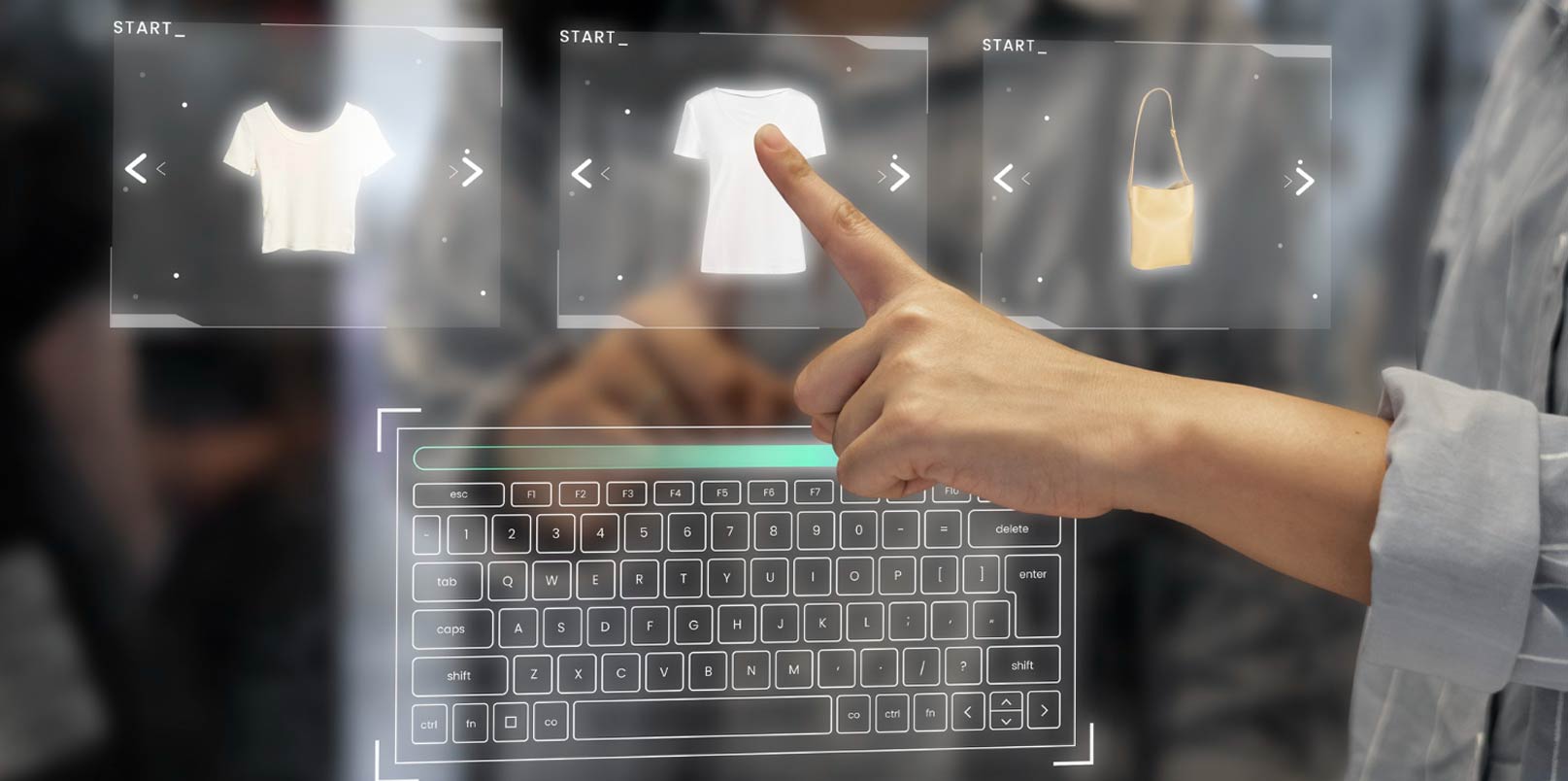
For years, e-commerce design teams scaled through headcount. More SKUs meant more designers, more outsourcing, and more repetitive production work. But now AI is beginning to disrupt that equation inside Korea’s marketplace ecosystem. The immediate shift is not mass replacement. It is something quieter and potentially more important: companies are reorganizing how creative work itself gets distributed between humans and AI systems.
Korea’s E-commerce Boom Is Creating a Content Production Problem
The pressure inside Korea’s e-commerce market is no longer limited to customer acquisition. Sellers increasingly face operational pressure around content volume, listing speed, and multi-channel management.
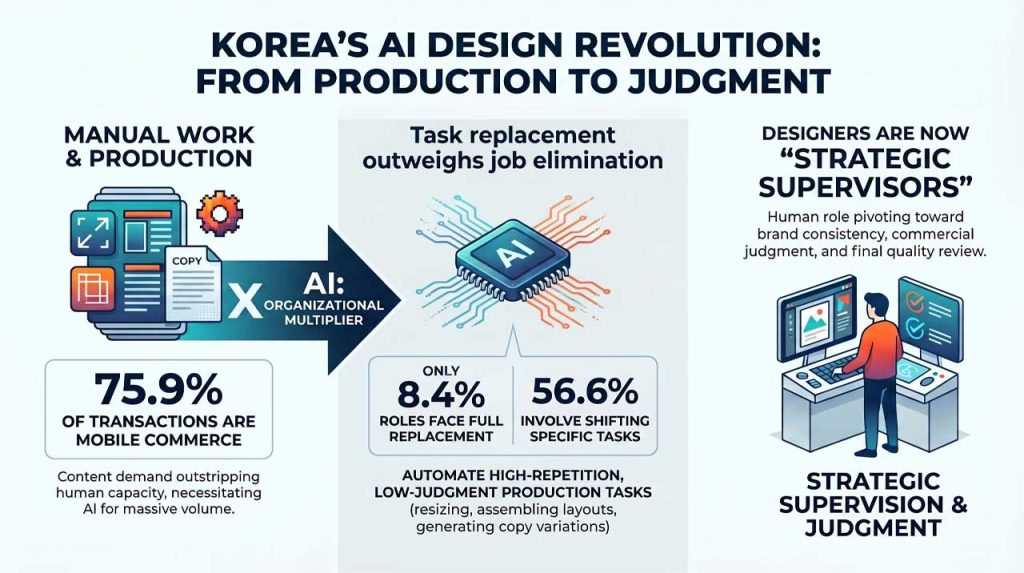
Statistics Korea (KOSTAT) reported that South Korea’s online shopping transaction value reached KRW 25.577 trillion (approximately USD 17.3 billion) in March 2026, up 13.3% year-on-year. Mobile commerce represented 75.9% of total online shopping transactions during the same month.
That scale creates a practical challenge for sellers managing large product catalogs across marketplaces such as Naver Smart Store and Coupang. Product-page production is no longer an occasional branding exercise. It has become a continuous operational workflow tied directly to listing throughput and sales activity.
The same pressure is appearing globally across retail and commerce teams. Adobe’s 2025 retail digital trends report found that creative teams currently satisfy only about 55% of content demand across retail touchpoints. The report also showed that 43% of retailers face increasing pressure to produce more content across channels while simultaneously improving customer engagement and conversion performance.
As catalog volume expands and marketplaces demand constant optimization, many companies are starting to rethink how design labor itself should be structured.
Korea’s AI Shift Is Starting with Workflow Redesign, Not Designer Elimination
Public discussion around AI and creative work often gravitates toward replacement narratives. Korea’s emerging e-commerce workflow changes suggest something more nuanced is happening.
According to Korea Labor Institute (KLI) research discussed during a 2025 policy seminar, AI adoption is more commonly associated with partial task restructuring rather than full job elimination. The cited breakdown showed 56.6% of AI-related labor changes involved partial task replacement, while only 8.4% involved complete job replacement. Another 35.1% involved newly created tasks emerging around AI systems.
That distinction matters inside e-commerce design operations because much of the repetitive production layer is highly standardized.
Tasks such as resizing assets, assembling detail-page layouts, adapting marketplace formats, generating copy variations, and organizing product information are increasingly becoming automatable inside AI-assisted workflows.
Human designers, meanwhile, remain responsible for evaluating output quality, protecting brand consistency, reviewing accuracy, and determining commercial usability.
Woobin Koh, CEO of Fulcrum Technologies, believes this transition is already changing hiring logic among larger e-commerce operators.
“Existing designers are not displaced,”
Koh previously told KoreaTechDesk during discussions on Korea’s AI-driven e-commerce infrastructure shift.
“Leadership simply stops adding headcount and redirects the budget toward AI-augmented workflows.”
That operational shift may become one of the earliest large-scale labor reorganizations emerging from Korea’s AI commerce ecosystem.

Designers Are Gradually Moving Closer to QA, Review, and Commercial Judgment
The practical changes are becoming visible inside companies managing high SKU volumes and multi-marketplace operations.
Koh explained that stronger demand for AI workflow integration tends to come from companies with internal design teams and larger operational complexity, including SMBs above certain revenue thresholds and Series B/C-stage startups.
The underlying goal is not necessarily to remove designers entirely. It is to increase the amount of commercial output each designer can supervise.
“Tasks that are high in repetition and low in judgment will migrate to automation quickly.”
That transition mirrors broader findings emerging across creative-industry research.
A 2025 review published in AI & Society found that generative AI is increasingly shifting creative work away from pure production and toward curation, evaluation, and supervisory roles. The researchers then identified growing emphasis on AI oversight, output selection, and quality assessment rather than manual asset creation alone.
In practice, this means designers may spend less time building every product page element manually and more time determining which AI-generated outputs align with marketplace standards, customer expectations, legal compliance, and brand identity.
The creative bottleneck begins to move away from production capacity and toward decision-making quality.
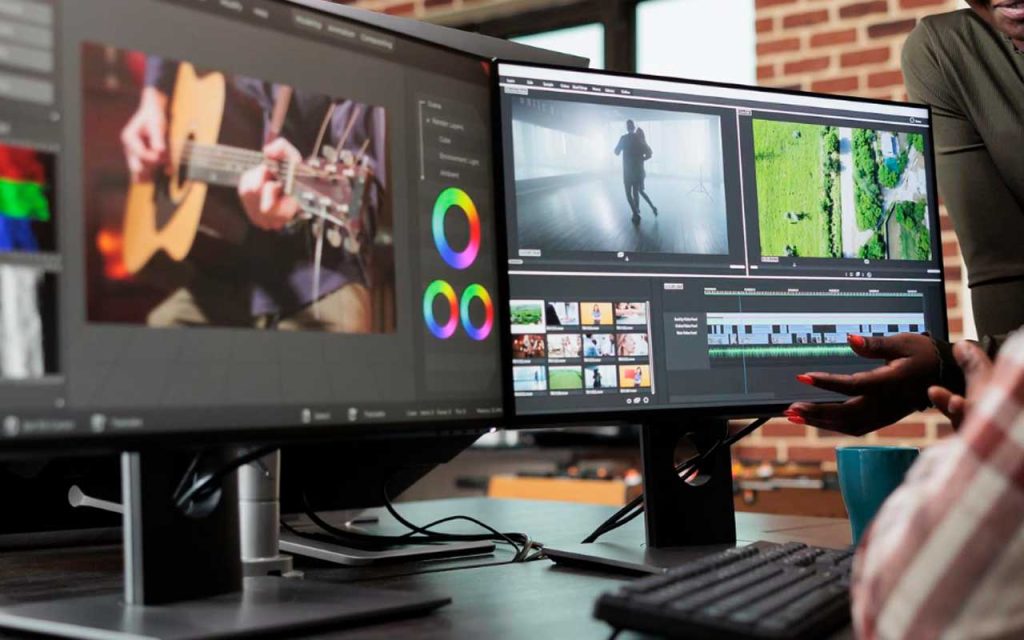
Korea’s Design Industry May Offer an Early View Into AI-Augmented Creative Labor
The scale of Korea’s design economy makes these shifts economically meaningful.
According to Korea’s e-Nara Index, the country’s design industry reached KRW 21.5 trillion in 2024, supporting roughly 298,000 design workers across specialized design firms and design-utilizing companies. Most of those workers operate inside companies using design as part of broader commercial operations rather than inside standalone creative agencies.
That distinction becomes increasingly important in AI-enabled commerce environments.
Inside e-commerce teams, design work is closely tied to operational speed, platform adaptation, product turnover, and conversion performance. AI systems capable of accelerating repetitive production workflows therefore affect organizational structure more directly than in slower-moving creative sectors.
Korean content industries are already seeing broader AI integration trends. Data cited by Electronic Times from the Korea Creative Content Agency showed that 20% of Korean content companies used generative AI during the first half of 2025, up 7.1 percentage points from the previous reporting period. Content production and editing represented the most common use case.
Yet even as AI adoption expands, trust in fully autonomous creative output remains limited.
Adobe’s 2025 creative-professional survey found that while 99% of surveyed creative professionals already use generative AI tools in some capacity, 45% said they would never fully trust AI systems to create final assets independently.
That tension helps explain why many Korean e-commerce teams appear to be moving toward hybrid production structures rather than fully automated ones.
AI’s Real Impact May Be Organizational, Not Merely Technical
The deeper transformation may ultimately involve management structure rather than software capability alone.
McKinsey’s 2025 AI research noted that organizations generating stronger returns from AI adoption tend to redesign workflows and define clear boundaries for human review instead of simply layering AI tools onto existing systems.
Korea’s e-commerce ecosystem may be especially suited for this kind of operational redesign because marketplace competition already forces companies to optimize speed, consistency, and output volume aggressively.
In that environment, AI becomes less valuable as a standalone creative tool and more valuable as an organizational multiplier.
The companies likely to adapt fastest may not be the ones attempting to remove human designers entirely. They may instead be the companies learning how to redistribute work between AI systems and human judgment more efficiently than competitors.
The Future of E-commerce Design Teams May Depend on Human Judgment Density
The broader implication extends beyond Korea’s marketplace ecosystem.
As AI-generated commerce content becomes cheaper and faster globally, competitive differentiation may increasingly shift toward areas that remain difficult to automate reliably: brand judgment, trust calibration, quality control, cultural nuance, and commercial decision-making.
That may explain why the immediate impact of AI inside Korean e-commerce design teams looks less like replacement and more like compression.
Fewer people may eventually supervise larger amounts of commercial output. But the remaining human roles could become more strategically important, not less.
The question for e-commerce companies is no longer simply how many designers they employ.
It is how much operational and commercial judgment each designer can effectively oversee when AI handles the first production layer.
Key Takeaway
- South Korea’s e-commerce growth is increasing operational pressure around product-page production, listing speed, and multi-channel content management.
- AI adoption inside e-commerce design teams is currently centered more on workflow restructuring than full workforce replacement.
- Korea Labor Institute research suggests most AI-related labor changes involve partial task replacement and newly created work rather than total job elimination.
- Repetitive production tasks such as formatting, resizing, layout assembly, and copy variation are becoming increasingly automatable inside AI-assisted workflows.
- Human designers are shifting toward QA, review, brand consistency, and commercial judgment roles as AI handles more first-layer production work.
- Korean e-commerce teams may provide an early example of AI-augmented organizational redesign, where competitive advantage depends on how effectively companies distribute work between AI systems and human oversight.
🤝 Looking to connect with verified Korean companies building globally?
Explore curated company profiles and request direct introductions through beSUCCESS Connect.
– Stay Ahead in Korea’s Startup Scene –
Get real-time insights, funding updates, and policy shifts shaping Korea’s innovation ecosystem.
➡️ Follow KoreaTechDesk on LinkedIn, X (Twitter), Threads, Bluesky, Telegram, Facebook, and WhatsApp Channel.