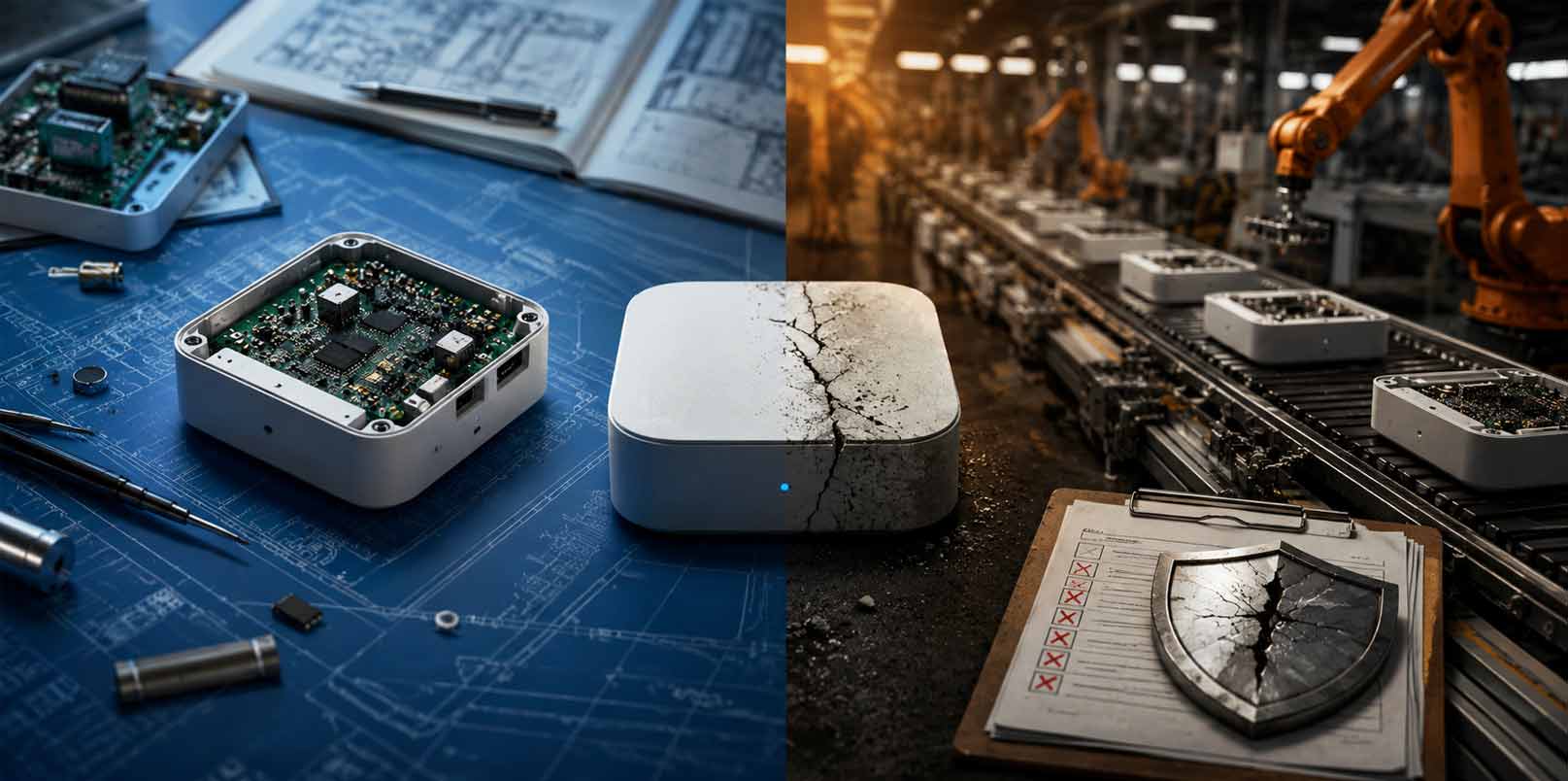
Korea has spent decades building one of the world’s most advanced manufacturing ecosystems. Fast development cycles, skilled technical workers, deep electronics expertise, and dense supplier networks continue attracting hardware founders looking for production advantages. Still, for many small startups, entering that ecosystem also introduces a different reality: manufacturing strength alone does not guarantee scalable business outcomes.
Korea’s Manufacturing Strength Is Real, but Startups Still Face Structural Limits
It is widely known that South Korea remains one of the world’s most manufacturing-intensive economies.
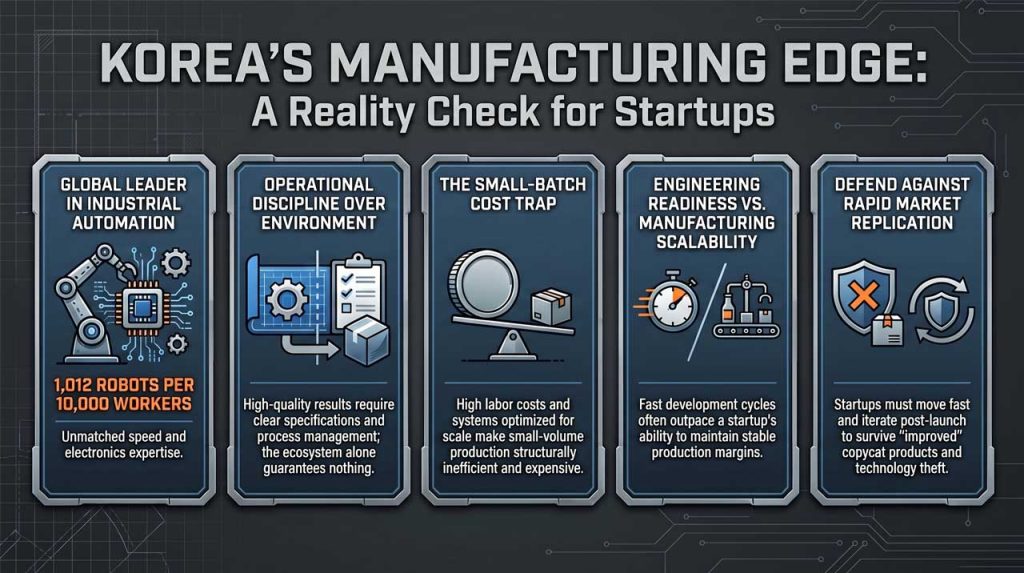
According to World Bank data, manufacturing accounted for roughly 27% of South Korea’s GDP in 2024, significantly higher than many advanced economies. At the same time, the International Federation of Robotics ranked Korea as the world leader in industrial robot density, with 1,012 robots per 10,000 manufacturing workers.
Why do these strengths matter for startups? Because Korea offers unusually strong access to electronics engineering capability, production expertise, industrial automation, and high-speed product development environments. And all these are built through decades of automotive, semiconductor, and consumer-electronics manufacturing growth.
Sung Bong Kang, CEO of NEWNOP Group, previously worked in Korea’s electronics, automotive, and manufacturing sectors, where he managed production operations, industrial quality systems, and factory-level execution processes before leading the company.
He believes Korea’s manufacturing competitiveness is genuine, especially in technical capability and development speed.
“Korea clearly has strong manufacturing competitiveness,”
Kang told KoreaTechDesk as discussions on manufacturing scalability and startup production challenges continued.
“There are high quality standards, fast development speed, and skilled technical workers.”
Still, Kang also warned that many smaller hardware startups misunderstand what that advantage actually means in practice.
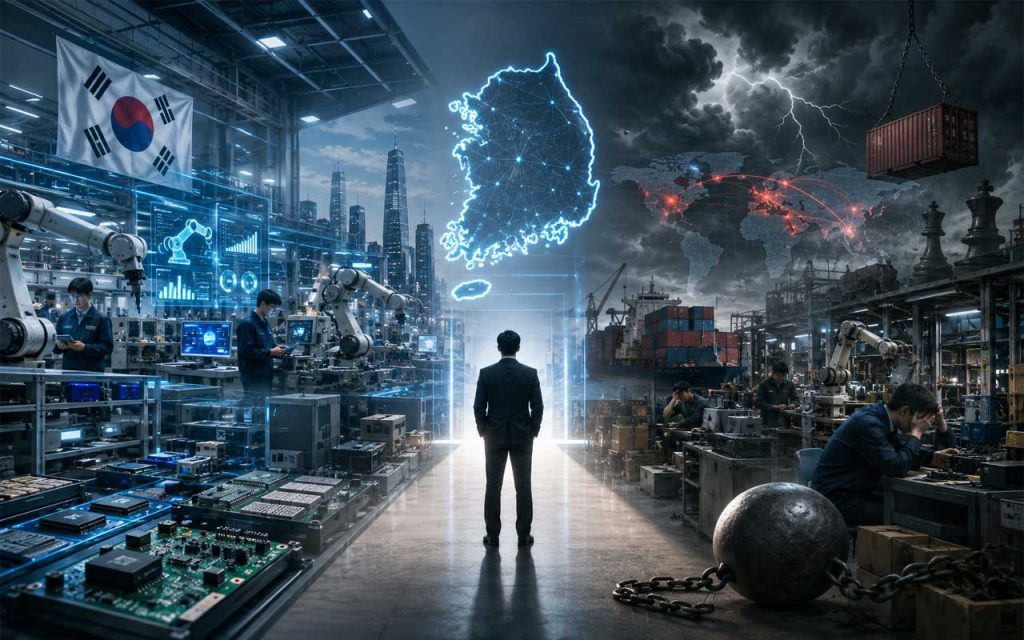
Korea Creates Manufacturing Opportunities, Not Guaranteed Outcomes
Global startup founders often view Korea as a shortcut to high-quality production. In reality, the ecosystem itself does not remove operational pressure from startups.
“Korea is an environment where good results can be made, but it does not guarantee the result,”
Kang explained.
“If there are no clear specifications, process management, and quality standards, results cannot be guaranteed anywhere.”
That distinction is becoming increasingly important as global hardware markets become more competitive and cost-sensitive. Strong engineering infrastructure can improve manufacturing potential, but startups still need disciplined operational systems to turn that environment into repeatable production outcomes.
This challenge is also visible at policy level. South Korea’s Ministry of SMEs and Startups announced in its 2025 policy plan that it would continue expanding smart-factory transformation programs for manufacturing SMEs, including AI-driven anomaly detection, autonomous manufacturing systems, and digital-twin production environments.
The policy direction itself reflects an important reality. Korea is not assuming that legacy manufacturing capability alone will sustain industrial competitiveness. Instead, the country is actively trying to modernize how smaller manufacturers operate.
High Labor Costs Are Changing the Economics of Startup Manufacturing
One of the biggest structural pressures facing small hardware startups in Korea is cost.
While Korea offers advanced manufacturing capability, it also operates within one of the highest-cost industrial environments in Asia. Skilled technical labor, production engineering, and quality-control capability are expensive compared with lower-cost manufacturing regions.
Kang pointed out that this creates immediate pressure for startups attempting low-volume production.
“High labor costs and the inefficiency of small-volume production become major burdens for startups.”
This issue becomes especially difficult during early commercialization stages, when startups cannot yet spread manufacturing costs across large production runs.
South Korea’s own SME outlook data reflects these concerns. In February 2026, the Small Business Health Index for manufacturing fell to 80.9, while Korean SME surveys cited weak sales, labor-cost increases, and raw-material cost pressure as major concerns affecting smaller manufacturers.
This means many Korean manufacturing partners are also operating under tighter margin pressure themselves. As a result, startups entering production with unstable order volumes or frequent changes may encounter rising costs faster than expected.
Small-Batch Manufacturing Remains Difficult Across Advanced Production Systems
The problem is not simply labor expense alone. Smaller production runs have remained structurally inefficient in many industrial environments.
Large-scale manufacturing systems are typically optimized around production stability, repeatability, and economies of scale. Small startups, however, often require mixed-volume production, rapid iteration, and flexible adjustment cycles.
Korean industrial research on digital manufacturing transformation has noted that traditional rigid production systems struggle to produce high-mix, low-volume products efficiently without additional automation and smart-manufacturing adaptation.
For startups, this creates a difficult contradiction.
The same ecosystem that enables fast industrial production at scale can become expensive when production quantities remain small, unpredictable, or operationally unstable.
This is one reason why many early-stage hardware companies underestimate commercialization difficulty. Engineering readiness and manufacturing readiness are not always synchronized at startup scale.
Product Copy Risks Continue After Market Entry
Korea’s manufacturing ecosystem also exposes startups to another concern: post-launch product replication pressure.
Kang noted that startups increasingly face situations where competing products appear with improved functionality after market release.
“Products with improved performance may appear after launch.”
This issue has become serious enough that South Korea has expanded institutional responses to SME technology theft and industrial leakage. In April 2026, the Korean Intellectual Property Office announced the launch of an integrated SME technology-theft reporting center involving multiple ministries and agencies.
The initiative was designed to consolidate fragmented reporting systems and improve support for smaller companies facing technology-leakage concerns.
For startups, this creates additional pressure to move quickly, maintain operational discipline, and continuously improve products after commercialization instead of assuming first-mover advantage alone guarantees market protection.
Korea’s Hardware Ecosystem Is Becoming More Demanding, Not Less
Now, the global manufacturing environment is changing rapidly. AI-driven factory systems, automation upgrades, smart-manufacturing transitions, and rising geopolitical pressure are reshaping how industrial ecosystems operate worldwide.
South Korea still offers one of the strongest manufacturing foundations available to hardware startups. The country combines technical talent, industrial infrastructure, automation capability, and deep production experience across advanced sectors.
Yet the ecosystem is also becoming more demanding for smaller companies operating without production scale, operational discipline, or long-term manufacturing stability.
That shift matters for founders, investors, and global startup operators evaluating Korea’s hardware environment today. Strong manufacturing ecosystems can improve execution potential, but they cannot replace clear specifications, stable operational systems, realistic cost planning, and scalable production structures.
Korea’s Manufacturing Strength Is Also Raising the Survival Standard
South Korea built one of the world’s strongest manufacturing environments through decades of industrial discipline, engineering speed, and production capability. But that same environment is now becoming harder for smaller hardware startups to fully keep up with.
Because as manufacturing systems become faster, more automated, and more cost-sensitive, the margin for operational mistakes continues shrinking. Small production inefficiencies, unstable planning, or weak execution structures can quickly become expensive inside ecosystems designed around industrial precision.
And that is the contradiction many startups now face in Korea.
The country’s manufacturing advantage can help startups move faster, but it also raises the standard required to survive inside it.
Key Takeaways
- South Korea remains one of the world’s strongest manufacturing economies, supported by advanced automation, industrial robotics, and deep engineering capability.
- Korea’s manufacturing ecosystem creates opportunities, not guaranteed outcomes, according to NEWNOP CEO Sung Bong Kang.
- High labor costs and small-volume production inefficiency create growing pressure for smaller hardware startups.
- Manufacturing readiness still depends on operational discipline, including clear specifications, process management, and quality standards.
- Small-batch production remains structurally difficult across many advanced manufacturing systems optimized for scale.
- Copy-product and technology-leakage concerns continue affecting startups after commercialization, prompting expanded institutional response in Korea.
- Global founders evaluating Korea’s startup ecosystem should understand that manufacturing strength alone cannot replace scalable operational execution.
- Korea’s manufacturing advantage is also raising the survival standard for small hardware startups.
🤝 Looking to connect with verified Korean companies building globally?
Explore curated company profiles and request direct introductions through beSUCCESS Connect.
– Stay Ahead in Korea’s Startup Scene –
Get real-time insights, funding updates, and policy shifts shaping Korea’s innovation ecosystem.
➡️ Follow KoreaTechDesk on LinkedIn, X (Twitter), Threads, Bluesky, Telegram, Facebook, and WhatsApp Channel.