
AI is entering a phase where deployment decisions are shaping competitive advantage more than model breakthroughs. Across industries, systems that perform well in testing are meeting friction inside real operations. The challenge is no longer speed alone, but how AI interacts with infrastructure, workflows, and accountability. Understanding this shift is becoming critical for founders, operators, and investors navigating real-world adoption.
AI Doesn’t Break at the Model: It Breaks When It Meets the System
AI systems today are fast, accurate, and increasingly capable in controlled environments. Yet once deployed, many of these systems struggle to remain usable inside real operations.
The issue is often framed as a latency problem. Real-time environments introduce network delays, degraded inputs, and inconsistent data flows. While these conditions matter, they rarely determine whether a system ultimately succeeds.
Recent work by the National Institute of Standards and Technology highlights that deployed AI must maintain consistent service across infrastructure, not just achieve high performance in isolation. This shifts the focus away from raw speed and toward how systems behave under operational conditions.
Because in practice, latency does not cause failure. It exposes it instead.
Latency Reveals Stress. It Does Not Resolve It
Real-world environments are inherently unstable. Inputs degrade, networks fluctuate, and system conditions change continuously.
The Organization for Economic Co-operation and Development notes that these environments impose latency sensitivity and unpredictability that differ sharply from controlled testing settings. AI systems must respond under these constraints, often in real time.
As discussion on AI’s deployment bottleneck continues, Byungjoon Kim, founder and CEO of H’ Intelligence, describes this moment as the first visible signal of deeper issues.
“Latency is the first visible problem.”
As latency increases, continuity begins to break down, leading to inconsistent outputs and a gradual loss of operator trust. At that point, the system is no longer judged purely on accuracy, but on whether it can maintain stable performance under pressure.
Many deployments start to fail here, not because the model lacks capability, but because the surrounding system cannot sustain reliable operation.

From Continuity to Trust: Where Deployment Starts to Break
Once performance becomes inconsistent, the problem shifts from computation to operations.
NIST emphasizes that operational monitoring must account for system-wide consistency across distributed infrastructure. Fragmented logging and disconnected system layers remain unresolved challenges in deployed AI environments.
These issues directly affect how operators perceive and use AI outputs. When responses vary or degrade, confidence in the system declines. Trust becomes a function of continuity, not intelligence.
Kim describes this progression clearly. Latency increases lead to continuity breakdown, which then undermines trust across the system.
This sequence matters because trust determines whether AI remains part of the workflow or is quietly bypassed.
Integration Is the Final Gate in AI Deployment
At this point, the central issue becomes integration. As Kim noted,
“Integration is the final gate that determines whether deployment actually works.”
This is not a narrow technical problem. It reflects how AI outputs interact with existing systems, processes, and responsibilities inside organizations.
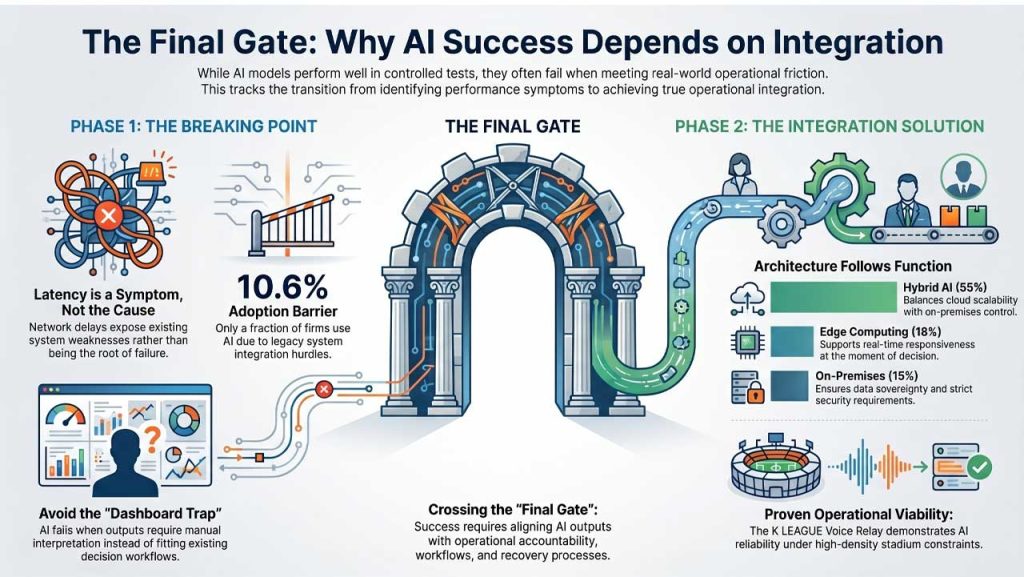
OECD data shows that AI adoption remains limited in sectors such as manufacturing, with only 10.6 percent of firms using AI in 2024 despite steady growth in capability. One of the key barriers identified is the difficulty of integrating AI into legacy operational and IT systems.
Integration requires more than connecting APIs or moving data between systems. It involves aligning AI outputs with:
- operational workflows
- approval structures
- accountability and ownership
- recovery processes when failures occur
As Kim described,
“The hardest part is not API connectivity by itself but bringing AI outputs into the language and procedure of the existing operational system…
Integration is not just a technical connection problem. It is an operational handoff design problem.”
If AI outputs cannot fit into these structures, they do not become part of decision-making. They remain external signals with no operational consequence.
Why Many AI Systems Become Just Another Dashboard
This gap explains why many deployments fail even when the underlying technology performs well.
Organizations often push raw detections or alerts into existing systems without translating them into actionable formats. Outputs remain disconnected from workflows, requiring manual interpretation or verification.
In these cases, AI does not reduce workload. It adds to the complexity instead.
“If AI does not fit that structure, it usually ends up as just one more dashboard.”
OECD findings reinforce this pattern. Fragmented data environments, inconsistent system architectures, and limited integration capability continue to slow adoption across industries.
So the problem is not access to AI. It is the ability to embed it into how decisions are actually made.
Architecture Shifts Reflect Integration Pressure
Deployment architectures are already adapting to these constraints.
According to the World Economic Forum, 55 percent of organizations now use hybrid AI infrastructure combining on-premises and cloud environments. Around 15 percent anchor systems on-premises to meet data sovereignty requirements, while 18 percent extend edge computing to support real-time responsiveness.
These shifts reflect a broader reality. It means that systems must balance:
- latency requirements
- data control and sovereignty
- integration with existing infrastructure
Kim frames this in operational terms,
“The closer a function is to latency, safety, and continuity, the closer it should be to the field…The edge owns the moment of decision, while the centralized layer owns governance and system-wide control.”
This structure is not designed to maximize performance alone. It reflects the practical need to make AI systems usable within real operational environments.
Operational Proof Under Real Constraints
One example of this dynamic can be seen in the K LEAGUE AI Voice Relay system, developed with H’ Intelligence.
The system delivers real-time audio commentary for visually impaired spectators inside stadium environments. It operates under high object density, fluctuating network conditions, and continuous real-time demands.
“What matters is that this was not just a demo. It was real users under real constraints,”
Kim explains.
The system was later recognized with a Silver Award at the Edison Awards 2026. And beyond technical merit, this recognition highlights its performance under real operational conditions, where reliability and usability define success.
South Korea’s Push Toward Integration-Ready AI Systems
South Korea’s current policy direction reinforces this shift toward operational integration.
The Ministry of Trade, Industry and Energy has set a target of building more than 500 AI-enabled factories by 2030, expanding from around 102 in 2025. The initiative also includes the development of 15 manufacturing AI models designed for industrial deployment.
Separately, government-backed testbeds such as the KAIST physical AI integration platform are focused on combining sensors, robotics, and manufacturing software into unified operational systems.
These initiatives reflect a move beyond model development toward building environments where AI can be deployed repeatedly across real sites.
The opportunity is clear, but scaling will depend on whether these deployments can be translated into repeatable architectures and practical integration capabilities across sites.
What This Means for Founders, Investors, and Operators
If integration is the point where most AI systems fail, then the implications for those building and deploying AI are immediate.
AI systems can no longer be designed in isolation from the environments where they are expected to operate. Integration is not a later-stage task but must be built into the system from the beginning, including how outputs align with workflows, who takes ownership of decisions, and how failures are handled within existing processes.
This shift is already changing how investors evaluate AI companies. Model performance still matters, but it is no longer sufficient. Increasingly, attention is moving toward whether a system can be deployed, integrated, and maintained inside real operational environments.
For enterprises, the challenge is more structural. Legacy systems must be adapted or replaced, and internal processes must evolve to accommodate AI-driven decision flows. Without this alignment, even strong models struggle to deliver value.
That said, the competitive edge is no longer defined by access to models alone. It now depends on the ability to make those models function inside real systems.
AI Survives Only When It Fits the System
In the end, latency indeed exposes weaknesses in AI deployment, but it does not determine success. Integration does.
After all, AI systems do not fail because they cannot detect or predict. They fail when they cannot operate within the structures that organizations rely on to function.
This is where the next phase of competition is forming. The systems that succeed will not simply be faster or more accurate. They will be the ones that integrate into workflows, persist under real conditions, and remain usable over time.
In this environment, AI is no longer judged by what it can do in isolation, but by whether it can operate as part of a system that people depend on.
Key Takeaway
- Latency is the first visible issue in AI deployment, but not the root cause of failure
- NIST highlights operational consistency across infrastructure as a key challenge in deployed AI systems
- OECD data shows limited AI adoption in manufacturing, with integration into legacy systems as a major barrier
- Byungjoon Kim emphasizes that “integration is the final gate” in real-world deployment
- Many AI systems fail because they do not align with workflows, ownership, and decision structures
- Hybrid, edge, and on-prem architectures are emerging to address latency, sovereignty, and integration constraints
- The K LEAGUE AI Voice Relay system, recognized with a Silver Award at the Edison Awards 2026, demonstrates operational viability under real constraints
- South Korea’s push toward AI factories and integrated testbeds reflects a shift toward deployment-ready systems
- The future of AI depends on integration into real operational environments, not model performance alone
🤝 Looking to connect with verified Korean companies building globally?
Explore curated company profiles and request direct introductions through beSUCCESS Connect.
– Stay Ahead in Korea’s Startup Scene –
Get real-time insights, funding updates, and policy shifts shaping Korea’s innovation ecosystem.
➡️ Follow KoreaTechDesk on LinkedIn, X (Twitter), Threads, Bluesky, Telegram, Facebook, and WhatsApp Channel.