
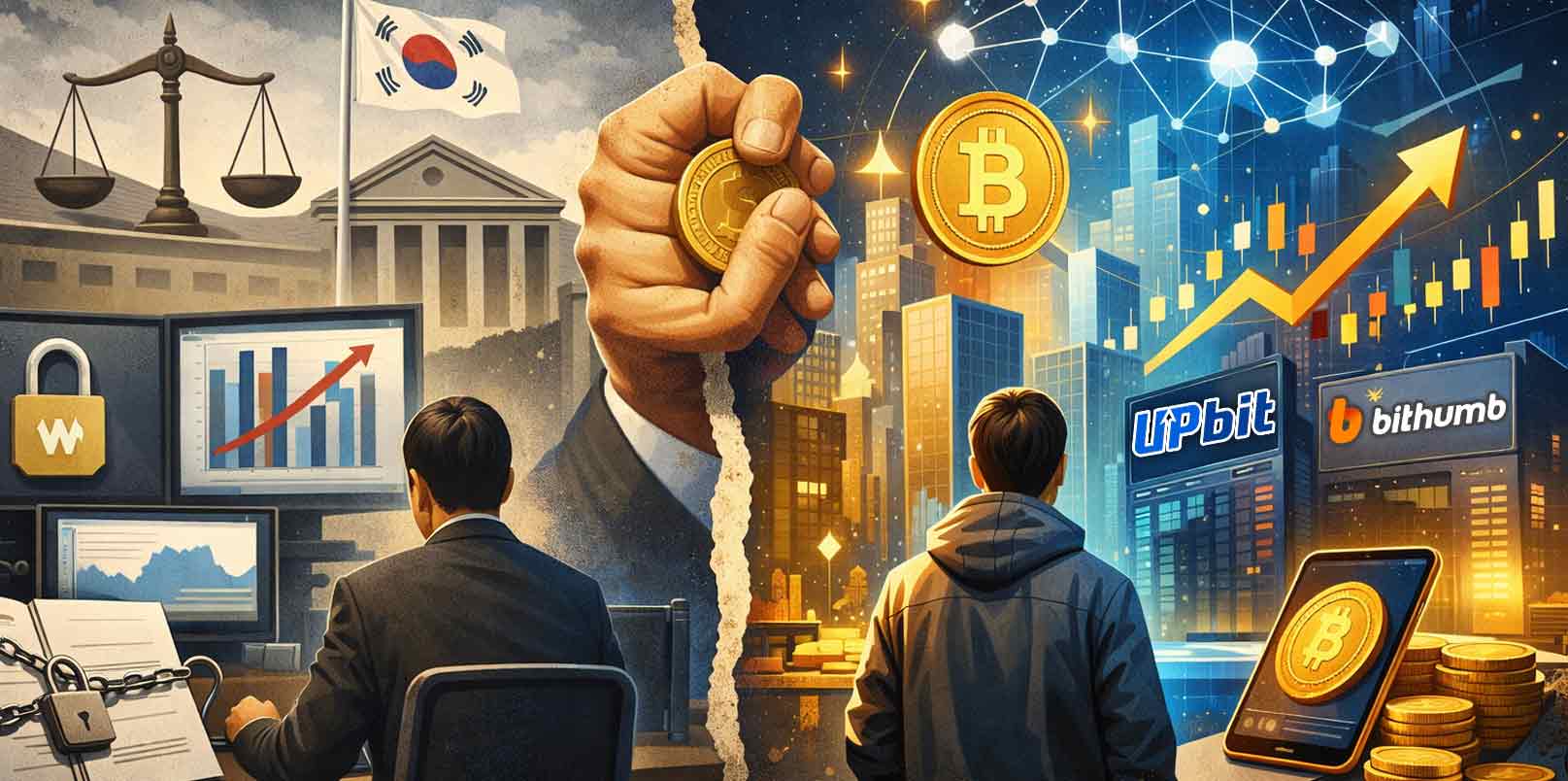
South Korea’s digital asset sector stands at its most consequential crossroads since the 2017 ICO ban. While trading volumes have surged and global exchanges diversify, Korea’s regulators are tightening ownership and governance standards. The debate over a proposed cap on major shareholders in crypto exchanges has ignited one of the country’s most significant policy reckonings on how to balance investor protection, innovation, and market competitiveness.
Regulators Push 15–20% Ownership Cap on Exchange Shareholders
The Financial Services Commission (FSC) is finalizing its Digital Asset Basic Act (Phase 2), introducing a limit on major shareholders’ ownership in virtual asset exchanges to 15–20 percent.
The measure aims to align crypto exchange governance with the Alternative Trading System (ATS) model used in traditional securities markets, dispersing ownership to enhance transparency, reduce conflicts of interest, and strengthen user protection.
Officials argue that the change would make digital asset exchanges operate more like financial infrastructure than private trading platforms. The plan is part of Korea’s broader effort to institutionalize its rapidly expanding crypto market, which counts more than 11 million users.
Industry Pushback: “Excessive Regulation Could Undermine Innovation”
The proposal has drawn unified opposition from Korea’s five largest exchanges — Upbit (Dunamu), Bithumb, Korbit, Coinone, and Gopax (Streami) — all represented through the Digital Asset Exchange Alliance (DAXA).
In a joint statement signed by their CEOs, DAXA warned that “attempts to artificially alter private ownership structures threaten the foundation of an industry that has grown organically.” The group emphasized that the rule could weaken competitiveness, drive users to foreign platforms, and erode investor confidence.
According to company disclosures, founders such as Song Chi-hyung of Dunamu and Cha Myung-hoon of Coinone hold stakes exceeding the proposed thresholds — roughly 28% and 53%, respectively. Industry leaders argue that forced divestments could disrupt management continuity and discourage long-term investment.
Venture and startup organizations have echoed those concerns. The Korea Startup Forum (KOSPO) and the Korea Venture Business Association (KOVA) both called for “a cautious reexamination,” warning that post-growth ownership restructuring could undermine entrepreneurship and create uncertainty in the innovation ecosystem.
Background: Reform Comes Amid a Booming but Constrained Market
The debate emerges as Korea’s digital asset market enjoys record activity yet remains structurally restricted by regulation.
In 2025, Upbit’s quarterly trading volume reached KRW 411 trillion (USD 286 billion), while Bithumb saw a near threefold increase to KRW 128 trillion. However, Korea’s exchanges still rely heavily on retail trading fees, unlike global counterparts such as Coinbase, which have diversified into derivatives, custody, and institutional products.
Our previous report has highlighted how this structural imbalance reflects a broader policy lag: Korea’s regulatory framework has improved user protection but still lacks pathways for institutional participation, derivatives, and stablecoin innovation.
Against this backdrop, the FSC’s push for ownership reform represents a pivotal test — can the state build market trust without suppressing private-sector dynamism?
Stakeholder Perspectives: Balancing Safety and Growth
Regulators’ View:
The FSC and supporting lawmakers argue that excessive concentration of ownership increases risks of insider trading, biased coin listings, and weak internal audits. Dispersed ownership, they contend, will enhance governance and ensure exchanges uphold public-interest responsibilities similar to financial institutions.
Industry’s View:
Exchange executives argue that major shareholders play a crucial role in maintaining accountability and user protection. As one DAXA representative explained,
“Major shareholders are not just investors; they are ultimately responsible for safeguarding user assets. Diluting their stake could dilute accountability.”
Venture Sector’s View:
Venture associations propose a market-driven alternative: encourage exchanges to go public (IPO) rather than impose forced divestments. IPOs, they note, would naturally diversify ownership and institutionalize oversight without infringing property rights.
Academic View:
Experts such as Professor Cho Jae-woo of Hansung University caution that governance reforms should focus on “oversight and transparency mechanisms” rather than blanket shareholding caps. Others warn that retroactive divestment could raise constitutional concerns over property rights and proportionality.
Ecosystem Significance: Korea’s Moment of Structural Maturity
The debate over ownership caps signals Korea’s transition from growth-by-volume to maturity-by-governance. The industry’s expansion — driven by domestic retail investors — is now colliding with regulatory demands for systemic accountability.
For policymakers, the challenge is to align crypto regulation with global benchmarks while preserving the country’s entrepreneurial edge. Global jurisdictions such as the United Kingdom and Singapore rely more on behavioral regulation — transparency, suitability tests, and corporate audits — rather than ownership limits.
Korea’s approach could therefore determine its positioning in the next wave of digital finance. Excessive restrictions might push capital and talent abroad, while well-calibrated governance could turn Korea into a model for regulated innovation in Asia’s blockchain economy.
Policy Dialogue Expands to Stablecoins and Banking Rules
The ownership issue has also spilled into related debates within the People Power Party’s Digital Asset Value-Up Committee, where exchange and fintech executives, including Kakao Pay and Toss, urged lawmakers to design laws reflecting “market realities.”
Participants also called for flexible rules on KRW-based stablecoin issuance, corporate and foreign investment, and the “one exchange, one bank” rule. Many emphasized the need for private-sector–led innovation under stable regulatory oversight — echoing the unresolved tension between financial control and fintech freedom.
A Defining Test for Korea’s Digital Asset Future
Korea’s crypto and digital asset market is entering its maturity test. The ownership-cap debate encapsulates a deeper question: can the nation evolve its governance model without constraining innovation?
As the Digital Asset Basic Act advances through legislative review, both regulators and industry leaders face a rare opportunity to build a balanced framework — one that protects users, upholds fairness, and sustains Korea’s ambitions as a global digital finance hub.
– Stay Ahead in Korea’s Startup Scene –
Get real-time insights, funding updates, and policy shifts shaping Korea’s innovation ecosystem.
➡️ Follow KoreaTechDesk on LinkedIn, X (Twitter), Threads, Bluesky, Telegram, Facebook, and WhatsApp Channel.
🤝 Looking to connect with verified Korean companies building globally?
Explore curated company profiles and request direct introductions through beSUCCESS Connect.