KoreaTechDesk | Korean Startup and Technology News

Sat, June 13, 2026

Sign in

Virtual Demo Day
Menu
  • Home
  • Startup News
    • AI & Big Data
    • AR & VR
    • Blockchain
    • Clean Technology
    • Content & Games
    • Cybersecurity
    • Enterprise & SaaS
    • FinTech
    • Gadgets & Electronics
    • Health & Bio
    • Manufacturing
    • Press Release
    • IoT
    • Marketplaces & E-commerce
    • Robotics
    • Transportation
    • Investments
    • Ecosystem & Lists
  • Governments
    • Artificial Intelligence Industry Cluster Agency
    • Daegu Technopark
    • GANGNAM-GU
    • Gyeonggido Business & Science Accelerator
    • Hwaseong Industry Promotion Agency
    • Invest Seoul
    • Korea Creative Content Agency
    • Korea Internet & Security Agency
    • Korea Information Security Industry Association
    • Korea Institute of Startup & Entrepreneurship Development
    • Korea Tourism Organization
    • Korea Trade-Investment Promotion Agency
    • Ministry of Culture, Sports and Tourism
    • Ministry of SMEs & Startups
    • National IT Industry Promotion Agency
    • Pangyo Techno Valley
    • Seoul Business Agency
    • Seoul FinTech Lab
    • South Gyeongsang Province
    • Seoul Metropolitan Government
  • Events
    • COMEUP
    • Korea Fintech Week
    • K-Content Expo
    • NextRise
    • Try Everything
  • Interviews
    • Investors’ interviews
    • Founders’ interviews
  • Programs
    • Asan Voyager
    • CAPA Global Program
    • Campus Town Program
    • SGSC Global Bootcamp
    • Gangnam-gu Global Roadshow
    • Global SaaS Marketplace Support Project
    • LAUNCHPAD
    • COMEUP STARS 120
    • K-Startup Grand Challenge
    • TIPS X beSUCCESS Global Project
    • SFL Global Program
    • KTO Global Showcase
    • Yonsei Univ Global Class
    • KOSME Global Program
  • Partner With Us
    • Press Release
    • Startup Scouting
    • Business Agencies
    • Global Mentorship Program
    • Investment Opportunities
    • K-Scouter Program
  • Lists
  • Home
  • Startup News
    • AI & Big Data
    • AR & VR
    • Blockchain
    • Clean Technology
    • Content & Games
    • Cybersecurity
    • Enterprise & SaaS
    • FinTech
    • Gadgets & Electronics
    • Health & Bio
    • Manufacturing
    • Press Release
    • IoT
    • Marketplaces & E-commerce
    • Robotics
    • Transportation
    • Investments
    • Ecosystem & Lists
  • Governments
    • Artificial Intelligence Industry Cluster Agency
    • Daegu Technopark
    • GANGNAM-GU
    • Gyeonggido Business & Science Accelerator
    • Hwaseong Industry Promotion Agency
    • Invest Seoul
    • Korea Creative Content Agency
    • Korea Internet & Security Agency
    • Korea Information Security Industry Association
    • Korea Institute of Startup & Entrepreneurship Development
    • Korea Tourism Organization
    • Korea Trade-Investment Promotion Agency
    • Ministry of Culture, Sports and Tourism
    • Ministry of SMEs & Startups
    • National IT Industry Promotion Agency
    • Pangyo Techno Valley
    • Seoul Business Agency
    • Seoul FinTech Lab
    • South Gyeongsang Province
    • Seoul Metropolitan Government
  • Events
    • COMEUP
    • Korea Fintech Week
    • K-Content Expo
    • NextRise
    • Try Everything
  • Interviews
    • Investors’ interviews
    • Founders’ interviews
  • Programs
    • Asan Voyager
    • CAPA Global Program
    • Campus Town Program
    • SGSC Global Bootcamp
    • Gangnam-gu Global Roadshow
    • Global SaaS Marketplace Support Project
    • LAUNCHPAD
    • COMEUP STARS 120
    • K-Startup Grand Challenge
    • TIPS X beSUCCESS Global Project
    • SFL Global Program
    • KTO Global Showcase
    • Yonsei Univ Global Class
    • KOSME Global Program
  • Partner With Us
    • Press Release
    • Startup Scouting
    • Business Agencies
    • Global Mentorship Program
    • Investment Opportunities
    • K-Scouter Program
  • Lists
2026-02-25_AIS 2026_Conference Banners_1920x480
Home Lists and Guides

Inside Korea’s Baby Unicorn Program: Recognition, Capital Signal, or Both?

by Zee Cindy
March 22, 2026
in Lists and Guides
0

South Korea has built an unusually structured pathway to turn promising startups into global contenders. At the center of that system sits the Baby Unicorn program, a policy designed to spotlight high-growth companies before they reach billion-dollar valuations. The label attracts attention across Korea’s venture ecosystem. The deeper question is what it actually changes once a startup earns the designation.

Korea’s “Baby Unicorn” Label Signals a New Stage in Startup Policy

South Korea’s startup policy has evolved beyond early-stage incubation. Government programs increasingly target companies that already demonstrate traction and now need capital, credibility, and global market access to scale.

The Baby Unicorn program, operated by the Ministry of SMEs and Startups (MSS), sits at the center of that shift. It is part of Korea’s broader Global Unicorn Project, a national effort designed to increase the number of high-value startups capable of reaching billion-dollar valuations.

The label has become a prominent signal within Korea’s venture ecosystem. Yet the real question is practical rather than symbolic. Does the designation unlock meaningful capital access, or does it mainly serve as policy recognition for startups already validated by the market?

Understanding that distinction helps explain how Korea’s scale-up policy actually works.

What the Korea Baby Unicorn Program Actually Is

The Baby Unicorn program identifies startups that have already demonstrated growth potential through investment traction or valuation milestones. The designation targets companies that have moved beyond early experimentation but have not yet reached full unicorn scale.

According to MSS program criteria, eligible companies must be registered venture firms and show evidence of market validation through cumulative investment or valuation benchmarks. Korea’s Unicorn policy framework treats Baby Unicorn companies as preliminary level before pre-unicorn scale-ups, firms that have the potential to cross the next valuation threshold with additional support.

This structure reflects Korea’s staged approach to startup policy. The government does not attempt to manufacture unicorns through direct capital injections. Instead, it tries to identify companies that the market has already partially validated and then provide policy tools to accelerate their next phase of growth.

That positioning explains why the program sits inside the larger Global Unicorn Project rather than within early-stage startup creation initiatives.

What Selected Startups Actually Receive

The Baby Unicorn designation comes with several policy instruments designed to reduce financial and operational friction during the scale-up phase.

Selected companies can receive market development funding of up to KRW 300 million to support commercialization and global expansion activities. The program also connects companies to government-linked financial tools.

One of the most significant mechanisms is a special guarantee facility that can reach up to KRW 5 billion, delivered through technology guarantee institutions. These guarantees do not represent direct government investment. Instead, they improve a startup’s ability to secure financing by reducing lender risk.

Additional policy support can include investment attraction programs, global expansion assistance, and access to networks that link startups with venture investors and industry partners.

Taken together, the program does not simply hand startups large capital checks. It adjusts the financing conditions around them.

Why the Label Matters in the Venture Ecosystem

Within Korea’s startup ecosystem, the Baby Unicorn designation functions as a credibility marker.

Selection signals that a company has passed a government screening process based on measurable growth indicators. For venture investors, that signal can reinforce an existing investment thesis or highlight companies that have reached a scale worth closer examination.

However, the designation does not replace market validation. Startups selected for the program typically already show evidence of investor confidence through previous funding rounds or valuation signals.

In other words, the state does not choose companies at random and then attempt to create unicorns around them. The program largely operates in the opposite sequence. Market traction comes first, followed by policy recognition.

That sequencing is an important distinction for international observers who may interpret the program as a form of government-driven venture selection.

Korea’s Policy Ladder for Scale-Stage Startups

The Baby Unicorn program also reveals how South Korea has structured a policy ladder designed to support startups at different growth stages.

Early-stage companies receive support through incubation, R&D programs, and venture funding initiatives. Once companies reach the scale-up stage, programs like Baby Unicorn step in to reinforce credibility and financing access.

The Global Unicorn Project extends this ladder further. Companies that demonstrate stronger growth can move into subsequent policy categories designed to support larger funding rounds and global market expansion.

This staged structure reflects a broader policy strategy. Korea is attempting to reduce the structural gap between promising startups and globally competitive scale-ups.

The Baby Unicorn program occupies the middle of that ladder.

Recognition Helps, but It Does Not Guarantee Unicorn Outcomes

Despite its visibility, the Baby Unicorn designation does not guarantee that selected companies will eventually reach unicorn status.

Policy support can reduce financial constraints and strengthen investor visibility. Yet the program does not eliminate the fundamental challenges of scaling a technology company.

Global expansion, sustained revenue growth, and competitive differentiation still determine whether a startup ultimately reaches a billion-dollar valuation.

Some Baby Unicorn companies have gone on to secure large investments, achieve public listings, or cross major valuation milestones. Others remain in earlier growth stages.

The label therefore functions best as a policy-backed scale-up signal, not a prediction of unicorn success.
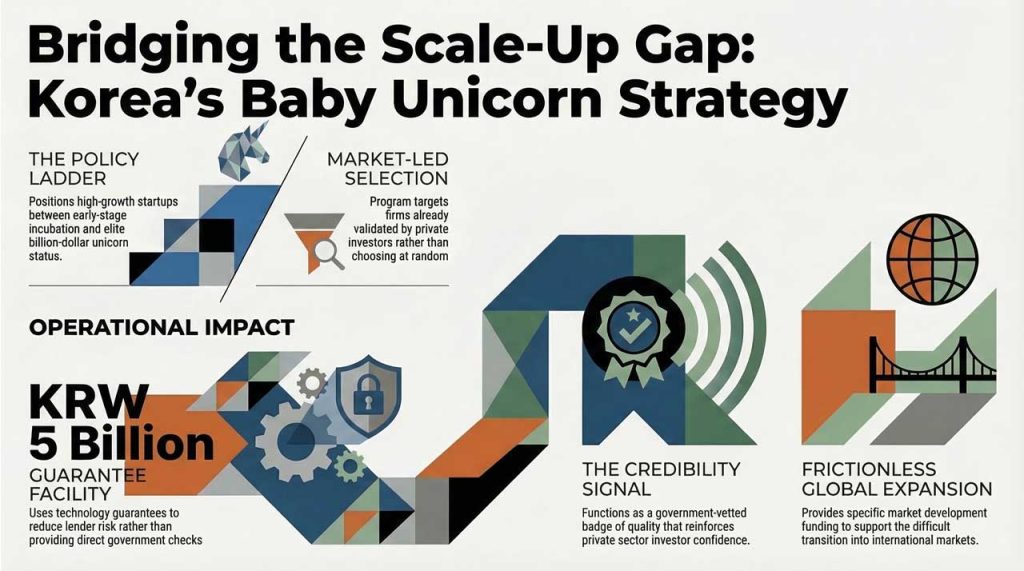
Korea’s Baby Unicorn program highlights scale-stage startups. But does the label unlock funding, or simply signal policy support to investors?

Why Global Startup Observers Should Pay Attention

For global founders, investors, and ecosystem analysts, the Baby Unicorn program highlights a distinctive feature of Korea’s startup strategy.

Rather than focusing exclusively on early-stage innovation, Korea has increasingly concentrated policy attention on the difficult transition between startup and scale-up.

That transition is often where promising companies struggle. Capital requirements grow, international expansion becomes necessary, and operational complexity increases.

Programs like Baby Unicorn show how Korea is trying to address that stage through policy tools that combine recognition, financial guarantees, and international expansion support.

The approach reflects a broader ambition. Seoul is not only trying to create startups. It is trying to produce companies capable of competing at global scale.

Key Takeaways on Korea Baby Unicorn Program

  • The Korea Baby Unicorn program is part of the government’s Global Unicorn Project aimed at nurturing scale-stage startups.
  • Companies selected for the program already demonstrate market validation through investment or valuation benchmarks.
  • Policy support includes market development funding and financial guarantees, rather than large direct investments.
  • The designation acts as a credibility signal within Korea’s venture ecosystem, reinforcing investor attention.
  • The program illustrates Korea’s broader strategy of building a policy ladder that supports startups as they transition into global scale-ups.

🤝 Looking to connect with verified Korean companies building globally?
Explore curated company profiles and request direct introductions through beSUCCESS Connect.


– Stay Ahead in Korea’s Startup Scene –
Get real-time insights, funding updates, and policy shifts shaping Korea’s innovation ecosystem.
➡️ Follow KoreaTechDesk on LinkedIn, X (Twitter), Threads, Bluesky, Telegram, Facebook, and WhatsApp Channel.

Tags: baby unicornBaby Unicorn KoreaBaby Unicorn Nurturing ProgramBaby Unicorn program KoreaBaby Unicorn Projecthow startups become unicorns in KoreaKorea Baby Unicorn programKorea Global Unicorn ProjectKorea startup ecosystem policyKorea startup guarantees programKorea startup scale-up policyKorea venture startup supportKorean government startup funding programsKorean scale-up startup supportMSS Baby Unicorn programSouth Korea Baby Unicorn startupsSouth Korea unicorn startup policy
Previous Post

Korea Bets on Startup for All to Revive Founder Pipeline as Youth Numbers Fall

Next Post

Telecom AI Hits a Reliability Wall as Evaluation Becomes the Real Bottleneck

Next Post

Telecom AI Hits a Reliability Wall as Evaluation Becomes the Real Bottleneck

MOST READ ARTICLE OF THE WEEK

1.
Can Your Startup Scale Without You? AsiaStartupExpo Q2 2026 Opens, Spotlighting Scalable Execution
7 Jun 2026
2.
Why Early Warning Signals Rarely Reach Decision-Makers in Korean Firms
7 Jun 2026
3.
Korea Is Buying More GPUs. The Bigger Question Is How Many Are Actually Being Used
8 Jun 2026
4.
Why Sell-Through, Not Sell-In, Decides Korean Brand Survival in the Middle East
8 Jun 2026
5.
Why Korea Is Becoming a Stress Test for Context-Aware AI
9 Jun 2026
Register for Event

AIS-2026 Conference

AIS 2026 Conference

List Article

1.
Why Good Startups Still Fail the Venture Capital Test
10 Jun 2026
2.
The Hardest Part of Korea Market Entry: Staying in The Game
3 Jun 2026
3.
Why M&A Value Is Lost After the Deal Closes
30 May 2026
4.
Foreign Companies Budget for Korea Entry, but the Real Costs Start After Hiring
23 May 2026
5.
Why Fast Korea Entry Structures Can Become Expansion Traps
16 May 2026

Similar Articles

Lists and Guides

Why Good Startups Still Fail the Venture Capital Test

More
Lists and Guides

The Hardest Part of Korea Market Entry: Staying in The Game

More
Lists and Guides

Why M&A Value Is Lost After the Deal Closes

More

Topics

Menu
  • AI & Big Data
  • AR & VR
  • Blockchain
  • Clean Technology
  • Content & Games
  • Cybersecurity
  • Enterprise & SaaS
  • FinTech
  • Gadgets & Electronics
  • Health & Bio
  • IoT

Program

Menu
  • Asan Voyager
  • CAPA Global Program
  • SGSC Global Bootcamp
  • LAUNCHPAD
  • COMEUP STARS 120
  • K-Startup Grand Challenge
  • TIPS X beSUCCESS Global Project
  • SFL Global Program
  • KTO Global Showcase
  • Yonsei Univ Global Class
  • KOSME Global Program

About

Menu
  • About Us
  • all articles
  • Terms of Use
  • Privacy
  • Cookie-policy
  • twitter

Subscribe and be informed first hand about actual Korean startup news.

All the day’s headlines and highlights, direct to you every morning.

[mc4wp_form id="3766"]

Contact us : [email protected]

Topics

Menu
  • AI & Big Data
  • AR & VR
  • Blockchain
  • Clean Technology
  • Content & Games
  • Cybersecurity
  • Enterprise & SaaS
  • FinTech
  • Gadgets & Electronics
  • Health & Bio
  • IoT

Program

Menu
  • Asan Voyager
  • CAPA Global Program
  • SGSC Global Bootcamp
  • LAUNCHPAD
  • COMEUP STARS 120
  • K-Startup Grand Challenge
  • TIPS X beSUCCESS Global Project
  • SFL Global Program
  • KTO Global Showcase
  • Yonsei Univ Global Class
  • KOSME Global Program

About

Menu
  • About Us
  • all articles
  • Terms of Use
  • Privacy
  • Cookie-policy
  • twitter

Subscribe and be informed first hand about actual Korean startup news.

All the day’s headlines and highlights, direct to you every morning.

[mc4wp_form id="3766"]

© 2023 Koreantech News & Media Korea Zrt. All rights reserved.

Our Spring Sale Has Started

You can see how this popup was set up in our step-by-step guide: https://wppopupmaker.com/guides/auto-opening-announcement-popups/

Our Spring Sale Has Started

You can see how this popup was set up in our step-by-step guide: https://wppopupmaker.com/guides/auto-opening-announcement-popups/

We hope you enjoy our content, May you please give us Feedback regarding our website!

[gravityform id=”17″]

dgdfgfdgdf

What you think about Koreatechdesk, Share your idea with us!

[gravityform id=”16″]

Invitation submission has been closed