

South Korea is moving ahead with one of its most ambitious founder recruitment efforts yet. The Startup for All program aims to bring 5,000 new entrepreneurs into the ecosystem through a nationwide selection process. Yet the launch comes as new data shows a sharp decline in young business owners, raising a critical question for policymakers and investors: can large-scale startup programs rebuild Korea’s next generation of founders?
Korea Launches Startup for All as Founder Demographics Shift
A preparation of Korea’s Startup for All Project is currently underway. This is a nationwide entrepreneurship program designed to recruit and train 5,000 prospective founders through a structured selection process.
The Ministry of SMEs and Startups (MSS) is expected to release the official recruitment notice at the end of March. The initiative forms part of the government’s broader effort to stimulate a nationwide entrepreneurship boom and expand Korea’s startup pipeline.
The program arrives at a sensitive moment for the country’s startup ecosystem. Government data shows that young entrepreneurs are declining rapidly, raising questions about the long-term sustainability of Korea’s founder base.
The policy now faces a practical challenge. Expanding entrepreneurship programs may widen participation, but rebuilding the next generation of founders requires reversing demographic and economic trends already affecting the ecosystem.
Korea Startup for All Program Targets 5,000 Founders Nationwide
The Korea Startup for All program aims to identify and support 5,000 aspiring entrepreneurs across the country.
The participant pool will include:
- 4,000 technology startup founders
- 1,000 local startup founders
Each selected participant will receive KRW 2 million in startup activity funding. The government will also provide startup education and mentoring support through a nationwide network of institutions and experts.
According to the Ministry of SMEs and Startups, more than 100 startup support institutions, 500 professional mentors, and approximately 2,000 support personnel will participate in the program.
The application process has also been simplified. Instead of submitting a detailed business plan, applicants can apply through a simplified idea-focused format, an approach intended to lower barriers for first-time founders.
For Korea’s startup ecosystem, this signals an attempt to expand the founder pipeline beyond traditional startup circles and encourage broader participation in entrepreneurship.
A National Startup Audition Will Select 100 “Startup Rookies”
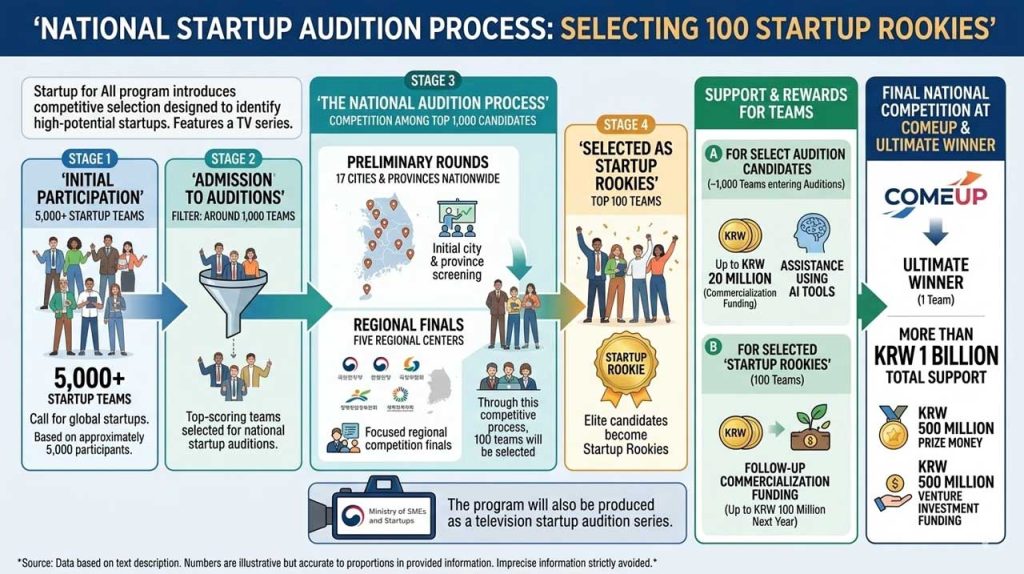
The Startup for All program will also introduce a competitive selection process designed to identify high-potential startups.
Among the 5,000 participants, around 1,000 will advance to national startup auditions. These candidates will compete through:
- Preliminary rounds in 17 cities and provinces
- Five regional finals
Through this process, 100 teams will be selected as “Startup Rookies.” And those chosen as Startup Rookies will become eligible for follow-up commercialization funding of up to KRW 100 million next year.
Participants who enter the audition stage may also receive additional support, including commercialization funding of up to KRW 20 million and assistance using artificial intelligence tools.
The final national competition will take place at COMEUP, Korea’s flagship global startup event. The ultimate winner is expected to receive more than KRW 1 billion in total support, including KRW 500 million in prize money and KRW 500 million in venture investment funding.
The program will also be produced as a television startup audition series, according to the Ministry of SMEs and Startups.
Policy Tools Expand Beyond Funding
Startup for All includes additional mechanisms intended to institutionalize entrepreneurial experience within Korea’s startup support system.
Participants will receive a “challenge resume” documenting their involvement in the program. The government also plans to issue a “failure resume” that formally certifies entrepreneurial failure.
These records can be used when applying for future government startup support programs.
In addition, the government plans to establish a KRW 50 billion Startup Boom Fund to support companies emerging from the program.
These measures suggest a policy attempt to recognize entrepreneurial attempts as part of a formal career track within the national startup support framework.
Youth Entrepreneurship in Korea Is Falling Rapidly
While the government is expanding founder support programs, new data indicates that young entrepreneurs are declining sharply.
Analysis of the Ministry of SMEs and Startups’ 2024 Small Business Survey shows that the number of small businesses led by owners in their twenties or younger fell to 36,000, down from 50,000 the previous year.
That represents a 26.6 percent decline within one year.
The trend contrasts with the overall small business sector. During the same period, the total number of small businesses increased from 5.96 million to 6.13 million, an increase of roughly 3 percent.
Additional labor statistics reveal a similar pattern. According to national employment data, the number of self-employed individuals aged 15 to 29 dropped to 132,000, down from 193,000 one year earlier, a decline of 31.6 percent.
Youth entrepreneurship had increased briefly during the pandemic but has now declined for two consecutive years.

Economic Pressure and Demographics Are Reshaping the Founder Pipeline
Researchers say several factors are contributing to the decline in youth entrepreneurship.
Demographic shifts are one driver. Korea’s youth population is shrinking as the country faces one of the world’s lowest birth rates.
At the same time, worsening business conditions may also be discouraging new founders. Analysts note that business closures have been increasing faster than new startups, suggesting that economic uncertainty and rising costs are affecting early-stage entrepreneurship.
Weak youth employment conditions may also be influencing the trend, according to researchers at the Korea SMEs and Startups Institute (KOSI).
These combined pressures are beginning to reshape the structure of Korea’s entrepreneurial ecosystem.
Why Young Founders Matter for Korea’s Startup Ecosystem
The decline in youth entrepreneurship has implications beyond founder numbers.
Young entrepreneurs are often associated with digital-first business models, including online commerce, delivery platforms, and social media-driven marketing strategies. They also tend to experiment with new products and business ideas.
So, if fewer young founders enter the ecosystem, analysts warn the startup landscape may become less dynamic and less digitally experimental.
Another concern involves the aging structure of small business ownership. Many Korean small business owners are now in their forties, fifties, or older, raising questions about long-term innovation capacity in the sector.
The demographic shift could also slow digital transformation in regional commercial districts, where younger founders often play a leading role in adopting new technology and business models.
Local Entrepreneurship Becomes a Policy Priority
Startup for All includes a specific track dedicated to local entrepreneurship.
The program will recruit 1,000 local founders, including individuals launching non-technology businesses sometimes described as lifestyle startups.
The government hopes these founders will develop innovative small businesses capable of revitalizing local commercial districts.
Experts say attracting young entrepreneurs to local regions requires more than startup funding. Prospective founders must believe that local markets can sustain demand and provide stable living conditions.
Some analysts also argue that stronger cooperation between central ministries and local governments may be necessary to create environments where young founders choose to build companies outside Seoul.
Korea’s Founder Pipeline Enters a New Policy Experiment
The launch of the Startup for All program reflects a broader effort by South Korea to expand its entrepreneurial base.
The government is attempting to widen access to entrepreneurship while also addressing structural changes in the country’s workforce and demographics.
Programs like Startup for All may help encourage new founders to enter the ecosystem. Yet the long-term outcome will depend on whether these initiatives can produce sustainable companies rather than temporary participation.
For Korea’s startup ecosystem, the coming years may reveal whether large-scale founder recruitment programs can strengthen the country’s entrepreneurial pipeline at a time when younger generations appear increasingly cautious about starting businesses.
Key Takeaway on 2026 Startup for All Project Preparation
- South Korea will launch the Startup for All Project, targeting 5,000 founders nationwide.
- The program includes funding, mentorship, and a national startup audition process culminating at COMEUP.
- Participants may receive commercialization funding, AI support, and access to a KRW 50 billion startup fund.
- At the same time, youth entrepreneurship in Korea is declining sharply, with the number of small business owners in their twenties falling more than 26 percent in one year.
- The policy therefore represents a major experiment in rebuilding Korea’s startup ecosystem pipeline at a time when younger founders are becoming less common.
– Stay Ahead in Korea’s Startup Scene –
Get real-time insights, funding updates, and policy shifts shaping Korea’s innovation ecosystem.
➡️ Follow KoreaTechDesk on LinkedIn, X (Twitter), Threads, Bluesky, Telegram, Facebook, and WhatsApp Channel.
🤝 Looking to connect with verified Korean companies building globally?
Explore curated company profiles and request direct introductions through beSUCCESS Connect.