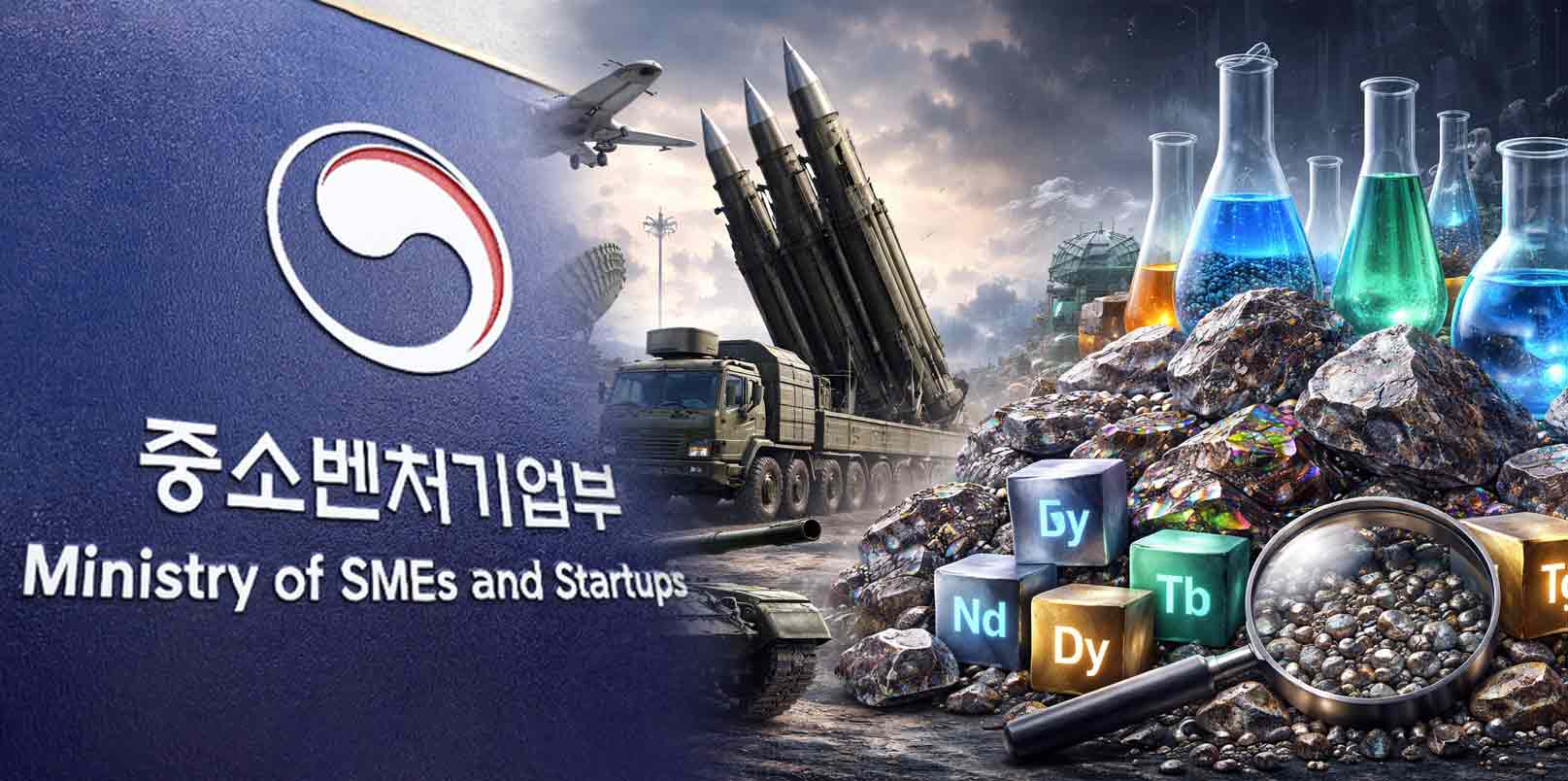
South Korea is pushing its SME innovation policy deeper into strategic industrial territory. The government plans to support 140 small and medium enterprises developing materials, parts, and equipment technologies, while expanding the program into defense systems and rare earth materials. The move connects supply chain security, regional industrial policy, and SME innovation in a single framework that increasingly shapes Korea’s technology ecosystem.
Korea’s SME Technology Innovation Program Expands into Strategic Supply Chains
South Korea’s Ministry of SMEs and Startups (MSS) will recruit companies for the materials, parts, and equipment track of the 2026 SME Technology Innovation Development Program between March 30 and April 15.
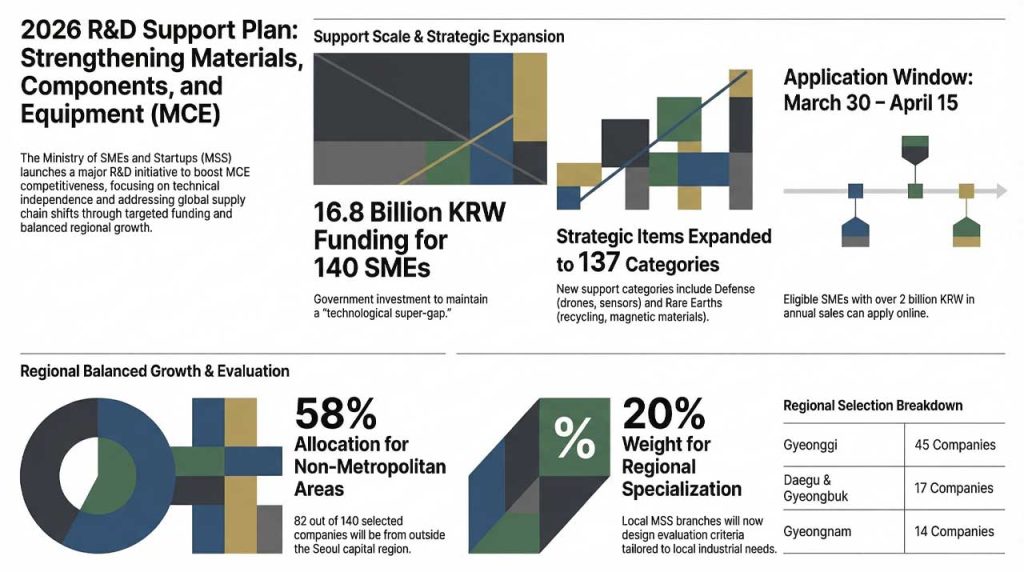
The ministry plans to select 140 projects and provide a combined KRW 16.8 billion in research and development funding.
The program targets the materials, parts, and equipment industry, widely known in Korea as the “so-bu-jang” sector. The government describes this segment as the technological foundation supporting advanced manufacturing and industrial competitiveness.
This year’s program expands the list of supported technologies from 113 to 137 items. Defense technologies and rare earth materials have been newly added.
The expansion reflects growing attention to strategic supply chains and industrial resilience.
According to MSS Technology Innovation Policy Director Hwang Young-ho, the sector represents more than technological development.
He said the materials, parts, and equipment industry has become “a survival strategy for Korea to maintain technological super-gap competitiveness amid global supply chain restructuring.”
Strategic Technologies Now Include Defense Optics, Sensors, and Rare Earth Materials
The updated program includes technologies linked to both national security and critical resources.
In the defense category, newly supported areas include:
- precision optical equipment
- lenses designed for extreme environments
- sensors built for extreme operational conditions
- drones capable of operating in extreme environments
The rare earth category focuses on materials technologies essential for advanced manufacturing.
Examples mentioned in the government program include:
- rare-earth-reduced magnetic materials
- high-performance magnets that minimize or eliminate rare earth use
- precursor materials for recovering high-purity rare earth elements from recycled resources
The addition of these sectors reflects Korea’s effort to secure key technologies connected to global supply chain competition and strategic industrial resources.
Regional Innovation Becomes a Central Feature of Korea’s SME R&D Policy
The program also introduces a strong regional development element.
Out of the 140 projects, 82 will be allocated to companies located outside the Seoul metropolitan area, representing roughly 58 percent of the total.
The government says the allocation is intended to reduce the concentration of innovation resources in the capital region and stimulate regional industrial ecosystems.
Some regional allocations identified in government announcements include:
- Gyeonggi Province: 45 companies
- Daegu and North Gyeongsang: 17
- South Gyeongsang: 14
- South Chungcheong: 9
In addition to project quotas, evaluation criteria have been redesigned to reflect regional industrial specialization.
A new “regional specialization” indicator will account for 20 percent of the evaluation score. Regional MSS offices can design these criteria based on local industrial clusters and technology priorities.
This allows regional authorities to shape R&D selection according to local manufacturing ecosystems.
Eligibility Rules and Application Timeline
Companies applying to the program must qualify as SMEs under Korean law and record annual sales of at least KRW 2 billion in the most recent fiscal year.
However, this requirement does not apply to firms selected under two national startup development initiatives:
- Materials-Parts-Equipment Strong SMEs 100+ Program
- Baby Unicorn 200 Program
Program details will be available beginning March 16 through the Integrated R&D Support System (IRIS) and the MSS website.
Applications must be submitted through the IRIS platform between March 30 and April 15 at 6:00 PM.
A second recruitment round is scheduled for May, which will support 60 additional SMEs with KRW 4.8 billion in funding.
A Policy Layer Focused on Industrial Supply Chain Resilience
The funding scale of this specific program is modest compared with Korea’s broader R&D spending. However, its sector focus provides insight into the government’s evolving industrial strategy.
The inclusion of defense technologies and rare earth materials places SME innovation programs closer to sectors linked to supply chain resilience and strategic industrial capacity.
This direction aligns with Korea’s wider policy approach toward strengthening critical technology sectors while encouraging participation from smaller technology firms.
For the startup ecosystem, the program highlights growing opportunities in industrial deep-tech fields tied to advanced components, materials engineering, and resource technologies.
These areas often intersect with manufacturing supply chains rather than traditional software startup markets.
What Global Startup Ecosystem Participants Should Watch
Not only that but this program also reveals several signals relevant to founders, investors, and technology partners working with Korea.
First, supply chain technologies are becoming a more visible part of SME innovation policy. The program highlights sensors, optics, magnetic materials, and resource recovery technologies.
Second, regional ecosystems may gain stronger roles in Korea’s industrial innovation structure. With most projects allocated outside Seoul and regional evaluation authority expanded, local manufacturing clusters could become more active participants in technology development.
Third, Korea’s startup support programs continue to intersect with broader industrial strategy. Strategic sectors such as defense technologies and rare earth materials are increasingly appearing inside SME R&D initiatives.
Linking Innovation Policy with Industrial Strategy
South Korea’s SME Technology Innovation Development Program illustrates how innovation policy is increasingly linked with industrial strategy.
By expanding support to defense technologies and rare earth materials while directing most projects to regional firms, the government is positioning smaller technology companies within supply chains that have become central to global industrial competition.
The long-term impact will depend on how effectively participating SMEs translate this support into scalable technologies that strengthen Korea’s role in strategic manufacturing and materials innovation.
Key Takeaways on Korea’s SME R&D Program 2026
- South Korea will support 140 SMEs with KRW 16.8 billion in R&D funding through the 2026 SME Technology Innovation Development Program.
- The program expands supported technologies from 113 to 137 items, adding defense systems and rare earth materials.
- 58 percent of projects will be allocated to non-capital regions to strengthen regional industrial ecosystems.
- Regional MSS offices will influence project selection through a 20 percent regional specialization evaluation indicator.
- The policy signals Korea’s effort to connect SME innovation with supply chain resilience and strategic industrial technologies.
– Stay Ahead in Korea’s Startup Scene –
Get real-time insights, funding updates, and policy shifts shaping Korea’s innovation ecosystem.
➡️ Follow KoreaTechDesk on LinkedIn, X (Twitter), Threads, Bluesky, Telegram, Facebook, and WhatsApp Channel.
🤝 Looking to connect with verified Korean companies building globally?
Explore curated company profiles and request direct introductions through beSUCCESS Connect.