KoreaTechDesk | Korean Startup and Technology News

Mon, July 06, 2026

Sign in

Virtual Demo Day
Menu
  • Home
  • Startup News
    • AI & Big Data
    • AR & VR
    • Blockchain
    • Clean Technology
    • Content & Games
    • Cybersecurity
    • Enterprise & SaaS
    • FinTech
    • Gadgets & Electronics
    • Health & Bio
    • Manufacturing
    • Press Release
    • IoT
    • Marketplaces & E-commerce
    • Robotics
    • Transportation
    • Investments
    • Ecosystem & Lists
  • Governments
    • Artificial Intelligence Industry Cluster Agency
    • Daegu Technopark
    • GANGNAM-GU
    • Gyeonggido Business & Science Accelerator
    • Hwaseong Industry Promotion Agency
    • Invest Seoul
    • Korea Creative Content Agency
    • Korea Internet & Security Agency
    • Korea Information Security Industry Association
    • Korea Institute of Startup & Entrepreneurship Development
    • Korea Tourism Organization
    • Korea Trade-Investment Promotion Agency
    • Ministry of Culture, Sports and Tourism
    • Ministry of SMEs & Startups
    • National IT Industry Promotion Agency
    • Pangyo Techno Valley
    • Seoul Business Agency
    • Seoul FinTech Lab
    • South Gyeongsang Province
    • Seoul Metropolitan Government
  • Events
    • COMEUP
    • Korea Fintech Week
    • K-Content Expo
    • NextRise
    • Try Everything
  • Interviews
    • Investors’ interviews
    • Founders’ interviews
  • Programs
    • Asan Voyager
    • CAPA Global Program
    • Campus Town Program
    • SGSC Global Bootcamp
    • Gangnam-gu Global Roadshow
    • Global SaaS Marketplace Support Project
    • LAUNCHPAD
    • COMEUP STARS 120
    • K-Startup Grand Challenge
    • TIPS X beSUCCESS Global Project
    • SFL Global Program
    • KTO Global Showcase
    • Yonsei Univ Global Class
    • KOSME Global Program
  • Partner With Us
    • Press Release
    • Startup Scouting
    • Business Agencies
    • Global Mentorship Program
    • Investment Opportunities
    • K-Scouter Program
  • Lists
  • Home
  • Startup News
    • AI & Big Data
    • AR & VR
    • Blockchain
    • Clean Technology
    • Content & Games
    • Cybersecurity
    • Enterprise & SaaS
    • FinTech
    • Gadgets & Electronics
    • Health & Bio
    • Manufacturing
    • Press Release
    • IoT
    • Marketplaces & E-commerce
    • Robotics
    • Transportation
    • Investments
    • Ecosystem & Lists
  • Governments
    • Artificial Intelligence Industry Cluster Agency
    • Daegu Technopark
    • GANGNAM-GU
    • Gyeonggido Business & Science Accelerator
    • Hwaseong Industry Promotion Agency
    • Invest Seoul
    • Korea Creative Content Agency
    • Korea Internet & Security Agency
    • Korea Information Security Industry Association
    • Korea Institute of Startup & Entrepreneurship Development
    • Korea Tourism Organization
    • Korea Trade-Investment Promotion Agency
    • Ministry of Culture, Sports and Tourism
    • Ministry of SMEs & Startups
    • National IT Industry Promotion Agency
    • Pangyo Techno Valley
    • Seoul Business Agency
    • Seoul FinTech Lab
    • South Gyeongsang Province
    • Seoul Metropolitan Government
  • Events
    • COMEUP
    • Korea Fintech Week
    • K-Content Expo
    • NextRise
    • Try Everything
  • Interviews
    • Investors’ interviews
    • Founders’ interviews
  • Programs
    • Asan Voyager
    • CAPA Global Program
    • Campus Town Program
    • SGSC Global Bootcamp
    • Gangnam-gu Global Roadshow
    • Global SaaS Marketplace Support Project
    • LAUNCHPAD
    • COMEUP STARS 120
    • K-Startup Grand Challenge
    • TIPS X beSUCCESS Global Project
    • SFL Global Program
    • KTO Global Showcase
    • Yonsei Univ Global Class
    • KOSME Global Program
  • Partner With Us
    • Press Release
    • Startup Scouting
    • Business Agencies
    • Global Mentorship Program
    • Investment Opportunities
    • K-Scouter Program
  • Lists
2026-02-25_AIS 2026_Conference Banners_1920x480
Home Startup Content & Games

Source-IP Contracts Are Becoming the Quiet Power Layer Behind Korean Drama Production

by Chloe kim
July 2, 2026
in Content & Games
0

Korea’s content industry has spent years building world-class intellectual property (IP) through webtoons, web novels, books, and original storytelling. But some of the most important decisions are made long before cameras ever start rolling. Behind every successful adaptation is a contract that quietly shapes who controls future opportunities, how the rewards are shared, and how far a story can grow beyond its first release.

Korea’s Growing Source-IP Economy Is Raising the Stakes

Korean content companies no longer see source IP as just material for the next television series. Instead, original stories are now treated as valuable assets that can grow across different formats, markets, and business opportunities.

According to the Ministry of Culture, Sports and Tourism’s latest Webtoon Industry Survey, South Korea’s webtoon industry generated KRW 2.2856 trillion (approximately USD 1.65 billion) in revenue in 2024, marking a 4.4% increase from the previous year. The survey also found that Japan accounted for 49.5% of Korean webtoon exports, followed by North America at 21.0%, Greater China at 13.0%, Southeast Asia at 9.5%, and Europe at 6.2%.

The industry’s international reach has also become more diverse. Online transmission rights represented 84.0% of exports, while secondary work creation rights licensing accounted for 3.9%, reflecting a growing commercial pathway for adaptations into dramas, films, animation, and other formats.

As Korea’s source-IP ecosystem continues to expand, adaptation rights have become increasingly valuable because the commercial potential of a successful story now extends well beyond its first publication. A successful webtoon or novel can naturally evolve into television series, films, overseas remakes, publishing ventures, games, or even future spin-offs.

And how far those opportunities can go often depends on how the rights are negotiated long before production begins.

Illustration of planning a new IP-based project. | Stock Photos

The First Business Decision Happens Before Production

For many audiences, adaptation begins when producers announce a new drama. Inside the industry, however, the process starts much earlier.

HeeKyoung Yun, founder and CEO of AnotherStory and a veteran producer whose career spans more than two decades across Korean television, web dramas, international projects, and large-scale content production, including prominent titles like Sungkyungkwan Scandal (2010) and Reborn Rich (2022), believes that acquiring rights is only the beginning.

“The first step is securing the rights,”

Yun told KoreaTechDesk during an exclusive interview on Korea drama production business.

“From there, we work with the original creator at the contracting stage to establish guidelines around the adaptation process: what needs to be respected, what can be changed, and where the boundaries are.”

Those conversations go beyond creative discussions, shaping the commercial framework that ultimately guides every decision throughout development and production.

Some creators welcome extensive adaptation. Others expect closer adherence to the original work. While neither approach is inherently better, Yun explained, both require clear alignment before production moves forward.

“The underlying principle is that IP acquisition is not just a legal transaction. It’s the beginning of a relationship.”

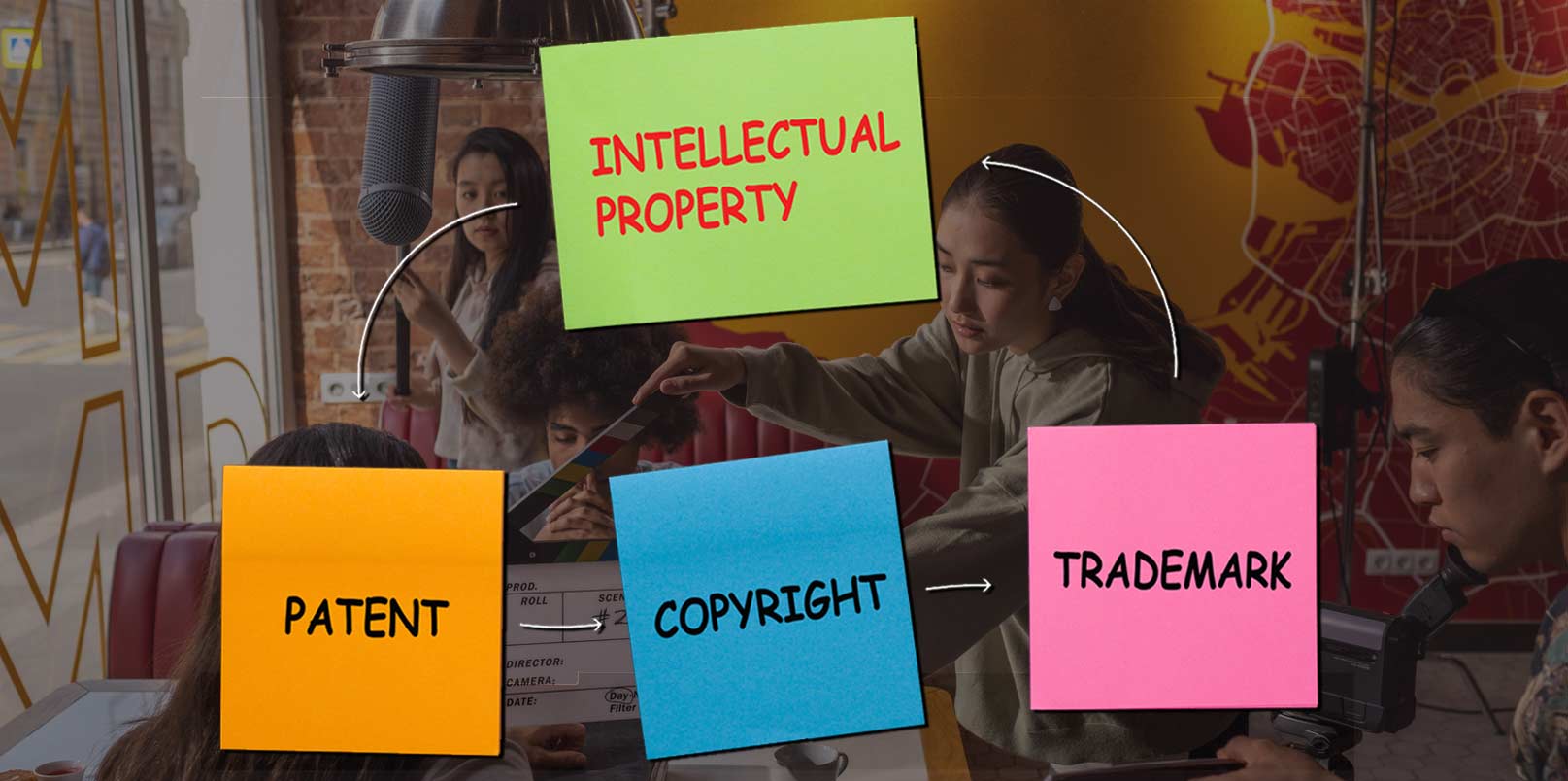
Illustration of IP elements. | Stock Photos

Derivative Rights Can Shape Years of Future Value

Contracts have now increasingly extended far beyond the first television adaptation.

Production companies now evaluate sequel rights, spin-offs, overseas remakes, and other derivative opportunities during the earliest negotiation stage rather than waiting until a project becomes commercially successful.

“Because you generally cannot move forward with either without the original creator’s consent, the smarter approach is to negotiate that framework before production begins rather than after the first season has aired,”

Yun explained.

And once a title succeeds, the commercial balance changes.

“By that point, everyone’s leverage and expectations have shifted, and conversations that would have been straightforward become considerably more complicated.”

That observation reflects a broader shift taking place across Korea’s content business. Rights planning has become part of long-term business strategy instead of post-release legal administration.

Illustration of derivatives. | Stock Photos

Korea’s Contract Practices Are Becoming More Structured

The industry’s growing attention to rights management has also attracted regulatory attention.

Earlier this year, Korea’s Fair Trade Commission reviewed contract terms used by webtoon and web novel companies, leading to corrections across numerous standard agreements after identifying clauses that could unfairly affect creators’ rights. The review highlighted derivative works as one area requiring clearer contractual treatment.

Separately, the Ministry of Culture, Sports and Tourism introduced updated standard contract guidelines that distinguish secondary work creation rights from original publishing agreements. The objective is to encourage more transparent negotiations when stories expand into television, film, animation, or other formats.

These developments illustrate that rights management has become an ecosystem issue rather than simply a legal matter between two parties.

Illustration of contracts. | Stock Photos

A More Mature Market Is Reducing Earlier Friction

Yun has witnessed that evolution firsthand.

She recalled that years ago, some projects overlooked discussions surrounding sequel rights, spin-offs, or overseas remakes during the original negotiation.

“In the past, the long-term franchise potential of IP was something the industry frequently overlooked.”

As adaptation became more common across Korea’s content industry, companies gradually refined their contractual practices.

“The industry has largely caught up,”

Yun said.

“Those kinds of disputes are increasingly rare now. The contractual frameworks have matured alongside the market.”

That maturity benefits both creators and production companies because expectations become clearer before commercial success changes negotiating dynamics.

Why This Matters Beyond Entertainment

This shift goes beyond Korean drama production and is increasingly shaping broader business and industry dynamics.

For founders building technology platforms, creative startups, publishing ventures, AI content tools, or digital IP businesses, intellectual property is no longer just a one-off product. Instead, it is becoming a long-term asset that can be developed, expanded, and monetized over time.

Now, contracts sit at the very center of that process. They define who can license technology, scale products, create derivative businesses, attract investment, or build future partnerships. And the same pattern is clearly visible within Korea’s rapidly evolving content ecosystem.

Because as Korean companies continue to expand globally, the ability to structure sustainable and forward-looking IP relationships is emerging as a key competitive advantage.

Contracts Quietly Decide the Next Chapter

In the end, yes, audiences mostly remember compelling stories.

But businesses, on the other hand, remember the agreements that made those stories possible.

So going forward, the next phase of growth in the Korean content industry may depend less on discovering the next breakout story and more on building solid contractual foundations that allow creators, production companies, and partners to continue creating value long after the first adaptation reaches the screen.
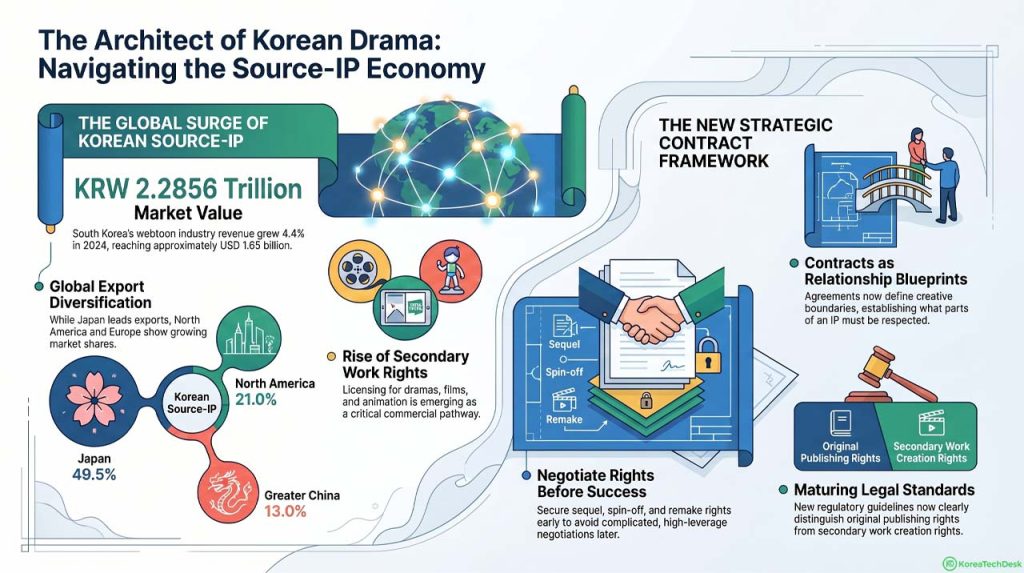
Navigating source-IP contracts and economy. | AI infographic

Key Takeaway

  • Source-IP contracts now influence long-term commercial value, not simply adaptation approval.
  • Early negotiation of sequel, spin-off, remake, and derivative rights helps reduce future business disputes.
  • Creator relationships begin during contract formation, making alignment an important production capability.
  • Korea’s regulatory and contractual frameworks are becoming more mature, reflecting the growing economic importance of content IP.
  • Production companies that plan ahead around IP are more likely to unlock new opportunities over time.
  • Successful adaptation depends just as much on how the business side is set up as it does on the creative execution.

– Stay Ahead in Korea’s Startup Scene –
Get real-time insights, funding updates, and policy shifts shaping Korea’s innovation ecosystem.
➡️ Follow KoreaTechDesk on LinkedIn, X (Twitter), Threads, Bluesky, Telegram, Facebook, and WhatsApp Channel.


🤝 Looking to connect with verified Korean companies building globally?
Explore curated company profiles and request direct introductions through beSUCCESS Connect.

Tags: Content IP commercializationDrama adaptation rightsIntellectual Propertyintellectual property (IP)intellectual property ownershipIntellectual property rightsKorean content businessKorean content industryKorean drama IP rightsKorean drama productionKorean entertainment industryKorean production companiesKorean webtoon industrySource IPWebtoon adaptation
Previous Post

Tax Complexity Could Give Brazil an Edge in Traceable Sustainability Data

Next Post

Market Pressure Is Revealing Which Startup Founders Can Actually Execute

Next Post

Market Pressure Is Revealing Which Startup Founders Can Actually Execute

MOST READ ARTICLE OF THE WEEK

1.
Korea’s Startup Ecosystem Built Global Ambition, Commercialization Is Still the Hard Part
30 Jun 2026
2.
Korean AI Startups Need Governance Before Users Start Auditing Their Systems
1 Jul 2026
3.
Korean Startups Need Decision Architecture as Much as AI Talent
30 Jun 2026
4.
Tax Complexity Could Give Brazil an Edge in Traceable Sustainability Data
1 Jul 2026
5.
Source-IP Contracts Are Becoming the Quiet Power Layer Behind Korean Drama Production
2 Jul 2026
Register for Event

AIS-2026 Conference

AIS 2026 Conference

List Article

1.
Commercialization Doesn’t Begin at Launch, It Begins with the Research Culture
4 Jul 2026
2.
Beyond the Startup Visa: What Foreign Founders Underestimate After Entering Korea
4 Jul 2026
3.
Why Good Startups Still Fail the Venture Capital Test
10 Jun 2026
4.
The Hardest Part of Korea Market Entry: Staying in The Game
3 Jun 2026
5.
Why M&A Value Is Lost After the Deal Closes
30 May 2026

Similar Articles

Content & Games

As K-Content Archives Grow, Finding Value Is Becoming Harder Than Storing Data

More
Content & Games

Why Korean Drama Production Is Becoming an IP-Led Global Business

More
Content & Games

AI Has Opened Production in Korea—But Distribution Still Decides What Gets Seen

More

Topics

Menu
  • AI & Big Data
  • AR & VR
  • Blockchain
  • Clean Technology
  • Content & Games
  • Cybersecurity
  • Enterprise & SaaS
  • FinTech
  • Gadgets & Electronics
  • Health & Bio
  • IoT

Program

Menu
  • Asan Voyager
  • CAPA Global Program
  • SGSC Global Bootcamp
  • LAUNCHPAD
  • COMEUP STARS 120
  • K-Startup Grand Challenge
  • TIPS X beSUCCESS Global Project
  • SFL Global Program
  • KTO Global Showcase
  • Yonsei Univ Global Class
  • KOSME Global Program

About

Menu
  • About Us
  • all articles
  • Terms of Use
  • Privacy
  • Cookie-policy
  • twitter

Subscribe and be informed first hand about actual Korean startup news.

All the day’s headlines and highlights, direct to you every morning.

[mc4wp_form id="3766"]

Contact us : [email protected]

Topics

Menu
  • AI & Big Data
  • AR & VR
  • Blockchain
  • Clean Technology
  • Content & Games
  • Cybersecurity
  • Enterprise & SaaS
  • FinTech
  • Gadgets & Electronics
  • Health & Bio
  • IoT

Program

Menu
  • Asan Voyager
  • CAPA Global Program
  • SGSC Global Bootcamp
  • LAUNCHPAD
  • COMEUP STARS 120
  • K-Startup Grand Challenge
  • TIPS X beSUCCESS Global Project
  • SFL Global Program
  • KTO Global Showcase
  • Yonsei Univ Global Class
  • KOSME Global Program

About

Menu
  • About Us
  • all articles
  • Terms of Use
  • Privacy
  • Cookie-policy
  • twitter

Subscribe and be informed first hand about actual Korean startup news.

All the day’s headlines and highlights, direct to you every morning.

[mc4wp_form id="3766"]

© 2023 Koreantech News & Media Korea Zrt. All rights reserved.

Our Spring Sale Has Started

You can see how this popup was set up in our step-by-step guide: https://wppopupmaker.com/guides/auto-opening-announcement-popups/

Our Spring Sale Has Started

You can see how this popup was set up in our step-by-step guide: https://wppopupmaker.com/guides/auto-opening-announcement-popups/

We hope you enjoy our content, May you please give us Feedback regarding our website!

[gravityform id=”17″]

dgdfgfdgdf

What you think about Koreatechdesk, Share your idea with us!

[gravityform id=”16″]

Invitation submission has been closed