
Startups often spend years chasing product-market fit as the defining milestone of success. However, many companies begin struggling only after customers arrive, revenue grows, and expansion accelerates. Now, this startup scaling problem rarely stems from demand alone. In many cases, the deeper breakdown actually starts when a founder’s personal execution model can no longer support the scale of the business itself.
Product-Market Fit Does Not Guarantee Startup Scalability
The startup ecosystem often treats product-market fit as proof that a company is ready to scale. But in practice, scaling startups introduces a completely different operational challenge.
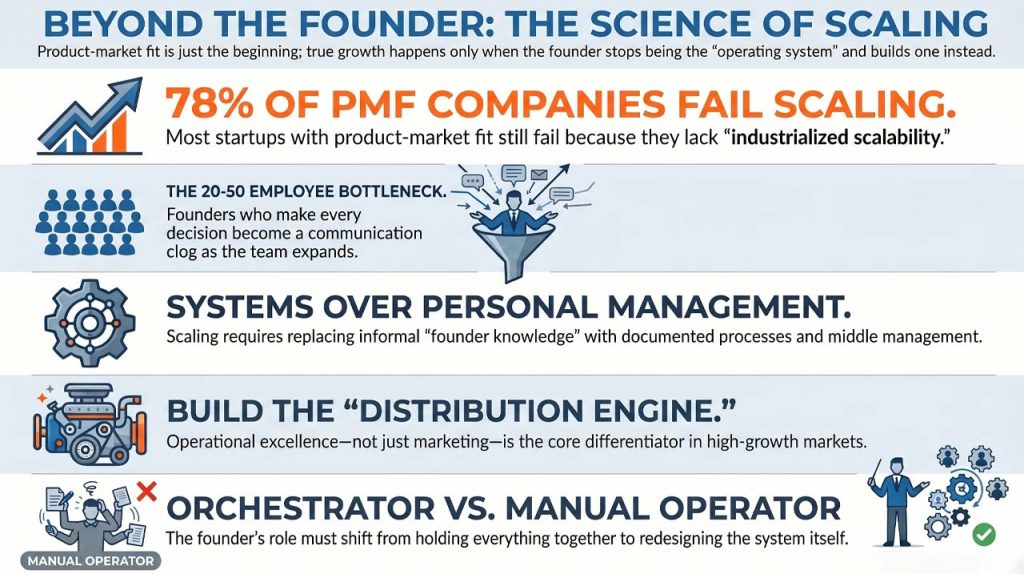
According to a 2025 McKinsey analysis, around 78% of companies that successfully build a product and achieve product-market fit still fail to scale effectively. McKinsey described the transition as a shift from founder-led execution toward “industrialized scalability,” where systems, processes, and organizational structures become critical growth infrastructure.
That distinction is becoming increasingly important across global startup ecosystems, including South Korea, where policymakers and investors are placing greater emphasis on scale-up support programs.

South Korea’s Ministry of SMEs and Startups (MSS) has continued expanding its Scale-Up TIPS initiative to support high-growth companies.
In February 2025, MSS announced that more than KRW 1.5 trillion in combined public and private funding had been directed into 379 companies through the program between 2022 and 2024. The ministry stated that 111 participating companies later secured follow-on investments totaling KRW 556.7 billion, while nine companies completed IPOs.
Yet even as funding support grows, execution challenges often emerge within the organization itself.
The Stage Where Founders Become the Bottleneck
Igor Strečko, Founding/Managing Partner at NeoZone Collective, Managing Director at Strecko Investment, and a global investor/business advisor, has led more than 25 strategic acquisitions during his time building Webglobe.
Strečko believes many startups encounter their most dangerous transition after initial growth begins working.
“Most commonly breakdown happens when the company outgrows the founder’s personal management capacity before a scalable system is built around it,”
Strečko told KoreaTechDesk.
He then explained that the problem often appears during the transition from roughly 20 to 50 employees.
Why? Because at earlier stages, founders can still personally oversee major decisions, maintain communication across teams, and preserve operational consistency through direct involvement. But as organizations expand, that same model starts creating internal friction.
“Up to this point, founders personally make almost every non-trivial decision. It works because it’s fast, consistent, and efficient,”
Strečko recounted his experience.
“But beyond a certain scale, that model breaks down.
The founder becomes a bottleneck simply because they, as a communication and decision channel, have limited capacity.”

Apparently, this challenge is not unique to one region or industry.
A 2024 study published in Technological Forecasting and Social Change found that hypergrowth companies frequently experience organizational strain caused by leadership pressure, hiring complexity, and insufficient operational development during scaling phases.
Now, in many startups, operational knowledge also remains concentrated inside a small number of individuals.
“Missing middle management” and “missing systems and processes” are among the most common causes of execution failure, according to Strečko.
He then noted that onboarding systems, sales strategies, decision-making structures, and internal processes often exist informally inside founders’ heads instead of functioning as repeatable organizational systems.
“At some point, the founder cannot remain the system.”
Why Operational Excellence Becomes the Real Competitive Advantage
Once demand is validated, growth no longer depends purely on product quality or market timing. Execution quality becomes increasingly decisive.
Strečko believes operational excellence becomes the core differentiator during scaling phases, particularly in competitive or “red ocean” markets where mistakes are punished quickly.
“Marketing and sales are basic hygiene. But the single most critical capability is the distribution engine.
That is the true foundation of scaling.”
The concept extends far beyond logistics alone. Distribution infrastructure includes operational capacity, delivery consistency, internal coordination, customer support systems, and the company’s ability to absorb growth without destabilizing itself.
A 2023 study examining high-growth firms identified operational excellence, leadership structure, organizational agility, and scalable workforce systems as major drivers separating successful scale-ups from companies that stall after early traction.
The risks become particularly visible when demand expands faster than operational readiness.
Strečko pointed to a Slovak telecom operator that launched a highly successful sales campaign but failed to prepare its operational delivery systems for the surge in customers.
“They completely failed operationally on the distribution and delivery side,”
he further explained.
“Many new customers left almost immediately, and the company ended up refunding a significant portion of orders.”
Now, the failure was never caused by weak demand. It came from an inability to operationally support the demand the company itself created.

Korea’s Scale-Up Push Faces the Same Execution Question
South Korea has intensified efforts to strengthen its startup scaling ecosystem as the country seeks to produce more globally competitive technology companies.
The Korea Development Institute (KDI) stated in a March 2026 policy briefing that high-growth firms account for a relatively small share of companies but contribute disproportionately to employment and sales growth.
KDI also noted that roughly 12 to 13 high-growth firms out of every 100 companies generate nearly half of total sales and employment growth.
At the same time, KDI warned that scale-up support cannot rely only on generalized R&D funding. The institute argued that growth constraints differ significantly between companies and often require identifying specific operational bottlenecks preventing expansion.
That observation reflects a broader shift happening across startup ecosystems globally. Product innovation still matters, but investors, operators, and policymakers are increasingly paying attention to organizational execution itself.
So the question is no longer simply whether a startup can build something valuable.
The more difficult question is whether the company can continue operating effectively once growth stops fitting inside the founder’s personal capacity.
Scaling Stops Being Personal
Yes, many founders initially succeed because of speed, intensity, and direct involvement. It is undeniable that those traits often help startups survive their earliest stages.
Still, the same habits can become dangerous later if companies fail to transition into structured organizations with distributed accountability.
Strečko believes the turning point comes when founders recognize that scaling is no longer about working harder individually.
“The real challenge is recognizing the right moment to redesign the system itself.
The goal is to build a company where the system operates independently, while the founder orchestrates it rather than manually holding everything together.”
And this shift remains one of the least visible but most crucial transitions in startup growth.
Key Takeaways
- Product-market fit does not guarantee scalability. Many startups struggle after early traction because operational systems fail to evolve alongside growth.
- Founder bottlenecks often emerge during the 20-to-50 employee stage. Decision-making and communication structures that worked earlier can become major constraints later.
- Operational excellence becomes a core competitive advantage after product-market fit. Distribution infrastructure, internal processes, and organizational systems determine whether growth can be sustained.
- Missing middle management and undocumented processes create scaling risks. Critical knowledge concentrated inside founders can destabilize expanding companies.
- South Korea’s scale-up ecosystem is increasingly focused on growth execution. Programs such as Scale-Up TIPS and KDI’s policy discussions reflect growing recognition that operational bottlenecks matter as much as innovation itself.
🤝 Looking to connect with verified Korean companies building globally?
Explore curated company profiles and request direct introductions through beSUCCESS Connect.
– Stay Ahead in Korea’s Startup Scene –
Get real-time insights, funding updates, and policy shifts shaping Korea’s innovation ecosystem.
➡️ Follow KoreaTechDesk on LinkedIn, X (Twitter), Threads, Bluesky, Telegram, Facebook, and WhatsApp Channel.