Korea’s e-commerce market has become too large, too fast-moving, and too operationally complex for product-page creation to remain a manual design task. Sellers managing hundreds of SKUs across Naver Smart Store and Coupang increasingly face a different problem: not how to make product pages prettier, but how to produce, adapt, and publish them fast enough to keep up with marketplace operations. That pressure is now reshaping how Korean AI startups position themselves.
Korea’s Marketplace Structure Is Creating a New Operational Bottleneck
South Korea’s online shopping market continues to expand at a pace that intensifies operational pressure on sellers.
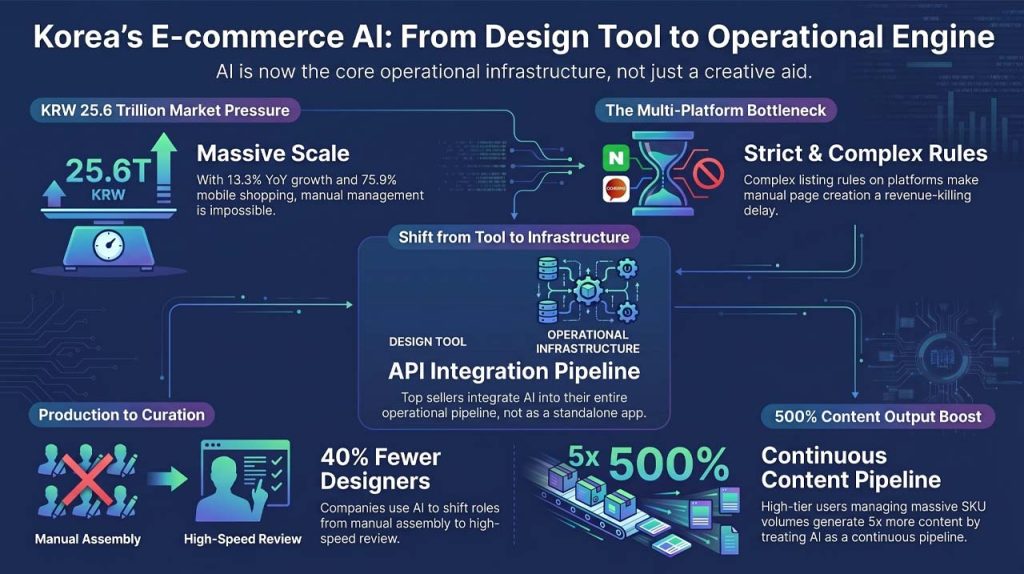
According to Statistics Korea (KOSTAT), the country’s online shopping transaction value reached KRW 25.577 trillion (approximately USD 17.3 billion) in March 2026, up 13.3% year-on-year. Mobile shopping accounted for 75.9% of total online shopping transactions during the same month.
Now, this scale matters because Korean marketplace ecosystems operate differently from many global e-commerce environments. Platforms such as Naver Smart Store and Coupang impose detailed operational structures around product registration, category metadata, image formats, disclosure fields, and listing compliance.
Coupang’s seller documentation alone outlines multi-step registration workflows involving category attributes, mandatory product disclosures, shipping information, option structures, and platform-specific metadata requirements. Naver Smart Store similarly maintains formatting and editor constraints that sellers must navigate when publishing product detail pages.
For large-volume sellers, these are no longer isolated design tasks. They are operational workflows tied directly to listing velocity and revenue generation.
That shift is becoming increasingly visible in Korea’s AI startup ecosystem.
Hookable’s Growth Reflects a Larger Shift in Korean E-commerce Operations
Fulcrum Technologies, the startup behind AI product-page generation platform Hookable, recently secured seed investment from Korean accelerator Primer. The company positions Hookable as an AI agent designed for e-commerce sellers producing product detail pages across Korean marketplaces.
According to Woobin Koh, CEO of Fulcrum Technologies, the company initially approached the market as a productivity tool. But then customer behavior eventually pushed the business toward a broader infrastructure role.
“We started as a tool. The original goal was straightforward: accelerate product page creation,”
Koh told KoreaTechDesk in a written interview.
“What shifted our thinking was what users actually started asking for. The requests were not about features. They were about structure.”
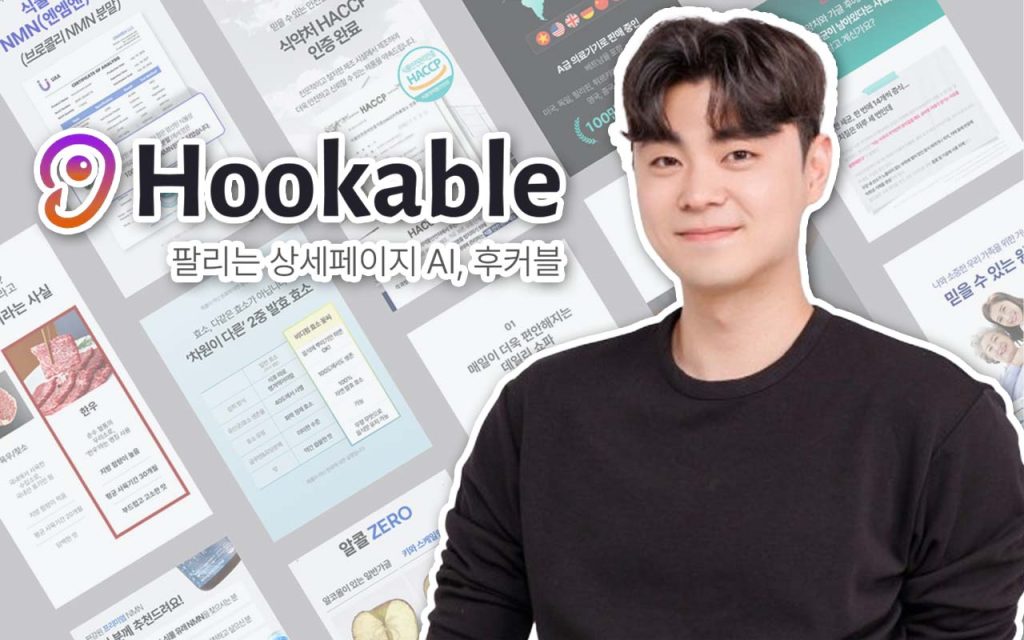
That distinction is becoming important inside Korea’s seller ecosystem.
As sellers expand across multiple marketplaces, the challenge increasingly revolves around maintaining consistency, adapting to platform-specific requirements, and managing high-volume listing operations without scaling headcount at the same pace.
Hookable’s internal data insight suggests that this operational pressure intensifies as sellers mature. Koh said higher-retention customers are often the ones requesting API access and workflow integration rather than standalone design functionality.
“They do not want to just open Hookable and use it only.
They want content to flow through it as part of a larger operational pipeline.”
Korean Sellers Are Rebuilding Product-Page Workflows Around AI
The implications extend beyond content generation itself.
According to Koh, some of Hookable’s larger customers are beginning to restructure how design operations are organized internally. Instead of continuously hiring additional designers to absorb growing SKU volume, companies are shifting toward smaller teams supported by AI-assisted production workflows.
“What we hear most consistently is a hiring-side calculus,”
Koh explained.
“Where a company would historically have hired five additional designers to absorb growing catalog volume, they’re now choosing to hire two or three and rely on Hookable to cover the rest.”
So the workflow changes are more practical rather than theoretical.
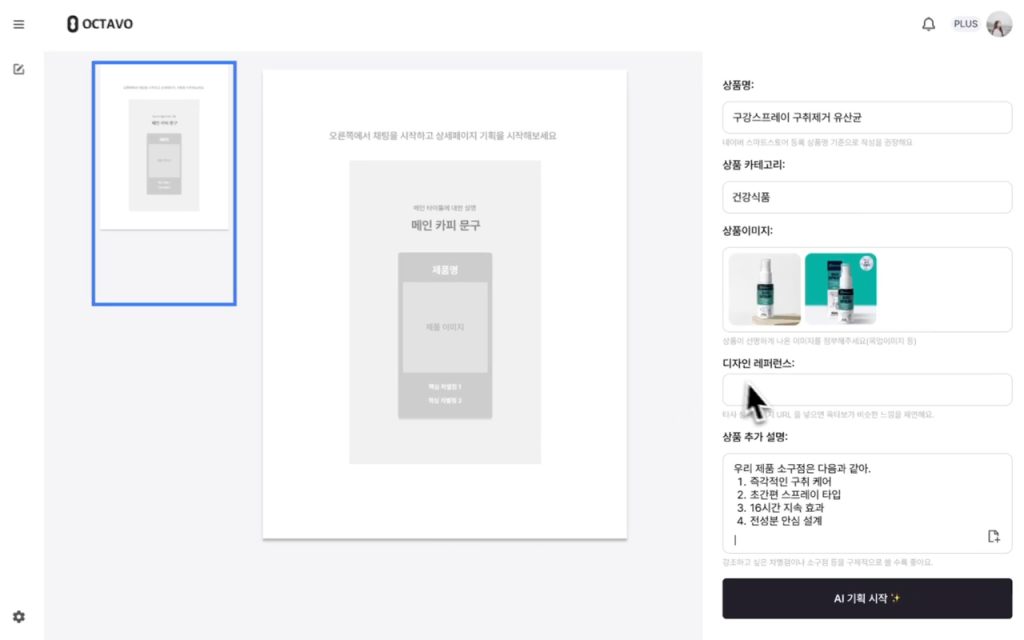
In one example shared by Koh involving a fashion-sector customer. The retouched product images are uploaded directly into Hookable, and the platform generates product pages automatically. Designers then move into review and refinement roles instead of manually assembling pages in Photoshop or Figma.
“The goal these operators express most clearly is that post-editing should take under ten minutes,”
Koh said.
“When that bar is met, Photoshop and Figma quietly drop out of the daily workflow, and the designer’s role evolves from production to curation.”
That distinction matters because it signals a broader transition occurring across AI-enabled business operations globally. The competitive value is no longer tied solely to content creation capability. It increasingly depends on how deeply AI systems integrate into operational workflows.
Why Vertical AI Matters More in Korean E-commerce
Global consulting firms have increasingly highlighted the same pattern.
McKinsey’s recent research on agentic AI in marketing argues that meaningful business value emerges when AI becomes embedded inside workflows rather than functioning as an isolated productivity layer. Deloitte’s Asia-Pacific commerce research similarly points to system interoperability, operational integration, and workflow automation as key differentiators as agentic AI adoption accelerates.
Korea’s marketplace structure may make this transition happen faster than in some other markets.
Korean e-commerce sellers operate in an environment shaped by mobile-first commerce behavior, high listing velocity, dense marketplace competition, and platform-specific operational rules. In practice, that creates conditions where workflow automation can deliver measurable operational leverage.
Hookable’s own user patterns reflect that reality.
According to Koh, users on Hookable’s higher-tier plans generate roughly five times more content than lower-tier users while simultaneously managing significantly larger SKU volumes.
The strongest operational pull comes from sellers treating product-page creation as a continuous pipeline rather than a one-time creative project.
“The more channels a seller manages, the more indispensable we become.”
That statement may ultimately describe a broader shift taking place across Korean e-commerce AI startups. The market is gradually moving away from standalone AI tools and toward systems designed to coordinate operational complexity across marketplaces, workflows, and seller infrastructure.
Korea’s AI Commerce Shift May Matter Beyond Korea
The significance of this transition extends beyond product-page generation itself.
Korea’s e-commerce ecosystem has historically functioned as an intense operational environment shaped by rapid mobile adoption, marketplace competition, and high consumer expectations around digital commerce experiences.
As AI systems become more deeply integrated into seller workflows, Korea may become an early testing ground for how vertical AI infrastructure develops inside marketplace-driven economies.
The companies likely to benefit most may not be the ones building the flashiest AI interfaces. They may be the ones embedding themselves deeply enough into seller operations that removing the system becomes operationally difficult.
That is a fundamentally different business category from design software.
Key Takeaway
- South Korea’s online shopping market reached KRW 25.577 trillion in March 2026, increasing operational pressure on marketplace sellers.
- Platforms such as Naver Smart Store and Coupang impose platform-specific listing structures and compliance requirements, making multi-channel product-page management increasingly complex.
- Hookable’s evolution reflects a broader shift inside Korean e-commerce AI startups, where AI systems are moving beyond content generation into operational infrastructure.
- Large-volume Korean sellers are beginning to restructure design workflows around AI-assisted production, with designers shifting toward QA and refinement roles.
- The strongest demand appears to come from sellers managing high SKU volumes across multiple marketplaces, where operational throughput becomes more valuable than isolated design productivity.
- Korea’s marketplace-driven commerce environment may become an early testing ground for vertical AI infrastructure models tied directly to workflow automation and seller operations.
🤝 Looking to connect with verified Korean companies building globally?
Explore curated company profiles and request direct introductions through beSUCCESS Connect.
– Stay Ahead in Korea’s Startup Scene –
Get real-time insights, funding updates, and policy shifts shaping Korea’s innovation ecosystem.
➡️ Follow KoreaTechDesk on LinkedIn, X (Twitter), Threads, Bluesky, Telegram, Facebook, and WhatsApp Channel.