
Governance Has Moved Inside the System — Enterprise AI is no longer judged only by what it can do. It is increasingly judged by how it operates, how it is controlled, and how it can be explained. Across global markets and in South Korea, governance is shifting away from policy documents and into the architecture of AI systems themselves. This shift is quietly redefining how AI products are built, deployed, and trusted.
AI Governance Is Moving into the Product Stack
Governance used to sit at the end of the process. Teams built systems first, then asked whether they were compliant.
Today, that sequence is no longer holding.
Joseph Bosco, Partner Manager for Professional Services Asia Pacific-Japan (APJ) at Databricks, described the shift to KoreaTechDesk as the enterprise AI discussion continues.
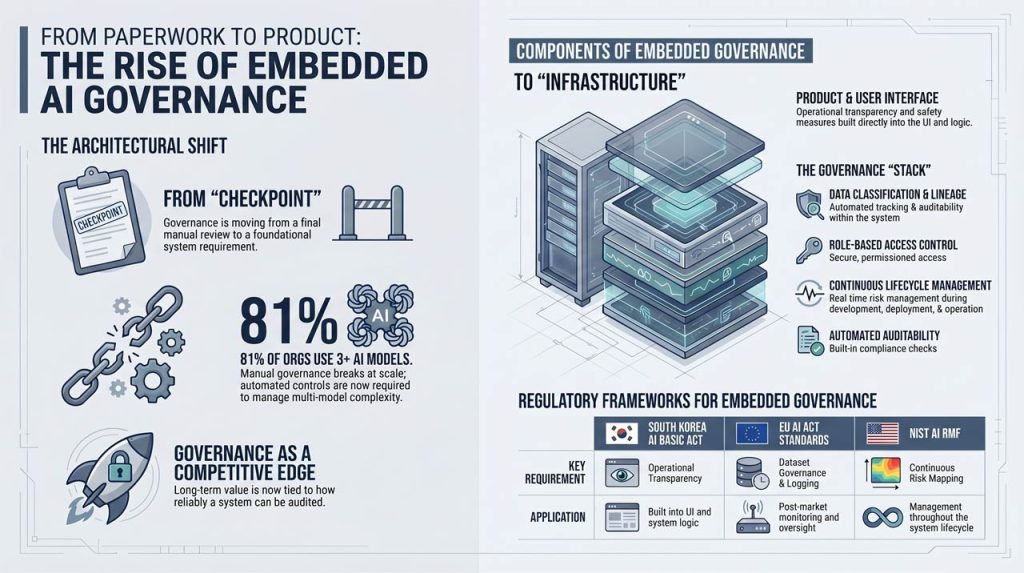
“The strongest organizations are moving from governance as a checkpoint to governance as infrastructure.”
This change reflects how enterprise AI is evolving. Systems are no longer static. They operate continuously, adapt to new data, and interact with multiple users and processes.
Therefore, governance has to move with them.
Why Manual Governance Breaks at Enterprise Scale
The pressure to embed governance is tied to scale.
IBM’s 2026 analysis notes that AI success is increasingly determined by the systems and controls surrounding models, not just the models themselves. The same research highlights that 81% of organizations are already using three or more generative AI models, which increases the complexity of managing risk, access, and accountability across systems.
At this level, manual review becomes impractical.
Governance that depends on approvals, documentation, or periodic audits cannot keep pace with systems that operate in real time.
Instead, governance needs to be built into how systems function.

What Embedded Governance Actually Looks Like in Practice
The shift from policy to infrastructure becomes clearer when broken down into system components.
Bosco outlined what this looks like inside enterprise environments.
“That means clear data classifications, role-based access, lineage, auditability, approved patterns for sensitive data use, and defined review thresholds for higher-risk use cases.”
Each element is operational, not theoretical.
Data classification determines how information is handled before it reaches a model. Role-based access controls who can interact with systems. Lineage tracks how data flows through pipelines. Auditability records decisions and system behavior.
While these may look like compliance checkboxes, they are actually the system requirements.
And they are even more essential as international standards are moving in the same direction. ISO/IEC 42001 treats AI governance as a lifecycle discipline that includes data governance, performance evaluation, monitoring, and continuous improvement.
Governance is becoming part of how systems are designed, not something applied afterward.
Korea’s AI Basic Act Turns Governance Into a Product Requirement
South Korea provides a clear example of this shift.
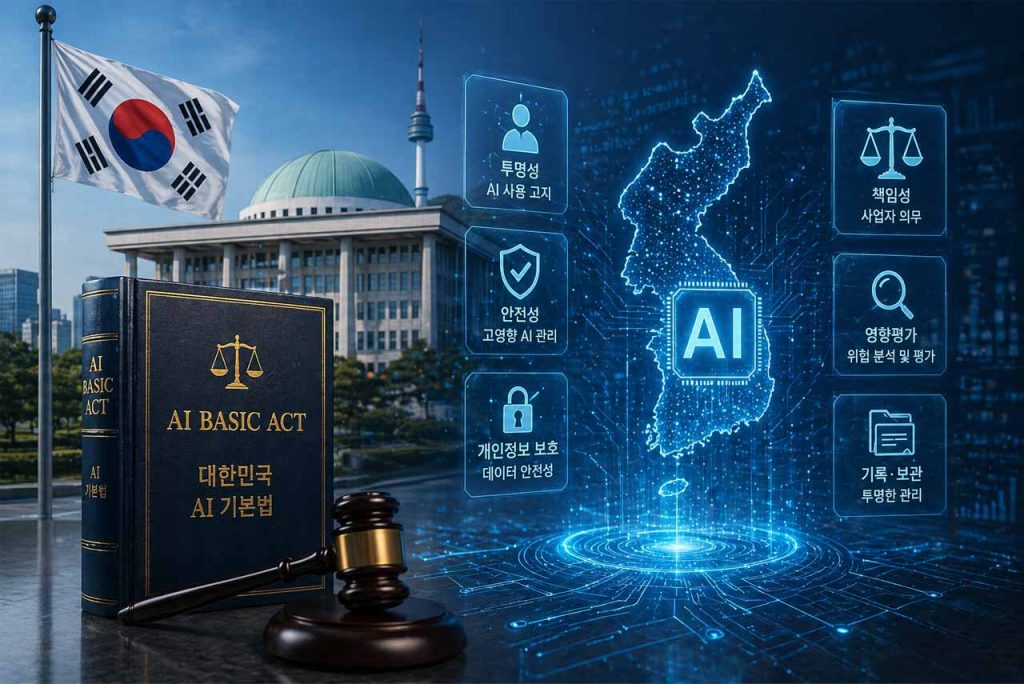
The AI Basic Act, which took effect on January 22, 2026, introduces transparency obligations for AI services, especially those involving high-impact or generative AI.
In practice, this means users must be informed when AI is used in products or services.
This requirement changes how products are built.
Transparency is no longer a disclosure in documentation. It becomes part of the user interface, the system logic, and the service design.
Korea has also established a dedicated AI Basic Act support desk to help companies interpret requirements such as impact assessment, transparency obligations, and safety expectations.
This reflects a broader direction, showing that governance is no longer being left to legal interpretation alone. It is being translated into operational guidance for developers and companies.
Privacy and Risk Management Are Now Built Into the Lifecycle
The shift is even more visible in how privacy is handled.
The Personal Information Protection Commission (PIPC) published a generative AI privacy guide in August 2025 that outlines how privacy risks should be addressed across the AI lifecycle.
This includes development, deployment, and ongoing operation.
PIPC has also introduced an AI privacy risk management model aimed at developers and service providers. The model emphasizes continuous risk identification, monitoring, and response, rather than one-time compliance checks.
A public-sector example shows how this is applied.
In 2026, PIPC supported an AI recommendation service within Korea’s national R&D administration system. According to the agency, safety measures included internal management planning, strengthened transparency, and the introduction of a user objection channel for recommendations.
These measures are not applied as separate audits after a system is built. They are integrated into the system itself, influencing how it operates, makes decisions, and handles data in real time.
Global Standards Are Reinforcing the Same Direction
Now, it’s also crucial to note that Korea is not moving alone.
The European Commission’s work on AI Act standardization identifies areas such as dataset governance, logging, human oversight, cybersecurity, and post-market monitoring as core requirements for AI systems.
Similarly, the U.S. National Institute of Standards and Technology (NIST) frames AI risk management as a continuous process that involves mapping, measuring, and managing risks throughout the system lifecycle.
These frameworks show a consistent direction: governance is no longer treated as a fixed set of rules applied at the end. It is now built into how AI systems operate, as a continuous capability that manages risk, tracks decisions, and adapts alongside the system itself.
What This Means for Startups, Investors, and Global Operators
The shift toward embedded governance is changing how AI products are evaluated across the ecosystem.
For founders, governance is no longer a separate layer. It sits inside the product itself. Enterprise customers are starting to expect clear answers to how data is handled, who has access, how decisions are recorded, and how risks are monitored over time. While model performance still matters, it is no longer enough on its own.
Investors are reading the same signals. Technical capability remains important, yet long-term value is increasingly tied to whether a company can operate within real governance environments across markets. That includes the ability to meet regulatory expectations while maintaining product reliability.
For companies entering South Korea, the requirements are more concrete. Compliance cannot remain at the level of documentation or legal review. It needs to be visible in the product experience, in system behavior, and in how data and decisions are managed in practice.
So this has now raised the bar completely.
Governance is no longer something added after market entry. It is something that must be designed from the start.
The Next Competitive Layer Is Governable AI
Enterprise AI is entering a phase where trust is built through system behavior, not claims.
Bosco captured this shift clearly.
“The better pattern is to encode governance directly into the platform and delivery model.”
As AI systems become more integrated into business operations, the ability to demonstrate control, transparency, and accountability becomes a core capability.
This is where competition is moving. And not only toward better models, but toward systems that can be trusted, audited, and sustained in real environments.
Governance Is Now Part of the AI Product
Finally, AI governance is no longer something applied after a system is built. It now shapes how that system is designed, deployed, and operated from the start.
South Korea’s regulatory direction, together with global standards and enterprise practices, points to a clear shift toward governance as an embedded capability.
This has direct implications for founders, investors, and operators, as the next generation of AI products will be judged not only by performance, but by how reliably they can be controlled, audited, and sustained in real-world use.
Key Takeaway
- AI governance is shifting from compliance to infrastructure, becoming part of system architecture
- Embedded governance includes data classification, access control, lineage, auditability, and monitoring
- IBM (2026) highlights systems and controls as critical to scaling AI, not just model performance
- South Korea’s AI Basic Act (2026) introduces operational transparency requirements in AI products
- PIPC frameworks require lifecycle-based privacy risk management, not one-time compliance
- Global standards (ISO, NIST, EU AI Act) define governance as continuous system capability
- Startups must design governance into products, not add it after deployment
- Enterprise AI competition is shifting toward governable, auditable systems
– Stay Ahead in Korea’s Startup Scene –
Get real-time insights, funding updates, and policy shifts shaping Korea’s innovation ecosystem.
➡️ Follow KoreaTechDesk on LinkedIn, X (Twitter), Threads, Bluesky, Telegram, Facebook, and WhatsApp Channel.
🤝 Looking to connect with verified Korean companies building globally?
Explore curated company profiles and request direct introductions through beSUCCESS Connect.