
Korea’s global talent strategy is entering a more complex phase. While foreign professional are no longer struggling to enter the workforce, many are still encountering limits after they arrive. As companies absorb international hires into daily operations, a deeper question is now emerging across the ecosystem. And it’s not about who gets in, but who actually strives and moves forward inside Korean organizations.
Entry Is Expanding. Advancement Is Becoming the Real Question
South Korea has made visible progress in integrating foreign professionals into its workforce. International talent is no longer confined to temporary roles or peripheral functions. In fact, many are now working inside Korean companies, contributing to operations, and building stable careers.
Still, a different constraint is emerging beyond entry.
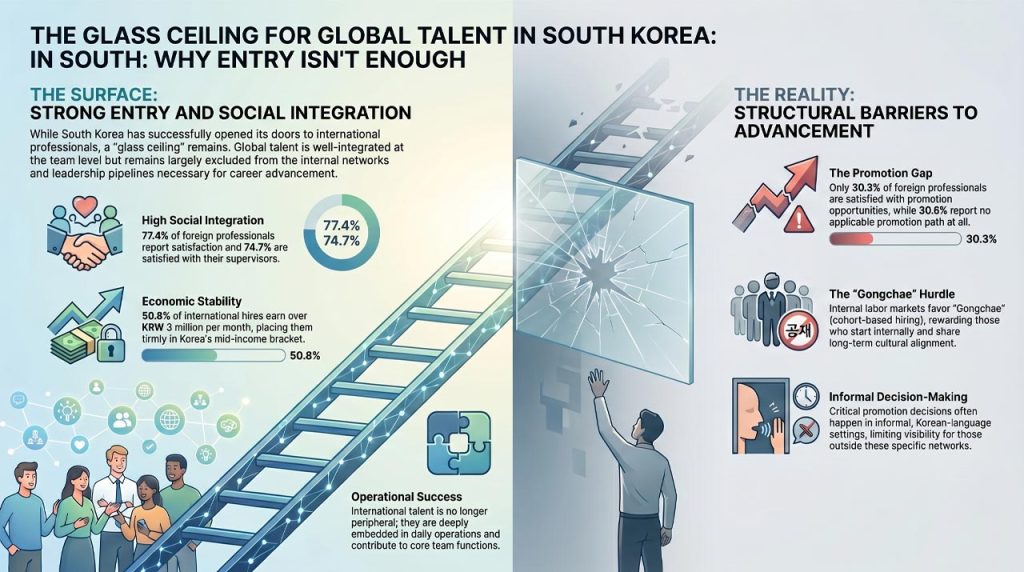
According to the 2025 Survey on Immigrants’ Living Conditions and Labor Force by Statistics Korea and the Ministry of Justice, only 30.3% of foreign professional workers reported satisfaction with promotion opportunities, while 30.6% said promotion was not applicable to their roles. This stands in contrast to relatively high satisfaction with workplace relationships, where 77.4% reported satisfaction with colleagues and 74.7% with supervisors.
The gap is not about whether foreign professionals can work inside Korean organizations. It is about whether they can move forward within them.
Integration Works at the Team Level, But Weakens at the Career Level
Meanwhile, at the operational level, integration is increasingly taking hold. Foreign professionals are now working within Korean organizations, contributing to teams and maintaining stable employment.
Recent data shows that 50.8% of foreign professionals earn over KRW 3 million per month, placing many within Korea’s mid-income range. Across the broader foreign workforce, most remain concentrated between KRW 2 million and 3 million, while a smaller but growing share has moved beyond that threshold.
At the same time, mobility remains relatively limited. Only around 10–11% of foreign workers report actively seeking new jobs, while overall job satisfaction remains high.
However, stability does not necessarily indicate clear progression. Among those considering a move, low pay remains the primary reason, suggesting that while many professionals remain within the system, their long-term advancement prospects may be less clearly defined.
Advancement Often Depends on Networks, Not Visibility Alone
The limitation becomes more visible when looking at how advancement decisions are made in practice.
As experienced career strategist who works closely with international professionals navigating the Korean job market, Monica Jung, founder and CEO of MH CAREER, points to a structural reality that is often overlooked.
“Even when the official working language is English, many important conversations and decisions still take place in Korean, often in more informal settings.”
This dynamic shapes how visibility and influence are built inside organizations.
Promotion decisions are not based solely on measurable output. They are influenced by participation in internal discussions, access to informal communication channels, and the ability to build trust within teams over time. And for foreign professionals, limited access to these layers can reduce their presence in decision-making contexts, even when performance is strong.
Internal Systems Still Favor Those Who Start Inside
This pattern is reinforced by how Korean companies structure career progression.
Research from the Korea Labor Institute shows that many firms continue to operate with internal labor market characteristics shaped by long-term employment systems. These systems are closely tied to cohort-based hiring, often built through traditional public open recruitment channels, commonly referred to as 공채 (Gongchae).
These structures do more than just define the hiring system. They shape how careers develop.
Employees who enter through these systems tend to build shared experiences, internal networks, and organizational familiarity from an early stage. Over time, this creates an environment where advancement is closely linked to accumulated internal trust and long-term alignment with company culture.
So for international professionals entering mid-career or through external hiring tracks, this presents a structural challenge. After all, they are indeed participating in the system, but not necessarily embedded within its original pathways.
Leadership Pathways Remain Limited and Less Visible
The outcome is not always immediately visible in official statistics, but it becomes clear at the leadership level.
While foreign professionals are present in skilled roles, there is limited data showing a strong pipeline into senior management or executive positions within Korean companies. The available occupational data groups managers together with professionals, making it difficult to isolate how many foreign workers are actually advancing into leadership roles.
Jung highlights this gap from an on-the-ground perspective.
“There are still relatively few examples of international professionals who have built their careers entirely within Korea and progressed into leadership roles. Many foreign leaders tend to be expatriates or externally hired executives, rather than internally developed talent.”
This absence of visible pathways can reinforce the perception that long-term advancement remains uncertain.
Retention Is Improving, But Long-Term Conversion Remains Weak
At a broader level, this aligns with international assessments of Korea’s labor market.
The Organization for Economic Co-operation and Development has noted that while Korea has made progress in attracting highly skilled foreign talent, it has historically retained fewer of them over the long term. Workplace structures and competitive labor market dynamics have been cited as contributing factors.
Indeed, this does not mean that foreign professionals are leaving immediately. In fact, many remain employed and stable within their roles.
However, long-term retention in a global context is not only about staying. It is about progression, influence, and integration into leadership structures.
Without those elements, retention becomes limited in its strategic value.
What This Means for Korea’s Startup Ecosystem and Global Talent Strategy
For startups and ecosystem operators, the implications are becoming more tangible.
The challenge is no longer limited to attracting or hiring global talent. It is increasingly about how that talent is developed and retained over time.
If foreign professionals remain concentrated in execution roles without clear pathways into leadership, companies may face limits in how effectively they can scale global operations, build diverse leadership teams, and integrate international perspectives into strategic decisions.
At the same time, this structure can shape how global talent evaluates Korea as a long-term career destination.
A system that supports entry but offers limited upward mobility may struggle to compete with ecosystems where leadership pathways are more transparent and accessible.
A System That Absorbs Talent, But Does Not Yet Fully Elevate It
South Korea’s workforce is evolving as foreign professionals take on a more visible role inside companies, contributing to operations and building stable careers. This shift reflects a clear foundation for a more international workforce.
Yet advancement remains uneven. Promotion pathways continue to be shaped by internal networks, Korean-language communication environments, and long-standing organizational structures that tend to favor those who develop within the system from the outset.
As a result, the workforce is becoming more global at the entry and operational levels, while leadership remains less accessible to international talent.
As Korea positions itself within the global startup and innovation ecosystem, the next phase of its talent strategy will depend not only on how many professionals it attracts, but on how far they can progress once they are inside.
Key Takeaway
- Only 30.3% of foreign professionals in Korea report satisfaction with promotion opportunities, while 30.6% see no applicable promotion path.
- Workplace integration is relatively strong, with over 74% satisfaction in colleague and supervisor relationships, but progression remains limited
- Advancement is shaped by informal networks and Korean-language decision environments, which affect visibility and influence
- Korea’s internal labor market structure and 공채 (Gongchae)-based systems continue to favor insiders in long-term career progression.
- Foreign professionals are present in skilled roles, but leadership pipelines remain unclear and less visible
- Korea’s challenge is shifting from global talent attraction to long-term progression and leadership integration
🤝 Looking to connect with verified Korean companies building globally?
Explore curated company profiles and request direct introductions through beSUCCESS Connect.
– Stay Ahead in Korea’s Startup Scene –
Get real-time insights, funding updates, and policy shifts shaping Korea’s innovation ecosystem.
➡️ Follow KoreaTechDesk on LinkedIn, X (Twitter), Threads, Bluesky, Telegram, Facebook, and WhatsApp Channel.