KoreaTechDesk | Korean Startup and Technology News

Sat, June 13, 2026

Sign in

Virtual Demo Day
Menu
  • Home
  • Startup News
    • AI & Big Data
    • AR & VR
    • Blockchain
    • Clean Technology
    • Content & Games
    • Cybersecurity
    • Enterprise & SaaS
    • FinTech
    • Gadgets & Electronics
    • Health & Bio
    • Manufacturing
    • Press Release
    • IoT
    • Marketplaces & E-commerce
    • Robotics
    • Transportation
    • Investments
    • Ecosystem & Lists
  • Governments
    • Artificial Intelligence Industry Cluster Agency
    • Daegu Technopark
    • GANGNAM-GU
    • Gyeonggido Business & Science Accelerator
    • Hwaseong Industry Promotion Agency
    • Invest Seoul
    • Korea Creative Content Agency
    • Korea Internet & Security Agency
    • Korea Information Security Industry Association
    • Korea Institute of Startup & Entrepreneurship Development
    • Korea Tourism Organization
    • Korea Trade-Investment Promotion Agency
    • Ministry of Culture, Sports and Tourism
    • Ministry of SMEs & Startups
    • National IT Industry Promotion Agency
    • Pangyo Techno Valley
    • Seoul Business Agency
    • Seoul FinTech Lab
    • South Gyeongsang Province
    • Seoul Metropolitan Government
  • Events
    • COMEUP
    • Korea Fintech Week
    • K-Content Expo
    • NextRise
    • Try Everything
  • Interviews
    • Investors’ interviews
    • Founders’ interviews
  • Programs
    • Asan Voyager
    • CAPA Global Program
    • Campus Town Program
    • SGSC Global Bootcamp
    • Gangnam-gu Global Roadshow
    • Global SaaS Marketplace Support Project
    • LAUNCHPAD
    • COMEUP STARS 120
    • K-Startup Grand Challenge
    • TIPS X beSUCCESS Global Project
    • SFL Global Program
    • KTO Global Showcase
    • Yonsei Univ Global Class
    • KOSME Global Program
  • Partner With Us
    • Press Release
    • Startup Scouting
    • Business Agencies
    • Global Mentorship Program
    • Investment Opportunities
    • K-Scouter Program
  • Lists
  • Home
  • Startup News
    • AI & Big Data
    • AR & VR
    • Blockchain
    • Clean Technology
    • Content & Games
    • Cybersecurity
    • Enterprise & SaaS
    • FinTech
    • Gadgets & Electronics
    • Health & Bio
    • Manufacturing
    • Press Release
    • IoT
    • Marketplaces & E-commerce
    • Robotics
    • Transportation
    • Investments
    • Ecosystem & Lists
  • Governments
    • Artificial Intelligence Industry Cluster Agency
    • Daegu Technopark
    • GANGNAM-GU
    • Gyeonggido Business & Science Accelerator
    • Hwaseong Industry Promotion Agency
    • Invest Seoul
    • Korea Creative Content Agency
    • Korea Internet & Security Agency
    • Korea Information Security Industry Association
    • Korea Institute of Startup & Entrepreneurship Development
    • Korea Tourism Organization
    • Korea Trade-Investment Promotion Agency
    • Ministry of Culture, Sports and Tourism
    • Ministry of SMEs & Startups
    • National IT Industry Promotion Agency
    • Pangyo Techno Valley
    • Seoul Business Agency
    • Seoul FinTech Lab
    • South Gyeongsang Province
    • Seoul Metropolitan Government
  • Events
    • COMEUP
    • Korea Fintech Week
    • K-Content Expo
    • NextRise
    • Try Everything
  • Interviews
    • Investors’ interviews
    • Founders’ interviews
  • Programs
    • Asan Voyager
    • CAPA Global Program
    • Campus Town Program
    • SGSC Global Bootcamp
    • Gangnam-gu Global Roadshow
    • Global SaaS Marketplace Support Project
    • LAUNCHPAD
    • COMEUP STARS 120
    • K-Startup Grand Challenge
    • TIPS X beSUCCESS Global Project
    • SFL Global Program
    • KTO Global Showcase
    • Yonsei Univ Global Class
    • KOSME Global Program
  • Partner With Us
    • Press Release
    • Startup Scouting
    • Business Agencies
    • Global Mentorship Program
    • Investment Opportunities
    • K-Scouter Program
  • Lists
2026-02-25_AIS 2026_Conference Banners_1920x480
Home Governments Ministry of SMEs & Startups

Korea Expands Foreign Startup Support as Global Founder Competition Intensifies

by Dae-jung Park
March 18, 2026
in Ministry of SMEs & Startups
0

The real signal is not the funding increase. It is how deliberately South Korea is lowering friction for foreign founders at the point of entry. English-first procedures, bundled support, and a tighter program structure all point to a system trying to behave less like a domestic policy tool and more like a global onboarding mechanism. The question is how far that shift actually goes once founders arrive.

South Korea Expands Global Startup Commercialization Program for Foreign Founders

South Korea’s Ministry of SMEs and Startups (MSS) has opened applications for the 2026 Global Startup Commercialization Support Program, targeting foreign-founded startups seeking to establish and scale in Korea.

According to the ministry, the program will support approximately 15 companies, up from 10 previously. Selected startups will receive average funding of KRW 50 million (up to KRW 80 million) to support activities such as product development, business model localization, intellectual property acquisition, and marketing.

In parallel, participants will gain access to programs linked with the Global Startup Center (GSC), which provides services including investment attraction support, corporate partnership opportunities, office space, and administrative assistance such as visa and company establishment support.

A notable operational change is that all procedures—from application to evaluation—will be conducted entirely in English, a move aimed at improving accessibility for non-Korean founders.

The program has previously drawn strong demand, recording a 13:1 competition ratio. MSS also cited Polymerize, a Singapore-based startup that entered Korea in September 2024, as a representative case. The company created 11 local jobs after participating in this program and the K-Startup Grand Challenge.

Cho Kyung-won, Director General for Startup Policy at MSS, stated in the official press release,

“MSS is expanding support to enable foreign entrepreneurs with strong technological capabilities and innovation to establish businesses in Korea. Through this program, we expect foreign startups to settle stably and grow within Korea’s startup ecosystem.”

Applications are open from March 18 to April 10 through the Global Startup Center platform.
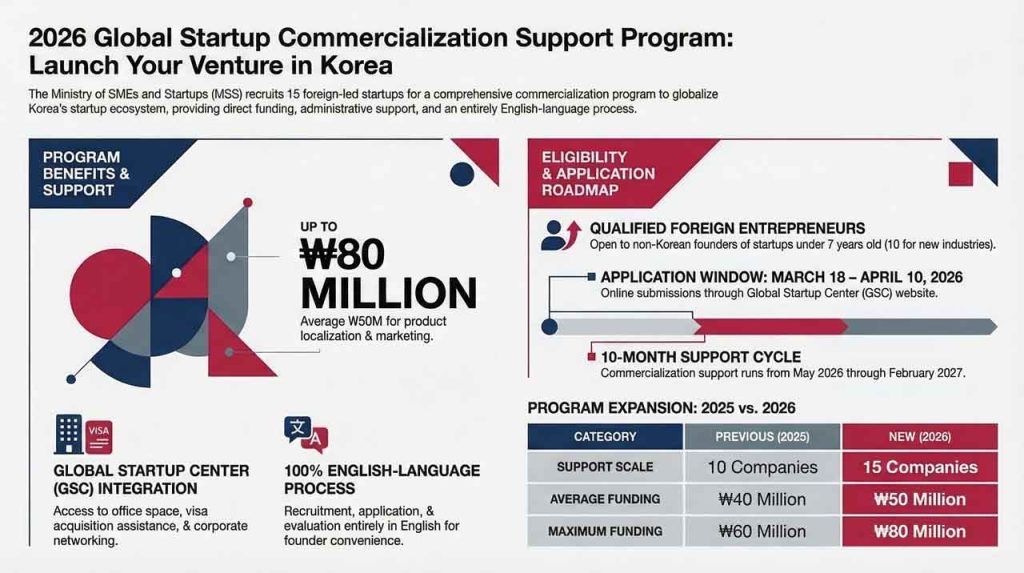
South Korea expands funding and slots for foreign startups, signaling a more aggressive push to attract and retain global founders within its ecosystem.

Korea’s Founder Strategy Is Shifting from Attraction to Early Settlement

The expansion itself is modest on a scale. The structural shift sits elsewhere.

Korea’s startup policy has long focused on attracting foreign startups through flagship programs and competitions. What stands out in this iteration is the growing emphasis on early-stage settlement mechanics rather than visibility.

Three elements reinforce that shift:

  • English-only process removes a common entry barrier at the administrative level
  • Bundled support via GSC integrates funding, workspace, and corporate access into a single pathway
  • Expanded funding range reflects an attempt to support not just entry, but initial execution

The inclusion of Polymerize as a case study signals what the government wants to validate: not just participation, but job creation and operational presence inside Korea.

This aligns with a broader policy direction where success is increasingly measured by retention and integration, not event-based exposure.

A Larger Door, Still a Narrow Corridor for Foreign Founders

The design is improving. But the scale currently remains constrained.

Supporting 15 companies per year limits the program’s systemic impact, particularly in a global environment where founder mobility is rising and countries are actively competing to attract startup talent.

Funding, while increased, still sits within an early-stage band. For foreign founders, the more difficult challenge often begins after initial entry:

  • navigating local hiring dynamics
  • securing follow-on capital
  • adapting business models to Korea’s market structure
  • building relationships within a network that still operates heavily in Korean

The GSC attempts to address part of this gap, especially around administrative setup and corporate connections. But integration into Korea’s deeper venture ecosystem is not something that can be fully program-managed.

The risk is not failure of intent. It is the gap between structured support and unstructured market reality.

What This Enables — and What It Still Does Not

The program clearly lowers the cost of entry.

Foreign founders now have:

  • a defined pathway into Korea
  • initial capital to test and localize
  • institutional support for setup and early partnerships

This is meaningful for founders exploring Asia expansion strategies or seeking a base in a technologically advanced market.

But at the same time, there are issues that the program would still need to pay attention to, including:

  • long-term capital scaling within Korea
  • deep local network integration
  • sustained market traction beyond pilot stages

Therefore, this initiative works best as an entry platform, not a complete growth system.

That distinction matters for how founders approach it. It is a starting point, not a guarantee of ecosystem fit.

What Global Founders and Investors Should Understand About Korea’s Approach

With this renewed program, South Korea is now becoming easier to enter in procedural terms. And this is particularly crucial for global founders looking to build in the country’s vast innovation ecosystem.

An English-first application process and bundled institutional support will most likely reduce the friction that has historically discouraged early exploration.

For investors, the signal is more nuanced. Korea is actively building structured pipelines to import startup talent, but the throughput remains selective and relatively small.

This creates two parallel dynamics:

  • a curated set of foreign startups receiving strong initial support
  • a broader ecosystem where integration still depends on local alignment and execution

For cross-border partners, especially corporates, the GSC-linked model offers a clearer interface to engage with international startups entering Korea.

Korea Is Refining Its Offer, Not Reinventing It

South Korea is not trying to outspend larger markets in attracting global founders. It is refining how it presents itself at the point of entry.

The program reflects a system that understands its earlier limitation: attracting attention is easier than sustaining presence.

What remains unresolved is whether incremental expansion and better design are enough to compete in a landscape where founder mobility is accelerating and alternative destinations are scaling faster.

The policy is moving in the right direction. The competitive question is how quickly it can move beyond controlled programs into broader ecosystem absorption.

Key Takeaway on Korea’s Improved Global Startup Founder Pipeline

  • South Korea expanded its foreign startup program to 15 companies with funding up to KRW 80 million
  • All application and evaluation processes are now conducted fully in English
  • The Global Startup Center (GSC) plays a central role in settlement support
  • Policy focus is shifting toward early-stage integration, not just attraction
  • Scale remains limited, raising questions about broader ecosystem impact
  • The program lowers entry barriers but does not fully address long-term growth and capital access challenges
  • For global founders, Korea is becoming more accessible, but still requires strong local adaptation to succeed

🤝 Looking to connect with verified Korean companies building globally?
Explore curated company profiles and request direct introductions through beSUCCESS Connect.


– Stay Ahead in Korea’s Startup Scene –
Get real-time insights, funding updates, and policy shifts shaping Korea’s innovation ecosystem.
➡️ Follow KoreaTechDesk on LinkedIn, X (Twitter), Threads, Bluesky, Telegram, Facebook, and WhatsApp Channel.

Tags: foreign entrepreneurs in Koreaforeign startup Korea entryGlobal Startup Center KoreaK-Startup Grand ChallengeKorea startup ecosystemKorea startup policyKorea startup program 2026Korea startup visa supportMinistry of SMEs and Startups (MSS)Ministry of SMEs and Startups KoreaSouth Korea foreign startup supportstartup funding South Koreastartup grants Korea
Previous Post

KOSPO and Lawmakers Test ‘Policy Pitch’ Forum to Break Startup Growth Barriers

Next Post

Physical AI Moves from Labs to Markets as Korea’s Deep-Tech Funding Expands

Next Post

Physical AI Moves from Labs to Markets as Korea’s Deep-Tech Funding Expands

MOST READ ARTICLE OF THE WEEK

1.
Can Your Startup Scale Without You? AsiaStartupExpo Q2 2026 Opens, Spotlighting Scalable Execution
7 Jun 2026
2.
Why Early Warning Signals Rarely Reach Decision-Makers in Korean Firms
7 Jun 2026
3.
Korea Is Buying More GPUs. The Bigger Question Is How Many Are Actually Being Used
8 Jun 2026
4.
Why Sell-Through, Not Sell-In, Decides Korean Brand Survival in the Middle East
8 Jun 2026
5.
Why Korea Is Becoming a Stress Test for Context-Aware AI
9 Jun 2026
Register for Event

AIS-2026 Conference

AIS 2026 Conference

List Article

1.
Why Good Startups Still Fail the Venture Capital Test
10 Jun 2026
2.
The Hardest Part of Korea Market Entry: Staying in The Game
3 Jun 2026
3.
Why M&A Value Is Lost After the Deal Closes
30 May 2026
4.
Foreign Companies Budget for Korea Entry, but the Real Costs Start After Hiring
23 May 2026
5.
Why Fast Korea Entry Structures Can Become Expansion Traps
16 May 2026

Similar Articles

Ministry of SMEs & Startups

Korea’s Startup for All Moves into Execution as Accelerators Take the Lead

More
Ministry of SMEs & Startups

Korea Bets on Startup for All to Revive Founder Pipeline as Youth Numbers Fall

More
Ministry of SMEs & Startups

Korea Expands SME R&D Into Defense and Rare Earth Supply Chains

More

Topics

Menu
  • AI & Big Data
  • AR & VR
  • Blockchain
  • Clean Technology
  • Content & Games
  • Cybersecurity
  • Enterprise & SaaS
  • FinTech
  • Gadgets & Electronics
  • Health & Bio
  • IoT

Program

Menu
  • Asan Voyager
  • CAPA Global Program
  • SGSC Global Bootcamp
  • LAUNCHPAD
  • COMEUP STARS 120
  • K-Startup Grand Challenge
  • TIPS X beSUCCESS Global Project
  • SFL Global Program
  • KTO Global Showcase
  • Yonsei Univ Global Class
  • KOSME Global Program

About

Menu
  • About Us
  • all articles
  • Terms of Use
  • Privacy
  • Cookie-policy
  • twitter

Subscribe and be informed first hand about actual Korean startup news.

All the day’s headlines and highlights, direct to you every morning.

[mc4wp_form id="3766"]

Contact us : [email protected]

Topics

Menu
  • AI & Big Data
  • AR & VR
  • Blockchain
  • Clean Technology
  • Content & Games
  • Cybersecurity
  • Enterprise & SaaS
  • FinTech
  • Gadgets & Electronics
  • Health & Bio
  • IoT

Program

Menu
  • Asan Voyager
  • CAPA Global Program
  • SGSC Global Bootcamp
  • LAUNCHPAD
  • COMEUP STARS 120
  • K-Startup Grand Challenge
  • TIPS X beSUCCESS Global Project
  • SFL Global Program
  • KTO Global Showcase
  • Yonsei Univ Global Class
  • KOSME Global Program

About

Menu
  • About Us
  • all articles
  • Terms of Use
  • Privacy
  • Cookie-policy
  • twitter

Subscribe and be informed first hand about actual Korean startup news.

All the day’s headlines and highlights, direct to you every morning.

[mc4wp_form id="3766"]

© 2023 Koreantech News & Media Korea Zrt. All rights reserved.

Our Spring Sale Has Started

You can see how this popup was set up in our step-by-step guide: https://wppopupmaker.com/guides/auto-opening-announcement-popups/

Our Spring Sale Has Started

You can see how this popup was set up in our step-by-step guide: https://wppopupmaker.com/guides/auto-opening-announcement-popups/

We hope you enjoy our content, May you please give us Feedback regarding our website!

[gravityform id=”17″]

dgdfgfdgdf

What you think about Koreatechdesk, Share your idea with us!

[gravityform id=”16″]

Invitation submission has been closed