South Korea’s AI sovereignty strategy has recently reached a critical turning point. A startup-led consortium has surpassed the country’s largest tech firms in the government’s national AI foundation model project. The success of Upstage and its startup alliance marks a significant shift, demonstrating that agility, credibility, and execution now matter more than corporate scale in the race for sovereign AI.
National AI Evaluation Names LG, SK Telecom, and Upstage as Top Performers
The Ministry of Science and ICT (MSIT) announced on January 15, 2026, that LG AI Research Institute, SK Telecom, and Upstage have passed the first stage of evaluations in Korea’s Independent AI Foundation Model Project.
The evaluation, jointly conducted by NIPA (National IT Industry Promotion Agency) and TTA (Telecommunications Technology Association), assessed five elite teams on benchmark performance, originality, usability, and ecosystem impact.
Naver Cloud and NC AI were eliminated. Despite strong performance in user and expert assessments, Naver failed the originality test due to reliance on non-independent pre-trained components.
The project’s goal is to secure sovereign AI capability—models developed entirely from scratch using domestic data, architecture design, and training, without dependence on foreign pre-trained weights.
Building Sovereign AI from Scratch
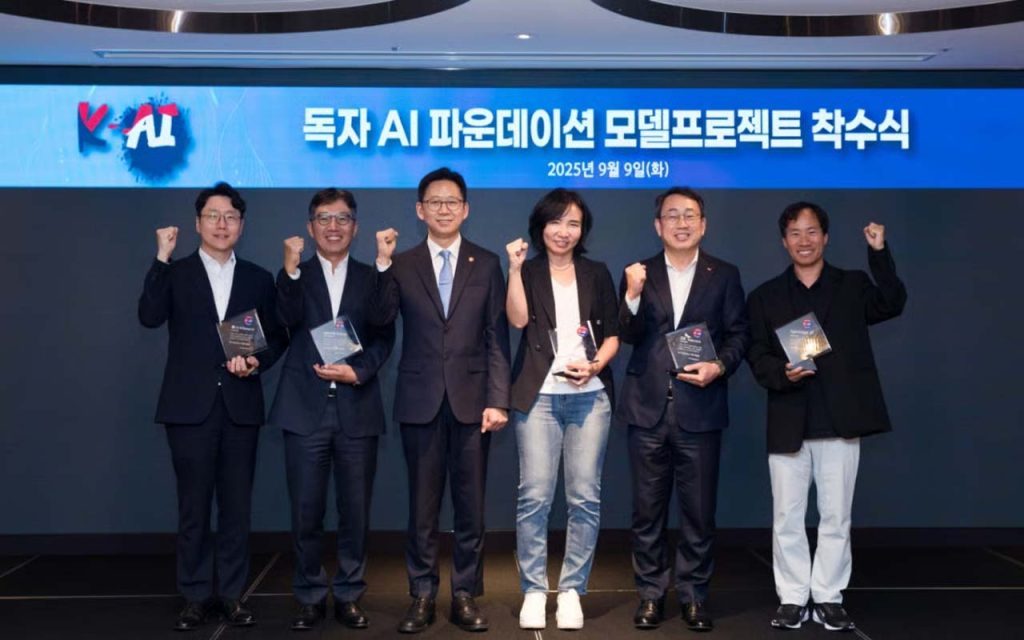
Launched in 2025, the Independent AI Foundation Model Project is central to Korea’s ambition to become one of the world’s top three AI powers. Each participant must design and train models that achieve at least 95% of global benchmark performance within limited time and GPU resources.
A total of KRW 213.6 billion (~ USD 162 million) in public funding has been allocated. The models aim to reduce Korea’s reliance on imported AI systems in sensitive domains such as national defense, healthcare, administration, and finance.
All five teams’ models—including Upstage’s Solar Open 100B, SKT’s A.X K1, and LG’s K-Exaone—have already been listed in Epoch AI’s “Notable AI Models”, a global database recognizing foundation models with measurable performance, academic citation, and operational scale.
Policymakers and Investors Respond to Upstage’s Rise
Vice Minister Ryu Je-myung of the Ministry of Science and ICT emphasized,
“Even if open-source components are used, sovereignty requires proof that the weights were trained independently. The ability to build and operate foundation models under full control is the essence of Korea’s AI autonomy.”
Lim Jung-wook, CEO of Startup Alliance and former SME policy chief, remarked,
“Upstage has pursued the sovereign AI goal since its founding. Startups operate with urgency and purpose—they must achieve milestones to survive. This result shows what mission-driven collaboration can achieve.”
SBVA Executive Director Jin Yoon-jung, one of Upstage’s early investors, added,
“This is proof that innovation speed and talent density now outweigh sheer capital. The success of the Upstage consortium is a milestone for Korea’s AI ecosystem.”
How Startups Surpassed Korea’s Tech Giants
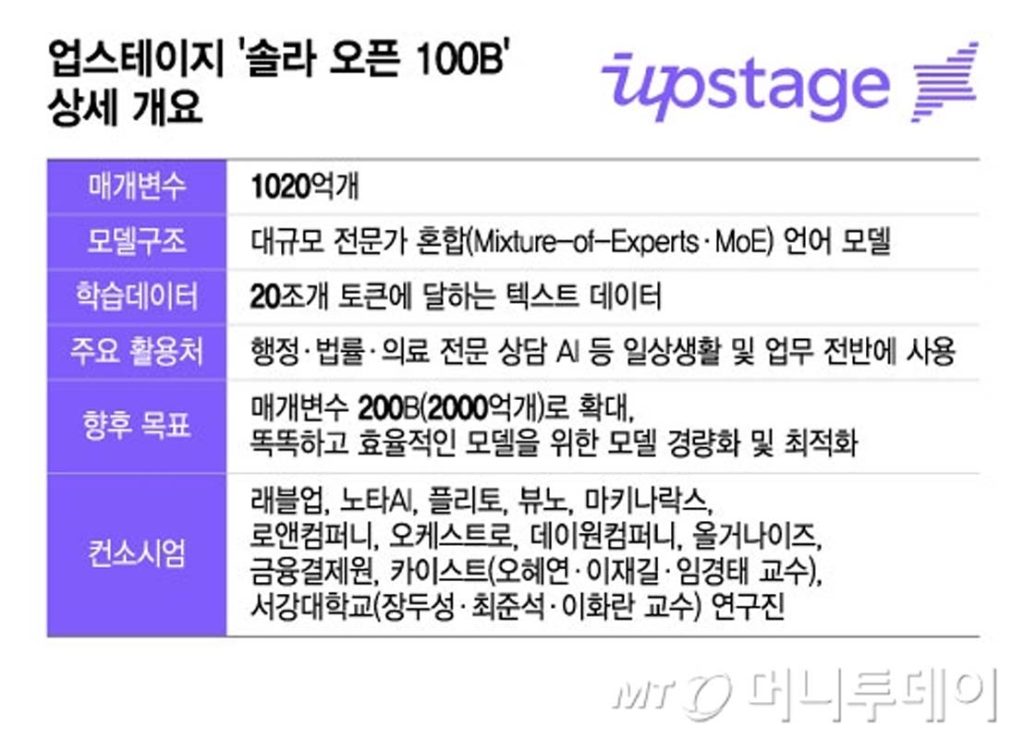
Upstage’s performance stands out because it built Solar Open 100B entirely “from scratch,” combining linguistic precision with resource efficiency. The model uses 100 billion parameters, trained on 20 trillion tokens across Korean, English, Japanese, code, and professional datasets.
Its architecture employs a Mixture-of-Experts (MoE) structure to maximize efficiency under limited GPU supply. Despite its smaller scale—just 15% the size of China’s DeepSeek R1—it surpassed DeepSeek’s performance by 10% in Korean, 3% in English, and 6% in Japanese benchmarks.
Partner startups contributed distinct technical strengths:
- Flitto provided high-quality multilingual datasets from 13 million users in 173 countries.
- Nota AI delivered quantization and lightweight model optimization.
- Lablup Inc. enabled GPU optimization to cut training time and cost.
This collaboration compressed the model development timeline from what would normally take a year into just four months.
Upstage CEO Kim Sung-hoon said,
“We’re deeply grateful for the government’s strong support, which made this progress possible. In the second phase, we’ll collaborate with Stanford University and New York University to push our technology further and deliver a foundation model that matches or surpasses those of global tech giants.”
Redefining Korea’s Deep-Tech Balance
The evaluation results reveal more than a competition outcome—they represent a structural shift in Korea’s innovation system.
For the first time, a startup-led consortium has outperformed conglomerates in a government-led AI competition. The achievement underscores how Korea’s deep-tech ecosystem is moving from hardware-heavy dependence toward talent-driven execution.
The results also highlight the growing credibility of Korea’s “sovereign AI” strategy, especially after recent controversies over originality were resolved through public verification and transparency. Upstage’s open disclosure of its full training logs in January—now validated by government evaluation—sets a precedent for accountability in foundation model development.
From a policy standpoint, the outcome validates the government’s decision to tie GPU access to originality standards and to require full training traceability. This approach is expected to become a model for responsible AI development frameworks across Asia.
Next Phase in Korea’s Sovereign AI Race: Expansion, Evaluation, and New Entrants
The Ministry of Science and ICT plans to hold an additional “revival round” in mid-2026, allowing previously disqualified or new consortia to compete for one more elite slot. Selected teams will receive GPU and data resources and may earn the designation of “K-AI Enterprise.”
Each of the remaining teams—LG, SK Telecom, and Upstage—will now move to the second phase of testing, which runs through June 2026, followed by the final evaluation in December 2026.
A New Standard for Korean AI Credibility
Korea’s sovereign AI project has become more than a technical contest—it’s a credibility test for how national innovation can evolve under transparency and competition.
The rise of Upstage and its consortium signals a transformation: startups are no longer peripheral players but key architects of Korea’s AI sovereignty. The combination of speed, collaboration, and integrity now defines Korea’s next phase of deep-tech growth.
As global investors watch, the message is clear—Korea’s path to AI leadership will be written not by size, but by trust and originality.
– Stay Ahead in Korea’s Startup Scene –
Get real-time insights, funding updates, and policy shifts shaping Korea’s innovation ecosystem.
➡️ Follow KoreaTechDesk on LinkedIn, X (Twitter), Threads, Bluesky, Telegram, Facebook, and WhatsApp Channel.
🤝 Looking to connect with verified Korean companies building globally?
Explore curated company profiles and request direct introductions through beSUCCESS Connect.