KoreaTechDesk | Korean Startup and Technology News

Tue, June 16, 2026

Sign in

Virtual Demo Day
Menu
  • Home
  • Startup News
    • AI & Big Data
    • AR & VR
    • Blockchain
    • Clean Technology
    • Content & Games
    • Cybersecurity
    • Enterprise & SaaS
    • FinTech
    • Gadgets & Electronics
    • Health & Bio
    • Manufacturing
    • Press Release
    • IoT
    • Marketplaces & E-commerce
    • Robotics
    • Transportation
    • Investments
    • Ecosystem & Lists
  • Governments
    • Artificial Intelligence Industry Cluster Agency
    • Daegu Technopark
    • GANGNAM-GU
    • Gyeonggido Business & Science Accelerator
    • Hwaseong Industry Promotion Agency
    • Invest Seoul
    • Korea Creative Content Agency
    • Korea Internet & Security Agency
    • Korea Information Security Industry Association
    • Korea Institute of Startup & Entrepreneurship Development
    • Korea Tourism Organization
    • Korea Trade-Investment Promotion Agency
    • Ministry of Culture, Sports and Tourism
    • Ministry of SMEs & Startups
    • National IT Industry Promotion Agency
    • Pangyo Techno Valley
    • Seoul Business Agency
    • Seoul FinTech Lab
    • South Gyeongsang Province
    • Seoul Metropolitan Government
  • Events
    • COMEUP
    • Korea Fintech Week
    • K-Content Expo
    • NextRise
    • Try Everything
  • Interviews
    • Investors’ interviews
    • Founders’ interviews
  • Programs
    • Asan Voyager
    • CAPA Global Program
    • Campus Town Program
    • SGSC Global Bootcamp
    • Gangnam-gu Global Roadshow
    • Global SaaS Marketplace Support Project
    • LAUNCHPAD
    • COMEUP STARS 120
    • K-Startup Grand Challenge
    • TIPS X beSUCCESS Global Project
    • SFL Global Program
    • KTO Global Showcase
    • Yonsei Univ Global Class
    • KOSME Global Program
  • Partner With Us
    • Press Release
    • Startup Scouting
    • Business Agencies
    • Global Mentorship Program
    • Investment Opportunities
    • K-Scouter Program
  • Lists
  • Home
  • Startup News
    • AI & Big Data
    • AR & VR
    • Blockchain
    • Clean Technology
    • Content & Games
    • Cybersecurity
    • Enterprise & SaaS
    • FinTech
    • Gadgets & Electronics
    • Health & Bio
    • Manufacturing
    • Press Release
    • IoT
    • Marketplaces & E-commerce
    • Robotics
    • Transportation
    • Investments
    • Ecosystem & Lists
  • Governments
    • Artificial Intelligence Industry Cluster Agency
    • Daegu Technopark
    • GANGNAM-GU
    • Gyeonggido Business & Science Accelerator
    • Hwaseong Industry Promotion Agency
    • Invest Seoul
    • Korea Creative Content Agency
    • Korea Internet & Security Agency
    • Korea Information Security Industry Association
    • Korea Institute of Startup & Entrepreneurship Development
    • Korea Tourism Organization
    • Korea Trade-Investment Promotion Agency
    • Ministry of Culture, Sports and Tourism
    • Ministry of SMEs & Startups
    • National IT Industry Promotion Agency
    • Pangyo Techno Valley
    • Seoul Business Agency
    • Seoul FinTech Lab
    • South Gyeongsang Province
    • Seoul Metropolitan Government
  • Events
    • COMEUP
    • Korea Fintech Week
    • K-Content Expo
    • NextRise
    • Try Everything
  • Interviews
    • Investors’ interviews
    • Founders’ interviews
  • Programs
    • Asan Voyager
    • CAPA Global Program
    • Campus Town Program
    • SGSC Global Bootcamp
    • Gangnam-gu Global Roadshow
    • Global SaaS Marketplace Support Project
    • LAUNCHPAD
    • COMEUP STARS 120
    • K-Startup Grand Challenge
    • TIPS X beSUCCESS Global Project
    • SFL Global Program
    • KTO Global Showcase
    • Yonsei Univ Global Class
    • KOSME Global Program
  • Partner With Us
    • Press Release
    • Startup Scouting
    • Business Agencies
    • Global Mentorship Program
    • Investment Opportunities
    • K-Scouter Program
  • Lists
2026-02-25_AIS 2026_Conference Banners_1920x480
Home Trends

High Entry, Low Survival: What Korea’s Pre-Startup Package Reveals About Early-Stage Risk

by Daehyun Song
December 19, 2025
in Trends
0

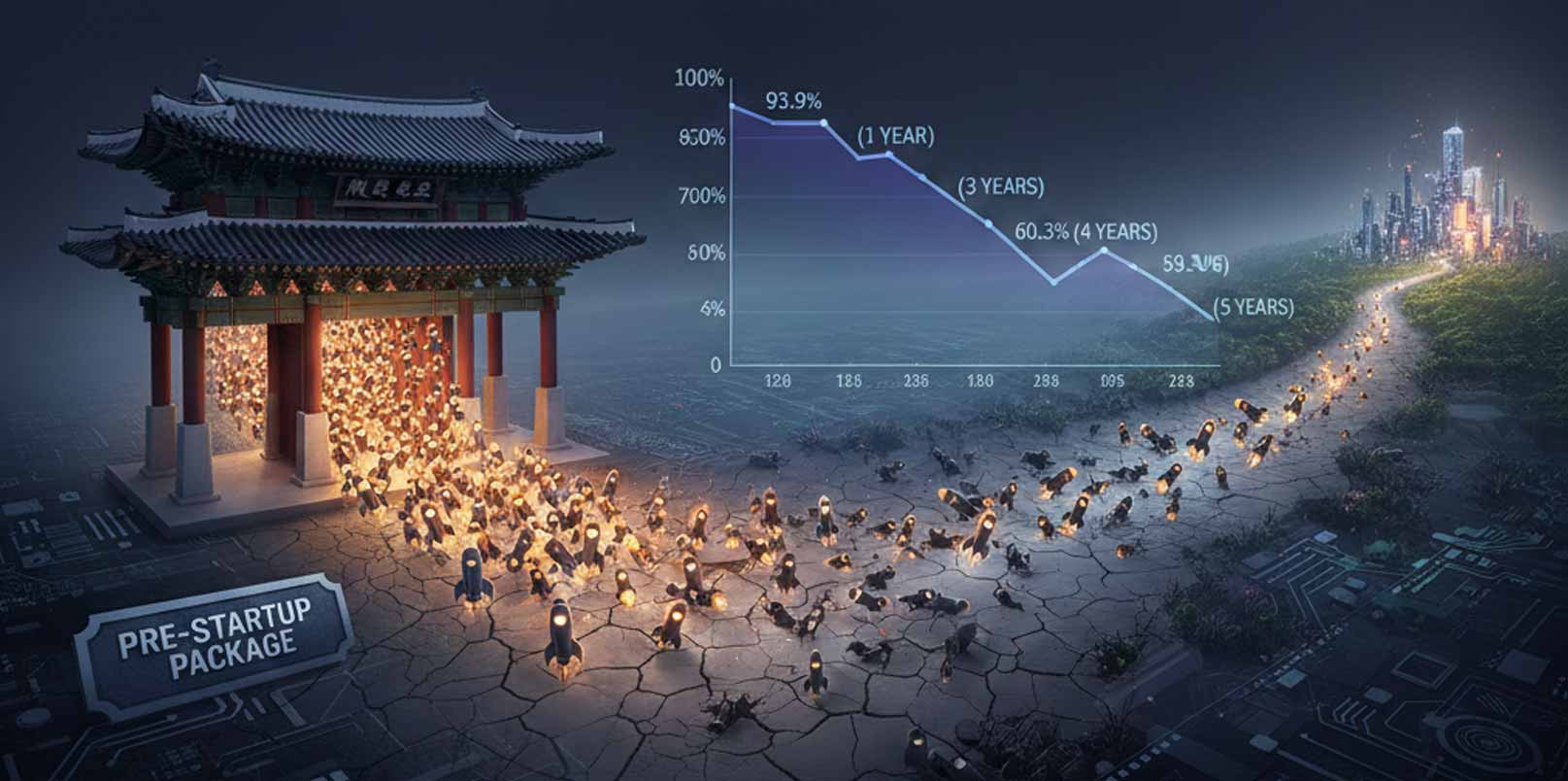
Korea’s flagship early-stage startup program has succeeded in opening the door to entrepreneurship, but new data suggests many companies struggle to stay in the game. An analysis of the Pre-Startup Package shows that four out of ten supported firms shut down within five years. For founders, investors, and policymakers, the figures raise difficult questions about how early-stage risk is managed once public funding helps startups cross the starting line.

Survival Data Exposes Limits of Korea’s Pre-Startup Package

Data analyzed by Asia Economy from materials provided by the office of Democratic Party lawmaker Kim Won-i shows that the five-year survival rate of companies supported by the Pre-Startup Package (a.k.a the Preliminary Startup Package) stood at 59.3 percent as of 2023.

While the one-year survival rate was relatively high at 93.9 percent, the numbers drop sharply after year three. Survival falls to 75.1 percent in the third year, 60.3 percent in the fourth, and below 60 percent by year five. This contrasts with a 72.2 percent five-year survival rate among companies participating in government startup support programs overall.

The Pre-Startup Package began as a supplementary budget initiative in 2018 and was formalized in 2019. The program is now in its seventh year of operation.
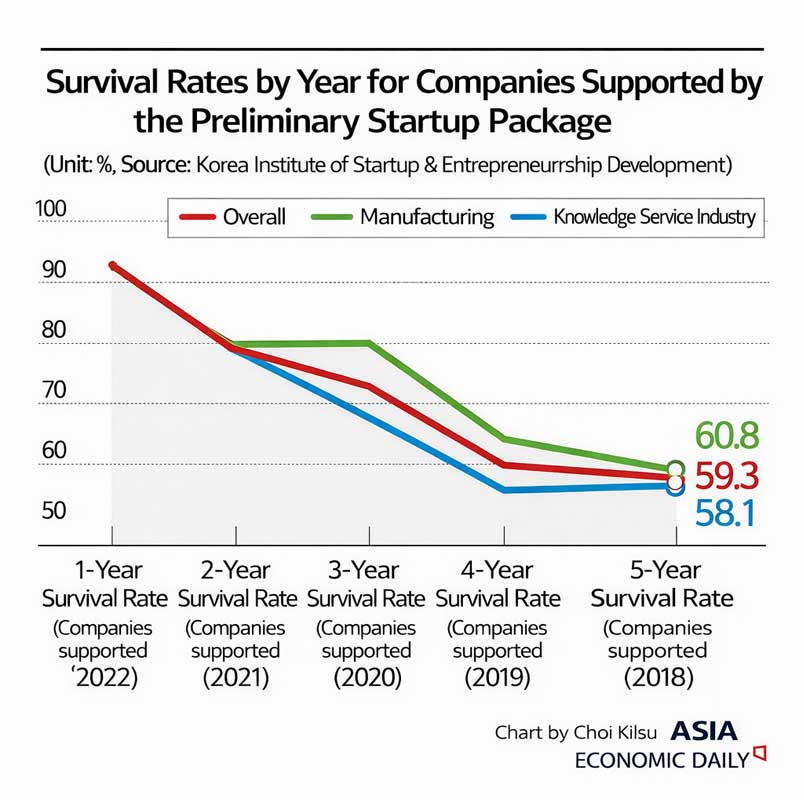
Five-year survival data shows how Korea’s Pre-Startup Package lowers entry barriers but struggles to carry early-stage startups beyond the critical growth phase
AI translation of Pre-Startup Package survival rates chart by Asia Economic Daily

Why Early Momentum Fades After Market Entry

The program targets aspiring founders before formal incorporation, providing up to KRW 100 million to support prototype development and market validation. Average support per company is around KRW 50 million, with roughly 890 firms selected each year.

This structure lowers entry barriers, but analysts argue it does not sufficiently address what happens after initial market entry. Many startups manage to launch but fail to secure stable customers or sustainable revenue, leaving them unable to cross the so-called “death valley” between early experimentation and commercial viability.

Industry data shows particularly weak outcomes in knowledge-based service sectors such as artificial intelligence and biotechnology. While first-year survival rates for manufacturing and knowledge services are similar, by the fourth year the gap widens to 65.0 percent for manufacturing versus 56.2 percent for knowledge services.

Structural Weaknesses of the Pre-Startup Package

Lee Il-han, a professor of business administration at Chung-Ang University, said knowledge service startups often face a delayed but sharper test. The professor explained,

 “These sectors have lower upfront investment burdens, which makes entry easier. However, if stable demand is not secured, revenue foundations weaken, and many companies face a critical hurdle around the third or fourth year.”

Criticism has also focused on what experts describe as a “broad but shallow” support model. Compared with later-stage programs such as the Initial Startup Package or the Scale-Up Startup Package, funding per company is smaller while the number of beneficiaries is larger, diluting long-term impact.

Budget pressure has compounded the issue. The Pre-Startup Package budget fell to KRW 54.3 billion this year, down 63.6 percent from KRW 149 billion in 2020, as new initiatives such as startup-centered university programs drew resources into parallel tracks.

What the Data Signals for Korea’s Startup Ecosystem

For Korea’s startup ecosystem, the findings highlight a persistent tension between access and durability. Broad entry programs expand participation and experimentation, but survival data suggests that many firms stall once initial government support ends.

The pattern mirrors challenges seen in other innovation-driven economies, where early public funding improves formation rates but does not automatically translate into scalable businesses. In Korea’s case, the gap appears most pronounced in technology-driven service sectors that require time to build demand and reference customers.

The findings also intersect with Korea’s broader push to strengthen scale-up policy frameworks that link early funding to mid- and late-stage growth, including programs such as Scale-Up TIPS and global expansion tracks. While these initiatives aim to help startups accelerate once traction is established, the survival data suggests a structural gap earlier in the pipeline.

Many companies appear to stall before reaching the stage where scale-up support becomes accessible, raising questions about whether the preliminary funding layer is sufficiently selective and well-resourced to prepare startups for the transition.

Policy experts argue that without adjustments, the current structure risks normalizing short-lived startups rather than cultivating companies capable of attracting follow-on private investment. Overlapping programs and fragmented budgets may further weaken the ability to concentrate resources where long-term growth potential is strongest.

Rethinking Depth Over Breadth in Early-Stage Support

The Pre-Startup Package has played a clear role in lowering the barriers to entrepreneurship in Korea. Yet five-year survival data suggests that access alone is not enough.

For policymakers, the challenge now lies in deciding where public intervention adds the most value. A shift toward more selective, higher-density support could strengthen the ecosystem by helping fewer startups travel further. For founders and investors, the message is equally direct. Early funding opens doors, but the real test begins once public support runs out and market discipline takes over.


– Stay Ahead in Korea’s Startup Scene –
Get real-time insights, funding updates, and policy shifts shaping Korea’s innovation ecosystem.
➡️ Follow KoreaTechDesk on LinkedIn, X (Twitter), Threads, Bluesky, Telegram, Facebook, and WhatsApp Channel.


🤝 Looking to connect with verified Korean companies building globally?
Explore curated company profiles and request direct introductions through beSUCCESS Connect.

Tags: death valley startupsearly stage companiesEarly stage startupsearly startupsearly-stage investmentInvestmentInvestment TrendsKorea Investment TrendsKorean startup trendsKorean StartupsMinistry of SMEs and Startups (MSS)Pre-Startup Packagestartup death valleystartup trendstrendsVenture Capital
Previous Post

Beyond Translation: How “Aurorah” AI by HiveMind Tackles Korea’s Web Novel Export Bottleneck

Next Post

Korea Doubles Down on Startups in 2026, but the Real Test Lies Beyond the First Funding Round

Next Post

Korea Doubles Down on Startups in 2026, but the Real Test Lies Beyond the First Funding Round

MOST READ ARTICLE OF THE WEEK

1.
Razer AVA Mini Shows Why AI Cost May Decide Which Consumer Features Reach Users
10 Jun 2026
2.
Why Good Startups Still Fail the Venture Capital Test
10 Jun 2026
3.
Korean VCs Are Entering Japan Through LP Investments Instead of Startup Deals — Why?
11 Jun 2026
4.
Why Korea’s Manufacturing Advantage Becomes Expensive for Small Hardware Startups
11 Jun 2026
5.
The New Phase of AI Adoption in Korea’s Media Industry: A Signal from Loomex by Catenoid
12 Jun 2026
Register for Event

AIS-2026 Conference

AIS 2026 Conference

List Article

1.
Why Good Startups Still Fail the Venture Capital Test
10 Jun 2026
2.
The Hardest Part of Korea Market Entry: Staying in The Game
3 Jun 2026
3.
Why M&A Value Is Lost After the Deal Closes
30 May 2026
4.
Foreign Companies Budget for Korea Entry, but the Real Costs Start After Hiring
23 May 2026
5.
Why Fast Korea Entry Structures Can Become Expansion Traps
16 May 2026

Similar Articles

Trends

Why Korea’s Talent Preparation Race Is Creating More Mismatch, Not Better Hiring

More
Trends

Why Korean Startups Still Can’t Find ‘Ready Talent’ Despite a Large Talent Pool

More
Trends

Why Korea’s Talent Pipeline Isn’t Converting into Real Employment Outcomes

More

Topics

Menu
  • AI & Big Data
  • AR & VR
  • Blockchain
  • Clean Technology
  • Content & Games
  • Cybersecurity
  • Enterprise & SaaS
  • FinTech
  • Gadgets & Electronics
  • Health & Bio
  • IoT

Program

Menu
  • Asan Voyager
  • CAPA Global Program
  • SGSC Global Bootcamp
  • LAUNCHPAD
  • COMEUP STARS 120
  • K-Startup Grand Challenge
  • TIPS X beSUCCESS Global Project
  • SFL Global Program
  • KTO Global Showcase
  • Yonsei Univ Global Class
  • KOSME Global Program

About

Menu
  • About Us
  • all articles
  • Terms of Use
  • Privacy
  • Cookie-policy
  • twitter

Subscribe and be informed first hand about actual Korean startup news.

All the day’s headlines and highlights, direct to you every morning.

[mc4wp_form id="3766"]

Contact us : [email protected]

Topics

Menu
  • AI & Big Data
  • AR & VR
  • Blockchain
  • Clean Technology
  • Content & Games
  • Cybersecurity
  • Enterprise & SaaS
  • FinTech
  • Gadgets & Electronics
  • Health & Bio
  • IoT

Program

Menu
  • Asan Voyager
  • CAPA Global Program
  • SGSC Global Bootcamp
  • LAUNCHPAD
  • COMEUP STARS 120
  • K-Startup Grand Challenge
  • TIPS X beSUCCESS Global Project
  • SFL Global Program
  • KTO Global Showcase
  • Yonsei Univ Global Class
  • KOSME Global Program

About

Menu
  • About Us
  • all articles
  • Terms of Use
  • Privacy
  • Cookie-policy
  • twitter

Subscribe and be informed first hand about actual Korean startup news.

All the day’s headlines and highlights, direct to you every morning.

[mc4wp_form id="3766"]

© 2023 Koreantech News & Media Korea Zrt. All rights reserved.

Our Spring Sale Has Started

You can see how this popup was set up in our step-by-step guide: https://wppopupmaker.com/guides/auto-opening-announcement-popups/

Our Spring Sale Has Started

You can see how this popup was set up in our step-by-step guide: https://wppopupmaker.com/guides/auto-opening-announcement-popups/

We hope you enjoy our content, May you please give us Feedback regarding our website!

[gravityform id=”17″]

dgdfgfdgdf

What you think about Koreatechdesk, Share your idea with us!

[gravityform id=”16″]

Invitation submission has been closed