
AI’s next competitive frontier is shifting away from model capability toward the ability to operate inside real-world systems. South Korea is positioning itself at the center of this transition through physical AI, backed by industrial depth and policy support. The real question is no longer ambition, but whether these conditions can be transformed into repeatable, scalable deployment systems with global relevance.
South Korea Is Moving Physical AI From Concept to National Strategy
South Korea is no longer treating artificial intelligence as a purely model-driven race. Its latest national direction places physical AI at the center of industrial and infrastructure transformation, with a stated ambition to become a global leader in this category by 2030.
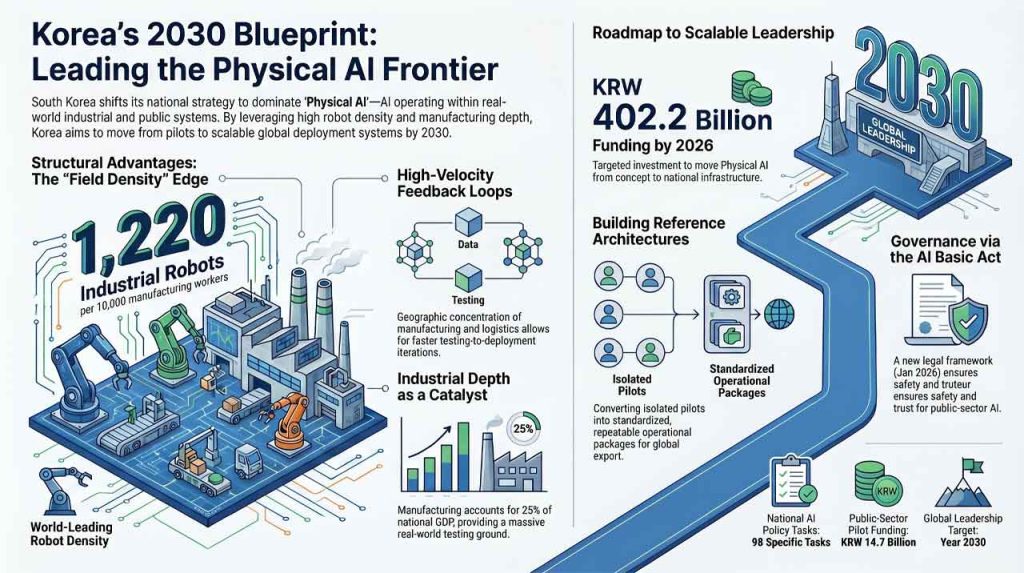
The government’s AI action plan outlines 98 policy tasks spanning infrastructure, data, security, and deployment ecosystems. This is paired with rising investment, including physical AI-related funding expanding to around KRW 402.2 billion in 2026, up from lower levels the year prior.
These figures signal intent, but they also raise a more important question: what would it actually take for Korea’s physical AI ambition to translate into durable global advantage?
Korea’s Structural Base Is Real, but Not Self-Executing
Actually, Korea’s starting position is stronger than most countries attempting to move into physical AI.
The country has the highest robot density in the world, with 1,220 industrial robots per 10,000 manufacturing workers, according to the International Federation of Robotics. Manufacturing still accounts for roughly a quarter of national GDP, supported by globally competitive electronics and automotive industries.
This combination creates what Byungjoon Kim, founder and CEO of H’ Intelligence, describes as a dense field environment.
“Korea has a structural advantage, but that advantage does not become real automatically.”
The distinction means that structural capacity alone does not translate into operational leadership. It only creates the conditions where such leadership could emerge.
Field Density Creates Faster Feedback Loops, Not Guaranteed Outcomes
One of Korea’s most overlooked advantages lies in proximity. Manufacturing, logistics, mobility systems, public infrastructure, and urban environments are geographically concentrated within relatively short distances.
Kim frames this as a feedback advantage.
“Manufacturing, urban infrastructure, public systems, logistics, and mobility are concentrated within a relatively short distance, which makes the feedback loop between PoC and real deployment faster.”
This density allows faster iteration between testing and real-world operation. It enables AI systems to move from pilot environments into live deployment conditions more quickly than in more geographically dispersed ecosystems.

However, faster iteration alone does not define leadership. Without a mechanism to convert these field experiences into standardized systems, the advantage remains local and fragmented.
Policy Is Shifting Toward Testbeds and Deployment Infrastructure
South Korea’s policy approach is beginning to reflect this reality. The current strategy is not limited to model development. It is increasingly focused on building environments where AI can be deployed repeatedly.
One example is the physical AI integration platform developed at KAIST, which integrates sensors, control systems, robotics, and manufacturing software into a unified operational stack. The platform is positioned as a foundation for factory scheduling, logistics optimization, and on-site decision systems.
In parallel, Jeonbuk National University is developing flexible production AI systems designed for multi-product, small-lot manufacturing environments.
These testbeds are not isolated experiments. Government materials describe them as open validation environments intended to support future deployment models, including exportable “intelligent factory packages.”
This marks an important shift. The focus is no longer just on proving that AI works. It is on proving that AI systems can be structured, packaged, and repeated.
Public-Sector Deployments Expand the Scope Beyond Manufacturing
Physical AI in Korea is not confined to factories.
The Ministry of Science and ICT has launched new on-device AI pilot programs, selecting five projects for 2026–2027, each receiving approximately KRW 2.9 billion, with total support reaching KRW 14.7 billion. These projects target sectors such as transportation, logistics, healthcare, and public safety.
These initiatives expand the definition of physical AI beyond industrial automation. They introduce deployment scenarios in real public environments, where systems must operate under regulatory, safety, and service constraints.
This matters for the broader ecosystem because physical AI advantage will no longer come from one sector alone. It will emerge from the ability to operate across multiple real-world environments with consistent performance.
The Missing Link: From Field Experience to Reference Architectures
Despite strong policy signals and dense deployment environments, a critical step remains unresolved.
Field deployments must be converted into repeatable systems.
Kim emphasizes this gap clearly.
“Unless field experience is converted into reference architectures, operational packages, edge-based architectures, integration capability, and governance frameworks, the advantage will not become durable.”
This is where many ecosystems fail. They generate pilots, demonstrations, and isolated successes, but do not transform them into scalable deployment models.
Reference architectures play a different role. They define how systems are structured, how components interact, and how deployments can be replicated across sites and sectors. Without them, each deployment remains a custom effort.
For Korea, this conversion step will determine whether its physical AI push remains domestic or becomes globally competitive.
Governance and Trust Are Becoming Structural Requirements
Technical deployment alone is not sufficient.
South Korea’s AI Basic Act, which took effect on January 22, 2026, establishes a legal foundation for AI safety, transparency, and accountability. It introduces requirements for high-impact AI systems and creates a framework for trust-based deployment.
This governance layer is becoming increasingly important in physical AI. Systems operating in infrastructure, manufacturing, and public services cannot scale without clear accountability structures.
International evidence supports this as well. OECD analysis highlights that widespread AI deployment in sectors such as mobility depends not only on technical progress, but also on improvements in regulation, data sharing, and physical infrastructure.
This reinforces a broader point. Physical AI advantage is not just purely technical. It is also systemic.
The Global Race Is Not About Models Alone
Globally, the competition in AI is often framed around model capability and compute scale. Physical AI introduces a different dimension.
It shifts the focus toward:
- real-world deployment environments
- operational reliability
- infrastructure integration
- governance and trust frameworks
This is where Korea’s positioning becomes relevant.
The country may not lead in foundational model development at the scale of the largest global players. However, its industrial base, robotics adoption, and deployment environments provide a different path.
That path depends on connecting physical systems with digital intelligence in ways that can be repeated, scaled, and exported.
The Real Opportunity Lies in the Operational Layer
The final question is not whether Korea can build physical AI systems. It has proved Korea already can.
Now, the question is whether it can define how those systems are deployed at scale.
Kim points to this layer as the core opportunity.
“Korea’s biggest opportunity is not only in the broad slogan of ‘physical AI,’ but in the operational AI layer that connects physical spaces and digital operations.”
This operational layer includes architecture, integration, governance, deployment workflows, and system management. It is where physical AI moves from concept to infrastructure.
Physical AI Leadership Will Be Defined by Repeatability
Finally, South Korea’s policy, infrastructure, and industry are aligning toward physical AI. But leadership will not be determined by ambition or early deployments. It will instead be determined by repeatability.
The ecosystems that succeed will not simply deploy AI systems. They will standardize them, replicate them, and integrate them across environments.
At last, yes, Korea has the ingredients. Yet, the outcome will depend on how effectively those ingredients are combined into systems that can move beyond pilot stages and operate consistently at scale.
Key Takeaway
- South Korea targets global leadership in physical AI by 2030, supported by a national plan with 98 policy tasks and rising investment
- Structural advantages exist, including world-leading robot density (1,220 per 10,000 workers) and strong manufacturing base
- Field density enables faster deployment feedback loops, but does not guarantee long-term advantage
- Government-backed testbeds like KAIST’s integration platform show a shift toward full-stack, real-world deployment systems
- Public-sector AI pilots (KRW 14.7 billion program) expand physical AI beyond manufacturing into real service environments
- The critical bottleneck is not deployment itself, but converting deployments into repeatable reference architectures
- AI Basic Act (effective Jan 2026) adds a governance layer essential for scaling physical AI in infrastructure and public systems
- Korea’s competitive edge will depend on building an “operational AI layer” that connects physical environments with scalable, standardized systems
– Stay Ahead in Korea’s Startup Scene –
Get real-time insights, funding updates, and policy shifts shaping Korea’s innovation ecosystem.
➡️ Follow KoreaTechDesk on LinkedIn, X (Twitter), Threads, Bluesky, Telegram, Facebook, and WhatsApp Channel.
🤝 Looking to connect with verified Korean companies building globally?
Explore curated company profiles and request direct introductions through beSUCCESS Connect.