
AI systems are already being deployed across finance, healthcare, logistics, and public infrastructure. Yet one question is becoming harder to ignore. What happens when a model performs accurately, but the outcome still fails in practice? South Korea’s AI Basic Act was designed to address safety, transparency, and trust. As deployment expands, it now faces a deeper test at the intersection of prediction, decision-making, and real-world consequence.
Korea’s AI Law Is Now Being Tested by Deployment Reality
South Korea’s AI Basic Act has already moved beyond the symbolic stage. The law took effect on January 22, 2026, and the government is now using its grace period, support desk, and public-private working group to refine how AI governance should work in practice.
Previous KoreaTechDesk coverage examined this as a calibration phase. The government is not simply enforcing a fixed framework. It is collecting feedback as AI systems move into real environments.
But really, what happens when an AI system performs accurately at the model level, but still creates failure once its output enters real-world decision-making?
That question matters for AI governance in Korea because the law already recognizes that AI systems can produce predictions, recommendations, and decisions that affect real or virtual environments. The harder issue is how to assess what happens after those outputs shape human or automated action.

The AI Basic Act Already Covers Safety, Transparency, and High-Impact AI
South Korea’s AI Basic Act, formally the Framework Act on the Development of Artificial Intelligence and Establishment of Trust, was enacted on January 21, 2025 and enforced on January 22, 2026.
The law defines AI systems broadly, including systems that infer outputs such as predictions, recommendations, and decisions. This matters because many startup AI products do not directly execute decisions. They influence decisions instead, through signals, rankings, alerts, forecasts, or workflow recommendations.
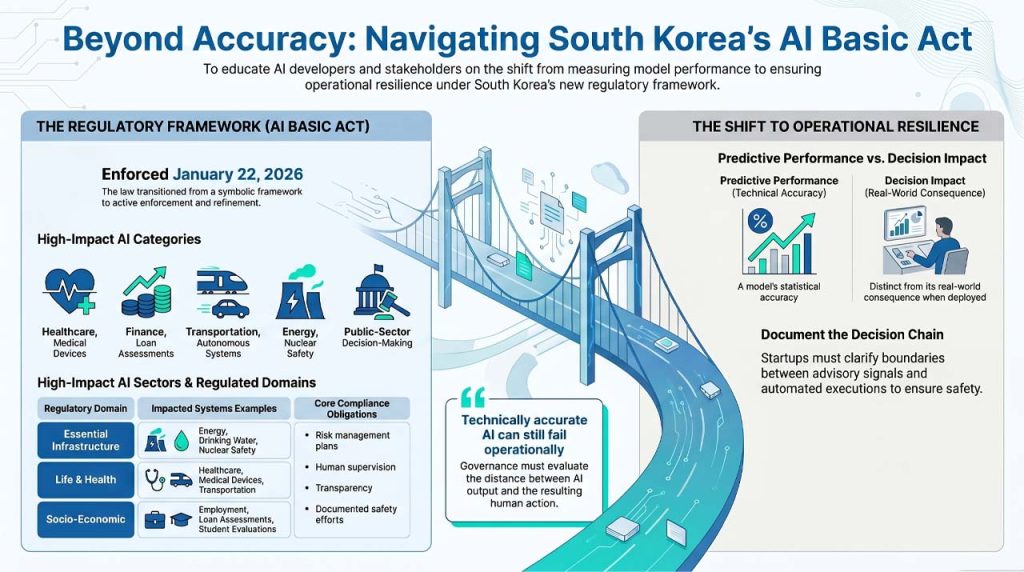
The law also identifies “high-impact AI” categories in areas such as energy, drinking water, healthcare, medical devices, nuclear safety, biometric use in criminal investigations, employment and loan assessments, transportation, public-sector decision-making, and student assessment.
Its obligations include transparency rules for high-impact AI and generative AI, lifecycle safety measures for certain advanced AI systems, risk management plans, human supervision, user protection measures, explainability where technically feasible, and documentation of safety and reliability efforts.
This means that the governance structure itself has been strong enough. It contains the architecture of trust, safety, and accountability.
Now, the open question is how those principles translate when the main risk does not come from a wrong output, but from the way a correct output is used.
The Harder Governance Gap: Predictive Performance Is Not Decision Impact
Andrew (Hyun-gyun) Jeon, CEO of Barca, Inc., raised this issue in a written interview with KoreaTechDesk while discussing AI systems used in real-world decision environments.
“Technically accurate AI can still fail operationally,”
Jeon said.
That sentence captures a governance problem that is easy to miss. AI regulation often evaluates systems through model performance, transparency, safety, bias, and documentation. Those remain necessary. But deployment creates another layer of risk.
Jeon framed the distinction directly.
“Predictive performance and decision impact should be evaluated separately.”
This does not mean Korea’s AI Basic Act ignores deployment risk. Article 32 addresses lifecycle risk identification, assessment, mitigation, and risk management for certain AI systems. Article 34 also requires high-impact AI operators to establish risk management plans, provide explanations where feasible, create user protection measures, ensure human supervision, and keep documentation.
Yet, the issue is more specific. The law already asks whether an AI system is safe, transparent, and properly governed. Jeon’s insight asks how governance should evaluate the distance between an AI output and the operational decision that follows.
After all, a model used as a reference signal carries a different risk profile than the same model linked to automated execution. A forecast reviewed by a human trader is not the same as a forecast that triggers an automatic transaction. A diagnostic recommendation reviewed by a clinician is not the same as a decision embedded directly into workflow action.
This is where AI deployment risk regulation becomes more complex than model evaluation alone.

Why Korea’s Grace Period Matters for Operational AI Risk
The government has already created mechanisms that make this question timely.
The Ministry of Science and ICT launched an AI Basic Act support desk on January 22, 2026. According to Korean government information, the desk aims to respond to general inquiries within 72 hours on business days, while complex or legally sensitive issues may take up to 14 days.
On March 25, 2026, MSIT launched the AI Basic Act Improvement Working Group with around 40 experts recommended by academic institutions, industry associations, civil society organizations, and the Presidential Council on National Artificial Intelligence Strategy. The group is expected to identify improvement areas in the first half of 2026 and prepare a tentative improvement plan in the second half.
On the other side, the Ministry of SMEs and Startups and MSIT also held an AI Startup Growth Strategy Briefing at TIPS Town on January 28, 2026. Around 200 AI startup employees attended sessions on the AI Basic Act, response strategies, and startup support programs, according to MSS.
These details show that South Korea is not treating AI compliance as static paperwork. The system is being refined while startups and operators are still learning how to apply the law.
This shifts execution-layer risk from a theoretical discussion into a concrete governance problem that regulators and operators must now address.
Resilience May Become the Next Compliance Standard
Jeon’s strongest regulatory point is not about accuracy. It is about resilience.
“The key metric should not be accuracy, but resilience,”
he told KoreaTechDesk.
This aligns with the direction of global AI governance debates. OECD work on AI risk and incidents emphasizes lifecycle risk management, accountability, and evidence on where risks materialize. CSET research on AI harms has also warned that model-based approaches alone can miss integration harms and human oversight failures.
Korea’s AI Basic Act already includes risk management, human supervision, and documentation. The next challenge is turning these principles into operational tests that companies can actually apply.
That may require startups to show more than performance benchmarks. They may need to explain how their systems behave when uncertainty rises, how users are warned, how human oversight works, what logs are retained, and what fallback process is triggered when output quality becomes questionable.
Jeon put this issue in practical terms.
“What happens when this model is wrong, and what safeguards exist?”
That question is likely to become more important as AI products move deeper into finance, logistics, healthcare, industrial systems, insurance, public services, and enterprise decision-making.
What This Means for AI Startups Entering Korea
Korea’s AI Basic Act creates both compliance pressure and market signaling value.
Startups working in Korea should not treat the law only as a legal checklist. The deeper competitive question is whether they can prove that their AI systems are safe under real deployment conditions.
That means three practical shifts.
First, startups need to document the decision chain around their models. A system that only provides advisory signals should make that boundary clear.
Second, companies need to define safeguards before deployment, not after a failure. This includes human review, uncertainty indicators, escalation pathways, user notification, and audit trails.
Third, founders need to understand that AI compliance for startups in Korea may increasingly depend on operational discipline, not just technical performance.
This has global relevance because Korea’s approach combines legal codification with ongoing adjustment. For foreign AI companies, Korea may become a market where regulatory readiness, documentation, and deployment governance affect partnership credibility.
Korea’s AI Governance Test Is Moving Beyond Accuracy
South Korea’s AI Basic Act already provides a framework for safety, transparency, high-impact AI responsibilities, and risk management.
The next governance challenge is more operational.
As AI systems become embedded in real-world decisions, the central question becomes less about whether a model can perform well in isolation. It becomes about how its outputs influence action, how failure is contained, and how responsibility is documented when accurate systems still produce costly outcomes.
That is where Korea’s AI governance framework may face one of its most important practical tests.
Key Takeaways on Korea’s AI Basic Act and Operational AI Risk
- Korea’s AI Basic Act took effect on January 22, 2026, creating a national framework for AI safety, transparency, and trust.
- High-impact AI Korea obligations include risk management plans, human supervision, user protection measures, explainability where feasible, and documentation.
- Andrew (Hyun-gyun) Jeon of Barca, Inc. told KoreaTechDesk that “technically accurate AI can still fail operationally.”
- The key governance gap is not model accuracy alone, but the relationship between predictive performance and decision impact.
- AI deployment risk regulation may need to evaluate how AI outputs affect real-world decisions, especially in automated or high-stakes settings.
- Operational AI risk management should include safeguards, uncertainty signals, human oversight, audit trails, and fallback protocols.
- Korea’s grace period and AI Basic Act working group create a window to refine how broad trust principles become practical compliance standards.
- Startups entering Korea should prepare for compliance as an operational credibility issue, not only a legal requirement.
– Stay Ahead in Korea’s Startup Scene –
Get real-time insights, funding updates, and policy shifts shaping Korea’s innovation ecosystem.
➡️ Follow KoreaTechDesk on LinkedIn, X (Twitter), Threads, Bluesky, Telegram, Facebook, and WhatsApp Channel.
🤝 Looking to connect with verified Korean companies building globally?
Explore curated company profiles and request direct introductions through beSUCCESS Connect.