Korea’s next phase of AI governance begins not with a new law, but with a new kind of table. The country has brought regulators, judges, researchers, and tech leaders together in a brand new AI Privacy Council to decide how data ethics will evolve when artificial intelligence acts on its own. What emerges from this collaboration could define how democracies govern agentic systems without losing public trust or technological pace.
Korea’s Joint Framework for AI Privacy and Data Governance
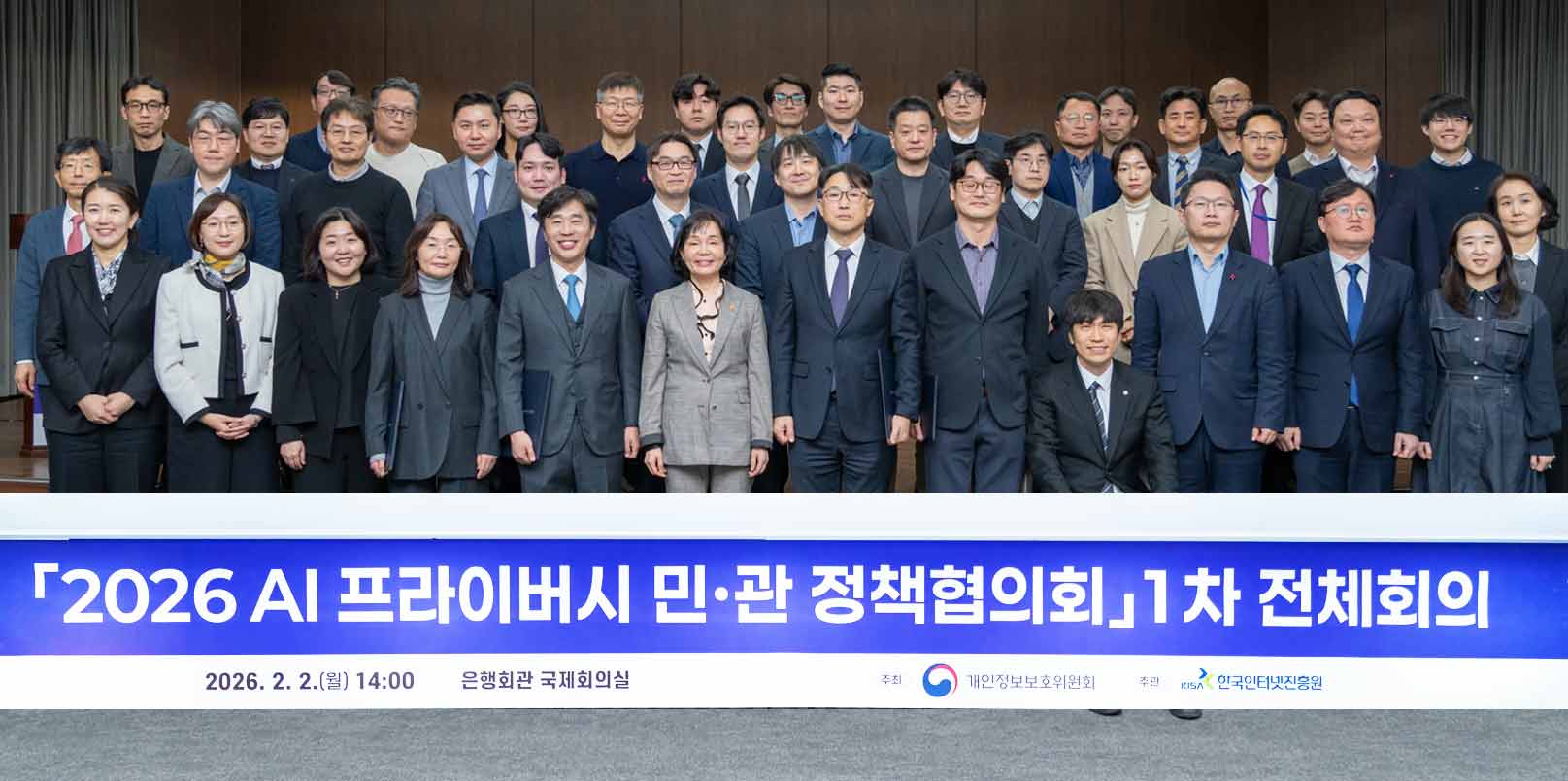
The Personal Information Protection Commission (PIPC) officially convened the 2026 AI Privacy Public-Private Policy Council on February 2 at the Federation of Banks building in Seoul.
The initiative builds on the government’s recognition that privacy frameworks designed in the pre-ChatGPT era are no longer sufficient. The council aims to establish a governance model that reflects how AI agents and physical AI systems now collect, infer, and act on data autonomously—posing ethical and regulatory challenges far beyond traditional consent-based structures.
The council comprises 37 representatives across government, academia, industry, the legal community, and civil society. PIPC Chairperson Song Kyung-hee serves as government co-chair, while Chief Judge Kwon Chang-hwan of the Busan Rehabilitation Court leads the private-sector side.
The body operates through three key divisions:
- Data Processing Standards — defining how AI systems handle and classify information;
- Risk Management — addressing algorithmic and operational vulnerabilities;
- Data Subject Rights — strengthening mechanisms for citizen control and redress.
Results from the council’s discussions will feed directly into national policymaking, coordinated with the National AI Strategy Committee and the AI Safety Research Institute.
Why This Moment Signals a Governance Shift
The council’s establishment reflects a deeper strategic pivot in Korea’s AI governance—from regulatory reaction to proactive co-design. It follows a series of structural reforms over the past year, including the enforcement of the AI Basic Act, which introduced the world’s first comprehensive AI governance law.
Unlike prior efforts focused on compliance, this initiative represents an attempt to rewrite the social contract of data in an age where AI systems operate autonomously and invisibly within consumer environments.
As Chairperson Song stated,
“2026 marks a pivotal moment when AI becomes deeply embedded in everyday life. The council will serve as a platform where public and private actors jointly design safety measures.”
The PIPC’s decision to institutionalize shared governance contrasts sharply with the top-down regulatory styles of many global peers. It also responds to domestic unease among startups and consumers after the country’s recent data breach scandals, where privacy failures exposed weaknesses in enforcement and corporate accountability.
The Friction Between Innovation and Oversight
Even as the council takes shape, its mission is already facing tension between innovation speed and ethical control. Startups building agentic AI systems—technologies that can act autonomously—argue that excessive oversight could slow domestic competitiveness just as global rivals race ahead.
Yet civil society groups warn of the opposite risk: that self-regulation and “sandbox-style” flexibility could normalize opaque data use, leading to silent erosion of privacy.
Korea’s challenge is therefore institutional, not ideological. Its AI governance architecture must move beyond privacy as static protection, toward privacy as dynamic design—a principle embedded into algorithmic behavior itself. The success of the new council will hinge on whether its output becomes enforceable standards rather than well-meaning consultation.
Building Guardrails Without Halting Progress
The council’s tripartite structure—spanning standards, risk, and rights—could become Korea’s testbed for AI-era privacy assurance frameworks. If executed effectively, it may allow data-driven companies to innovate under clear ethical boundaries while giving regulators real-time oversight capacity.
However, the system still lacks defined accountability mechanisms. The AI Basic Act mandates transparency and watermarking, but how these principles extend to autonomous or embedded systems remains uncertain. Without legislative synchronization, Korea risks creating overlapping regimes that confuse rather than clarify obligations.
For startups, the near-term advantage lies in predictable guidance. The PIPC’s plan to integrate council findings into AI safety policy could reduce compliance ambiguity—potentially turning privacy innovation into a new competitive edge.
Global Relevance: A Live Experiment in Democratic AI Governance
For international observers, Korea’s council represents a unique governance experiment: an open democracy attempting to regulate AI’s ethical foundations without halting industrial progress.
While the EU AI Act takes a rules-based approach and China relies on state control, Korea’s model blends legal authority with collaborative policymaking. If successful, it could become a blueprint for cooperative AI ethics governance—especially for nations balancing technological ambition with democratic accountability.
The council’s work also intersects with global discussions around data portability, AI safety auditing, and human oversight, all areas where cross-border interoperability will define trade and trust.
Revolutionizing AI Governance as Fast as the AI Itself
Korea’s decision to institutionalize dialogue between regulators and technologists is not a bureaucratic gesture—it is a recognition that AI governance must evolve as fast as AI itself. The coming year will test whether collaboration can keep pace with automation. What begins as a policy table may soon become the very frontier of democratic digital ethics.
Key Takeaways on Korea’s AI Privacy Council 2026
- Korea launched the 2026 AI Privacy Public-Private Policy Council to co-design ethical and regulatory frameworks for AI-era data governance.
- The council brings together 37 members across government, industry, academia, law, and civil society, chaired by PIPC Chairperson Song Kyung-hee and Chief Judge Kwon Chang-hwan.
- Three divisions—data processing, risk management, and data subject rights— will shape standards for privacy in autonomous AI systems.
- The initiative aligns with the AI Basic Act’s enforcement and Korea’s shift from reactive to proactive governance.
- Korea’s hybrid model could influence global standards for democratic, innovation-friendly AI ethics frameworks.
– Stay Ahead in Korea’s Startup Scene –
Get real-time insights, funding updates, and policy shifts shaping Korea’s innovation ecosystem.
➡️ Follow KoreaTechDesk on LinkedIn, X (Twitter), Threads, Bluesky, Telegram, Facebook, and WhatsApp Channel.
🤝 Looking to connect with verified Korean companies building globally?
Explore curated company profiles and request direct introductions through beSUCCESS Connect.