

A dispute over leadership rules at the Korea Federation of SMEs (KBIZ) is evolving into a broader debate about how South Korea’s small business representation system should function. What began as a legislative proposal to remove reappointment limits for KBIZ executives has now triggered calls to reconsider how the federation’s chairman is elected. The discussion is revealing deeper tensions about transparency, representation, and governance inside one of the country’s most influential SME institutions.
The KBIZ Leadership Controversy Is Entering a New Stage
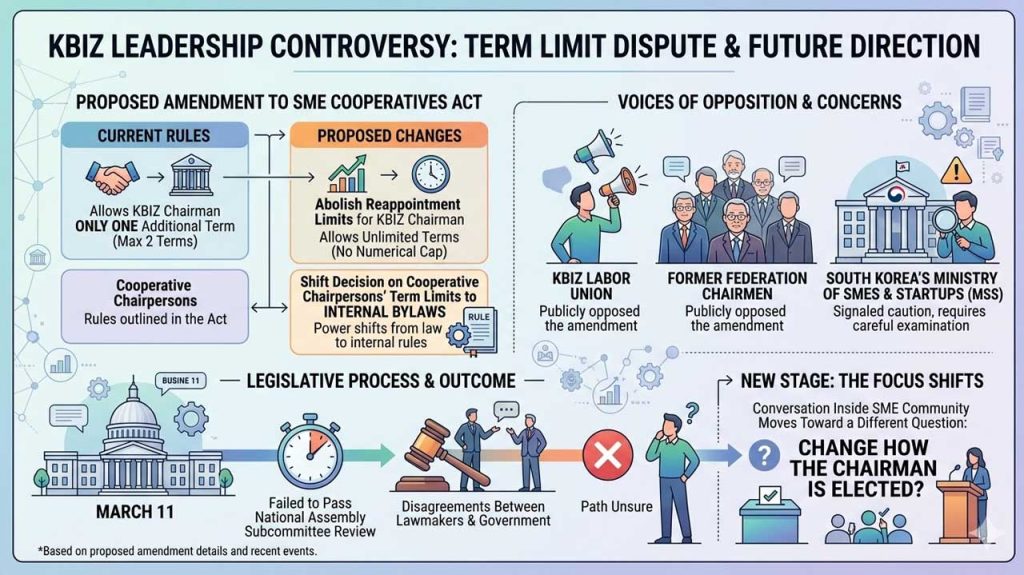
Debate over leadership rules at the Korea Federation of SMEs has intensified after a proposed amendment to the Small and Medium Enterprise Cooperatives Act sought to abolish limits on executive reappointments.
The proposal would remove the current rule allowing the KBIZ chairman to serve only one additional term and instead allow reappointment without a numerical cap. It would also change rules governing cooperative chairpersons by shifting decisions about term limits to internal bylaws.
Opposition quickly emerged from several directions.
The KBIZ labor union and former federation chairmen publicly opposed the amendment. South Korea’s Ministry of SMEs and Startups (MSS) also signaled caution during the legislative review process, stating that the issue required careful examination.
The bill ultimately failed to pass a National Assembly subcommittee review on March 11 after disagreements between lawmakers and the government.
With the legislative path uncertain, the conversation inside the SME community is now moving toward a different question: whether the federation should change how its chairman is elected.
How the Korea Federation of SMEs Chooses Its Chairman
The Korea Federation of SMEs has used an indirect election system since the Small and Medium Enterprise Cooperatives Act was enacted in 1961.
Under the current structure, approximately 500 chairpersons of industry-specific SME cooperatives act as electors. These cooperative leaders vote to select the KBIZ chairman.
The system reflects the organization’s structure as a federation of industry cooperatives rather than a membership body composed of individual firms.
Yet critics say this electoral structure concentrates influence among a limited group of cooperative leaders.
A KBIZ labor union official said the current system has created a perception that election outcomes can be heavily influenced by a few large industry groups. The official referenced the idea that securing support from the so-called “three-con industries” — ready-mix concrete, asphalt concrete, and cement — can significantly shape election results.
Union representatives argue that the system therefore reflects the interests of entrenched groups rather than the broader SME community.
Why the Direct Election Debate Is Emerging
Calls for a direct election system are gaining attention inside the SME sector as the term-limit dispute continues.
Supporters of the idea argue that allowing broader participation in leadership elections could improve transparency and democratic legitimacy within the organization.
Union representatives say discussions should begin on whether a model similar to other cooperative systems could be adopted.
For example, debates have also emerged around election reform at NongHyup, South Korea’s national agricultural cooperative federation. Policymakers have recently explored changes there after concerns about vote-buying and election integrity.
Within KBIZ, these developments have encouraged discussion about whether a more participatory election system could strengthen institutional credibility.
However, implementing such a model would involve significant structural challenges.
Questions remain about how a direct vote would work in an organization built around industry-based cooperatives with varying membership sizes.
Participants in the debate have raised issues such as how to balance representation among sectors and how to incorporate the voices of SMEs beyond cooperative leadership.
The Political Sensitivity Around Chairman Kim Ki-moon
The governance debate has attracted national attention partly because of its potential impact on KBIZ Chairman Kim Ki-moon.
Kim previously served as the federation’s 23rd and 24th chairman between 2007 and 2015. He returned to office in 2019 and currently serves as the 26th and 27th chairman.
His current term runs until February 2027.
Critics of the legislative amendment argued that abolishing reappointment limits could allow Kim to seek another term. Some industry voices described the proposal as effectively creating the possibility of a “lifetime chairmanship.”
Kim has publicly rejected that interpretation.
He stated in media interviews that he plans to complete his responsibilities and step down when his current term ends. He also said he has no intention of seeking another term even if the law changes.
Why Governance at KBIZ Matters for Korea’s Startup and SME Policy System
Although the current dispute centers on leadership rules, the issue extends beyond internal governance.
The Korea Federation of SMEs represents about 8.3 million small and medium-sized enterprises and plays a significant role in policy discussions related to SME development.
The organization is widely regarded as one of South Korea’s five major economic organizations, alongside the Korea Chamber of Commerce and Industry, the Korea International Trade Association, the Korea Enterprises Federation, and the Federation of Korean Industries.
Unlike many industry associations, KBIZ is also designated by the government as a public-service-related organization. This classification means the federation participates in policy processes and carries certain public responsibilities.
Government officials have pointed to this status as a reason why leadership rules require careful oversight.
According to legislative review opinions cited during the parliamentary process, the introduction of term limits in earlier reforms aimed to prevent governance problems associated with prolonged leadership tenure.
Officials also noted that other cooperative laws in Korea, such as the Agricultural Cooperatives Act, have recently strengthened restrictions on leadership reappointments.
Institutional Credibility and Representation in Korea’s SME Ecosystem
The KBIZ debate illustrates a structural issue that appears in many innovation ecosystems.
Organizations that represent large segments of the business community must balance two competing priorities. Leadership continuity can help maintain institutional experience and policy relationships. At the same time, governance safeguards such as term limits and transparent elections are designed to prevent the concentration of authority.
In South Korea’s case, KBIZ serves as a key intermediary between the SME sector and the government.
The federation regularly participates in policy discussions involving industrial support programs, regulatory reforms, and initiatives aimed at strengthening the country’s small business and startup environment.
Because of this role, governance debates inside the organization can influence how effectively SME interests are represented in national economic policy discussions.
What Global Startup Observers Should Watch
For international founders and investors following South Korea’s startup ecosystem, the KBIZ controversy offers insight into how institutional governance can shape the broader policy environment.
Industry associations and SME federations often play an important role in bridging government policy and business interests.
When leadership rules inside such organizations become contested, questions about institutional credibility and representation tend to follow.
In South Korea, the immediate legislative outcome remains uncertain. The amendment to the Small and Medium Enterprise Cooperatives Act is still under review, and discussions about potential election reforms are at an early stage.
Yet the debate itself reflects a deeper issue.
As Korea’s innovation ecosystem becomes more globally connected, the governance standards of institutions that represent SMEs are increasingly visible to international stakeholders.
KBIZ Dispute is Shaping Korea’s SME and Startup Institutions’ Credibility
The KBIZ dispute began with a proposed change to leadership term limits.
It is now evolving into a broader discussion about how one of South Korea’s most influential SME organizations should select its leadership and represent its members.
How that question is ultimately resolved may shape not only the federation’s governance structure but also the credibility of institutions that help shape the country’s SME and startup policy system.
Key Takeaways on the KBIZ Chairman Election Dispute
- A proposed amendment to the Small and Medium Enterprise Cooperatives Act sought to abolish limits on leadership reappointments at the Korea Federation of SMEs.
- Opposition from the KBIZ labor union, former chairmen, and cautious signals from the Ministry of SMEs and Startups led to the bill being held in a National Assembly subcommittee review.
- As the legislative process stalls, debate inside the SME community is shifting toward whether the KBIZ chairman should be elected through a direct election system.
- The federation currently uses an indirect election model in which about 500 cooperative leaders vote to select the chairman.
- The controversy highlights broader governance questions within institutions that influence South Korea’s SME and startup policy environment.
– Stay Ahead in Korea’s Startup Scene –
Get real-time insights, funding updates, and policy shifts shaping Korea’s innovation ecosystem.
➡️ Follow KoreaTechDesk on LinkedIn, X (Twitter), Threads, Bluesky, Telegram, Facebook, and WhatsApp Channel.
🤝 Looking to connect with verified Korean companies building globally?
Explore curated company profiles and request direct introductions through beSUCCESS Connect.