

Japanese enterprise partnerships can look like a breakthrough moment for startups entering the market. A pilot with a major corporation signals trust, validation, and potential revenue. Yet inside many early-stage startup operations, those same opportunities can quietly reshape the product itself. What begins as localization can eventually turn into roadmap distortion, growing maintenance pressure, and long-term scalability risk.
Japan’s Enterprise Pathway Is Becoming More Important for Korean Startups
South Korea is increasing institutional support for startups entering Japan, particularly through enterprise-linked programs.
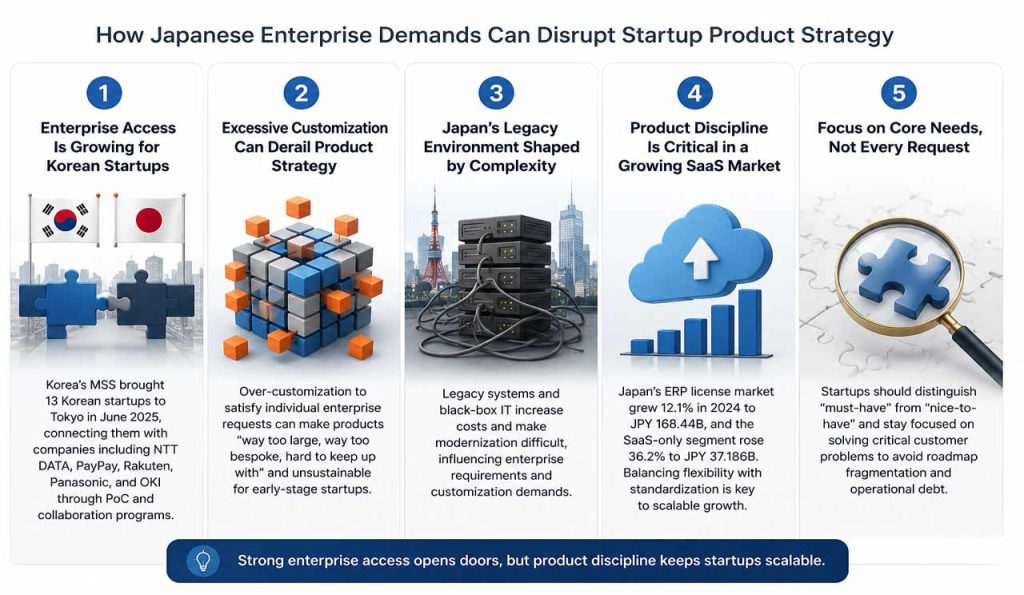
In June 2025, Korea’s Ministry of SMEs and Startups (MSS) brought 13 Korean “super-gap” startups to Tokyo through a market expansion program focused on artificial intelligence, robotics, future mobility, system semiconductors, and eco-friendly energy sectors.
The program included a “Strategic Fit PoC Day” connecting startups with companies including NTT DATA, PayPay, Rakuten, Panasonic, and OKI for one-on-one discussions on collaboration models and proof-of-concept opportunities.
The structure of the program reflects a broader shift in Korea’s outbound startup strategy. Japan entry is increasingly tied to enterprise collaboration, pilot projects, and strategic matching rather than standalone market testing.
That creates opportunity. But then, it also creates a different operational pressure.

The Hidden Risk Behind Enterprise Validation
Now, securing a large enterprise customer often feels like confirmation that the product is working, especially for early-stage startups.
Joshua Barry, founder of ZAIKO and startup advisor at Polyrhythm Consulting in Tokyo, has worked with startups navigating cross-border expansion and enterprise growth across Japan and Asia. And from his perspective, the danger often begins immediately after that initial enterprise validation.
“You build out your product to fit that customer,”
Barry told KoreaTechDesk during an interview discussing Korea-to-Japan startup expansion.
Yes, the process may appear reasonable at first.
Enterprise clients would request adjustments, workflow integrations, or additional functionality to match internal operations. And startups who are eager to secure long-term contracts frequently agree.
But then, over time, the product roadmap can begin shifting away from the startup’s original strategy.
“All of a sudden you have this product that is way too large, way too bespoke, hard to keep up with the amount of money that you have and all of these feature sets,”
Barry said.
And the problem is not the customization itself. Enterprise software markets everywhere require some level of adaptation. The real issue instead is the uncontrolled customization inside resource-constrained startups.

Japan’s Enterprise Environment Still Carries Legacy Complexity
Japan’s digital transformation push has accelerated in recent years, but legacy systems remain deeply embedded across many organizations.
Japan’s Ministry of Economy, Trade and Industry (METI) stated in its 2025 report on legacy systems that older systems continue to obstruct digital transformation and the adoption of advanced technologies. The report also noted that modernization efforts increasingly require companies to visualize existing systems, strengthen governance, and revisit operations with standardization in mind.
The Information-technology Promotion Agency (IPA) also warned that black-box legacy systems increase operating costs and reduce competitiveness by making modernization more difficult.
These conditions influence how enterprise buyers approach external software vendors.
That is why in practice, startups entering Japan may encounter customers operating with highly specific workflows, internal approval structures, or technical constraints built over decades. Requests for customization may reflect those realities rather than simple feature preferences.
Hence, for startups, the challenge becomes deciding how much complexity should be absorbed into the product itself.
SaaS Growth Is Expanding, but Product Discipline Matters More
Meanwhile, Japan’s enterprise software market continues to grow rapidly, especially in cloud and SaaS adoption.
Yano Research Institute estimated that Japan’s ERP package license market reached JPY 168.44 billion in 2024, up 12.1% year-on-year. The SaaS-only segment grew even faster, rising 36.2% to JPY 37.186 billion.
At the same time, Yano noted that some SaaS products are becoming more flexible, including support for individual customization and varied update timing.
That flexibility creates both commercial opportunity and operational danger.
A startup trying to satisfy every enterprise request may gradually lose product focus, especially if several customers demand different workflows or features simultaneously.
Barry believes this is where founders need stronger product discipline.
“You have to push back on customers.
If we build this, we’re building this for all of our clients, not just you.”
The statement reflects a broader strategic tension now emerging across enterprise SaaS markets globally. Customer acquisition pressure pushes startups toward customization. Long-term scalability pushes them toward standardization.
Japan’s enterprise environment can intensify that tension because relationship-driven pilots often evolve slowly and involve close operational collaboration with customers.
The Difference Between Localization and Roadmap Distortion
Moreover, once Korean startups enter the Japanese market, they are bound for the needs of localization. Language adaptation, workflow compatibility, regulatory considerations, and customer support structures may all require adjustment.
And so, the risk appears when localization gradually becomes customer-specific product fragmentation.
Barry argues that startups need to distinguish between critical operational needs and optional requests before committing engineering resources.
“Is this a must-have or is this a nice-to-have?
Let’s work together to make sure we’re solving your oxygen-level needs first.”
That distinction matters because enterprise requests rarely arrive all at once. They accumulate incrementally across pilots, integrations, and renewal discussions.
Hence, without clear prioritization, startups can end up maintaining multiple semi-customized product layers that become increasingly difficult to support.
The challenge becomes even harder inside Japan’s talent environment.
JETRO’s latest survey of foreign-affiliated companies found that sales and marketing positions were the hardest roles to fill, cited by 57.3% of companies struggling with recruitment. IT and technical positions followed at 39.1%.
This means that startups entering Japanese market have already faxed engineering and hiring constraints. So, for them to face these constraints together with excessive customization? It will most likely turn into expensive operational debt.
Enterprise Access Is Valuable, but Product Strategy Still Decides Survival
Still, none of this reduces the importance of enterprise partnerships in Japan. In fact, Japan’s enterprise-centered market structure may make those partnerships even more important for startups seeking traction.
The issue is not whether startups should work with large companies. The issue is how they maintain strategic control while doing so.
Barry believes the strongest startups are the ones that stay tightly focused on solving a narrow but urgent problem instead of trying to become everything for every enterprise client.
“The product itself isn’t as important as finding something that absolutely needs to be done,”
he said.
“If you have a very specific vertical knowledge and you can take care of that and provide a simple solution that eases people’s work lives, then I think you have a very good chance to get something done.”
That approach can reduce roadmap fragmentation while increasing clarity around product identity.
Why Product Discipline May Become the Real Competitive Advantage
Japan’s enterprise market is evolving alongside broader digital transformation efforts, cloud adoption, and growing corporate interest in startup collaboration.
At the same time, the structural realities inside large organizations have not disappeared. Legacy systems, internal operational complexity, and long decision cycles still shape how enterprise relationships develop.
So for Korean startups entering Japan, the next competitive challenge may not be access alone. It is knowing how far to adapt the product without turning customer requests into long-term operational burden.
Key Takeaway
- Korean startups entering Japan increasingly rely on enterprise pilots and PoC programs for market access
- MSS’s 2025 Tokyo expansion program connected Korean startups with companies including NTT DATA, PayPay, Rakuten, Panasonic, and OKI
- Japanese enterprise requests can create product roadmap distortion if startups over-customize for individual clients
- Joshua Barry warned that excessive customization can create products that become “way too bespoke” for startups to maintain sustainably
- Japan’s legacy systems and operational complexity continue influencing enterprise software requirements, according to METI and IPA reports
- Japan’s ERP and SaaS markets continue growing, with the SaaS ERP segment rising 36.2% in 2024, according to Yano Research Institute
- Startups entering Japan may need to distinguish carefully between necessary localization and customer-specific fragmentation
- Strong enterprise access does not automatically create scalable growth if startups lose control of product direction
- Product discipline may become a key competitive advantage for Korean startups scaling inside Japan’s enterprise-driven market structure
– Stay Ahead in Korea’s Startup Scene –
Get real-time insights, funding updates, and policy shifts shaping Korea’s innovation ecosystem.
➡️ Follow KoreaTechDesk on LinkedIn, X (Twitter), Threads, Bluesky, Telegram, Facebook, and WhatsApp Channel.
🤝 Looking to connect with verified Korean companies building globally?
Explore curated company profiles and request direct introductions through beSUCCESS Connect.