

South Korea’s export system was built for containers, customs declarations, and physical shipments. That architecture helped the country become a manufacturing powerhouse. But it left a gap for startups selling software globally without crossing a physical border. A new legislative proposal now attempts to close that gap by formally recognizing digital services such as apps and SaaS as export activities — a shift that could reshape how Korean startups access overseas expansion support.
Korea Proposes SME Export Promotion Law Recognizing Digital Services as Exports
South Korea’s National Assembly is reviewing a legislative proposal aimed at strengthening support for small and medium-sized enterprises expanding overseas. The bill, titled the Act on the Promotion of SME Exports and Overseas Expansion, was discussed during a legislative roundtable hosted by Democratic Party lawmaker Kim Dong-a at the National Assembly on March 13.
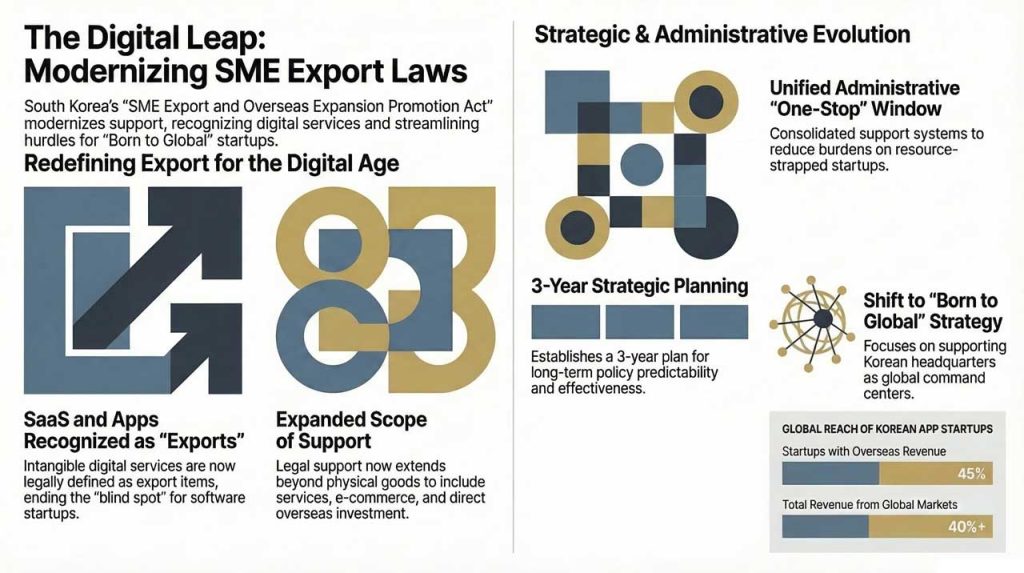
The proposed law would consolidate export support frameworks that are currently spread across multiple government ministries and broaden the policy definition of exports beyond physical goods.
Under the proposal, government support would extend to a wider range of cross-border economic activity, including:
- Services
- electronic commerce
- overseas direct investment
- “intangible goods in electronic form”
This final category is particularly significant for startups operating digital businesses.
During the roundtable, Choi Ji-young, Representative of the Korea Startup Forum, explained that the traditional export support system has largely relied on logistics and customs performance indicators, which makes it difficult for software companies to prove export activity, saying:
“Under the existing export support system, which focuses on logistics and customs clearance performance, startups providing digital services have consistently been placed in a blind spot.
The explicit recognition of intangible goods in electronic form as export items is a very encouraging change for the industry.”
The bill would also require the Minister of SMEs and Startups to establish a national export and overseas expansion promotion plan every three years and publish integrated annual support programs from relevant agencies.

Why Korea’s Export Policy Is Now Confronting the Software Economy
The legislative push reflects a structural change already underway inside Korea’s startup ecosystem.
According to data cited by the Korea Startup Forum, roughly 45 percent of startups operating apps on the Google Play Store generate revenue from overseas markets, and more than 40 percent of their total revenue comes from outside Korea.
Those figures illustrate how digital startups increasingly earn global revenue without traditional export infrastructure.
Software products travel instantly across borders through app stores, cloud services, and online platforms. Yet policy frameworks designed around physical trade have struggled to categorize those transactions.
The result is a mismatch between economic reality and policy recognition.
Startups generating international sales through software platforms may still find themselves outside export promotion programs designed decades earlier for goods-based trade.
The proposed law represents an attempt to align government support systems with that new commercial structure.
Fragmented Export Support Programs Remain a Practical Barrier for Startups
Even with strong policy intentions, entrepreneurs at the legislative roundtable described a support system that is difficult to navigate in practice.
Kwak Hyoseop, CEO of technology-based beauty startup MAKEMAKE, shared a concrete example.
Last year his company applied to 18 government support programs and was selected for 12 of them. Among those programs, eight export-related initiatives were managed by five different institutions.
The problem is that each agency used different application procedures, evaluation standards, and documentation requirements. And so for early-stage companies with limited administrative capacity, that fragmentation can consume significant internal resources.
CEO Kwak said during the discussion,
“Startups have limited resources, but each institution uses different selection methods and formats.
If a unified gateway is created and a predictable support system is established, the administrative burden will be greatly reduced.”
The proposed legislation attempts to address this issue by centralizing export promotion frameworks and publishing integrated support plans.
Still, consolidation at the legal level does not automatically eliminate institutional fragmentation. Implementation will determine whether startups experience real simplification or only a new layer of policy coordination.
What the Law Could Enable — and Where Its Limits Still Remain
If enacted and implemented effectively, the legislation could produce several structural changes for Korea’s startup ecosystem.
First, the formal recognition of digital services as exports could allow software companies to access programs previously reserved for manufacturers. That includes export promotion initiatives, financial support tools, and government-backed international expansion programs.
Second, a centralized export framework could improve policy visibility for startups seeking overseas growth. For founders operating with small teams, predictable access to support programs often matters as much as the funding itself.
The law also reflects a broader strategic shift in how Korean policymakers think about global expansion.
Rep. Kim Dong-a argued that Korea should move beyond earlier economic policies centered on reshoring production back to the domestic market. Instead, he suggested a model in which Korean companies keep research and management functions domestically while expanding operations internationally when needed.
However, policy recognition alone cannot guarantee global competitiveness.
Export classification may unlock access to support programs, but startups still face market entry barriers, localization challenges, and international competition. The legislation addresses a policy blind spot, not the full complexity of scaling globally.
Why Global Startup Ecosystem Players Are Watching Korea’s Policy Shift
For international founders, investors, and cross-border partners, the debate around Korea’s export law signals a broader policy transition.
Many countries built their export promotion systems during an industrial era dominated by physical goods. As software startups increasingly generate global revenue without shipping products, governments are being forced to rethink how export policy works.
Korea’s approach reflects the pressures faced by innovation-driven economies with relatively small domestic markets.
That is because startups in such limited markets often need to scale internationally from an early stage. Policymakers therefore face a practical question: how to support companies whose exports do not move through ports or customs.
By explicitly including digital services within export definitions, Korea is acknowledging that global software distribution has become a core part of its economic activity.
International investors evaluating Korean startups may see the policy shift as a signal that the government intends to align institutional support with the realities of digital globalization.
A Policy System Built for Factories Meets the Reality of Software
South Korea’s export model helped build one of the world’s most powerful manufacturing economies. It was designed around shipping containers, industrial supply chains, and customs documentation.
Software startups operate in a different environment.
Revenue may come through cloud subscriptions, app stores, or digital platforms where national borders matter less than distribution networks.
Recognizing that difference inside export policy is not simply administrative reform. It reflects a deeper question about how governments measure economic activity in a digital era.
The proposed law does not resolve that question entirely. But it acknowledges that Korea’s startup economy has already moved beyond the boundaries of the system designed to support it.
Key Takeaways on Korea’s Newly Proposed SME Export Promotion Law
- South Korea is reviewing a proposed SME Export Promotion Law that would formally recognize digital services, including SaaS and apps, as export activities.
- The bill would expand export support beyond goods to include services, e-commerce, overseas direct investment, and intangible digital products.
- Industry representatives say the current export system, built around logistics and customs data, has left many digital startups outside policy support programs.
- Startup operators report that export-related government programs are fragmented across multiple agencies, creating administrative burdens.
- The legislation aims to consolidate support frameworks and introduce integrated national export promotion planning.
- The policy shift reflects a broader challenge facing many economies: adapting export systems built for manufacturing to the realities of global software businesses.
– Stay Ahead in Korea’s Startup Scene –
Get real-time insights, funding updates, and policy shifts shaping Korea’s innovation ecosystem.
➡️ Follow KoreaTechDesk on LinkedIn, X (Twitter), Threads, Bluesky, Telegram, Facebook, and WhatsApp Channel.
🤝 Looking to connect with verified Korean companies building globally?
Explore curated company profiles and request direct introductions through beSUCCESS Connect.