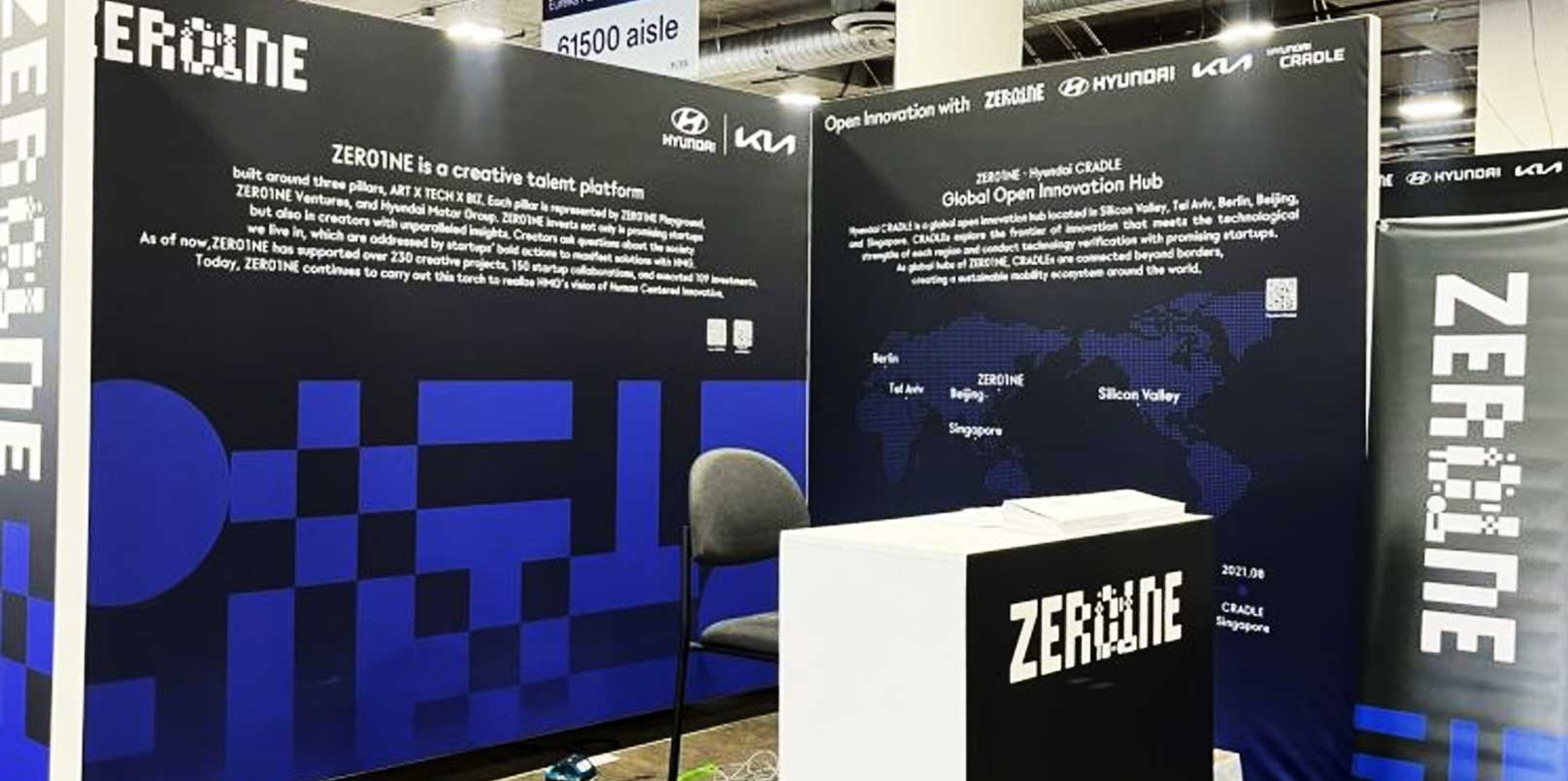
At CES 2026 in Las Vegas, Hyundai Motor Group’s ZER01NE (제로원) is redefining what corporate open innovation means in a deep-tech era. Beyond displaying new gadgets, ZER01NE has turned the global tech stage into a testing ground for Korea’s startup ecosystem—where ideas born inside and outside the company converge to shape the next generation of mobility, energy, and artificial intelligence.
Hyundai’s ZER01NE Showcases Ten Startups Across Quantum, AI, and Energy
Hyundai Motor Group’s open innovation platform ZER01NE (제로원) presented ten startups whose technologies reflect Korea’s evolving deep-tech landscape at CES 2026, held from January 6 to 9 (local time). This marks the platform’s fourth consecutive appearance at CES since 2023.
The participating startups include one in-house startup, four external startups accelerated through the ZER01NE Accelerator, and five global startups working in collaboration with Hyundai CRADLE, the group’s international innovation hub with offices in the United States, Germany, Israel, China, and Singapore.
According to Hyundai, half of the exhibiting companies were developed through global collaboration with CRADLE, highlighting ZER01NE’s growing role as a bridge between Korea’s innovation ecosystem and the global venture network.
The ten participating startups are:
- 솔라스틱 (Solarstic) – Plastic packaging-based solar module solutions.
- 큐노바 (Qunova) – Quantum computing application software.
- 아이디어오션 (IdeAOcean) – AI-driven design software and modular hardware based on mechanism self-design.
- 젠젠에이아이 (GenGen AI) – Domain-specialized generative AI for producing visual learning data.
- 딥인사이트 (Dinsight) – AI-powered 3D camera solutions.
- 일렉트릭피쉬 (Electric Fish) – Integrated solution combining distributed energy storage with ultra-fast EV charging.
- 에이아이올라 (aiOla) – AI voice workflow technology for industrial automation.
- 쓰리디씨 (3DC) – Graphene-based next-generation battery material design.
- 카포우 (CaPow) – Real-time energy supply systems for robotics and industrial automation.
- 데이터크루 (Data Crew) – EV battery analytics and intelligence solutions.

ZER01NE’s Open Innovation Model: Linking Corporate R&D with Startup Agility
Since its launch in 2018, ZER01NE has operated as Hyundai Motor Group’s experimental engine for fusing corporate R&D infrastructure with startup-level agility. Through the ZER01NE Company Builder, Hyundai invests in internal entrepreneurs who bring ideas beyond the automotive domain. To date, 40 in-house startups have been successfully spun off into independent ventures.
In parallel, the ZER01NE Accelerator identifies and supports promising external startups in sectors including AI, robotics, materials science, and renewable energy. The program has invested in 109 startups and completed 150 collaboration projects, turning early-stage technologies into validated, business-ready solutions.
At CES 2026, this combined model—where Hyundai’s internal creativity meets external innovation—was presented as a new form of corporate venture synthesis, signaling how conglomerate-backed platforms can evolve into self-sustaining innovation ecosystems.
Expanding the Horizon of Korea’s Open Innovation
A ZER01NE representative stated that the group’s participation is part of a broader strategy to deepen its innovation network:
“ZER01NE continues to strengthen Hyundai Motor Group’s open innovation capacity through collaboration with creative partners worldwide. We will actively promote the excellence of these startups to accelerate the growth of the global startup ecosystem.”
Industry analysts note that Hyundai’s sustained investment in open innovation programs like ZER01NE and CRADLE mirrors a broader shift in Korea’s industrial approach—from linear, in-house R&D to distributed, network-based collaboration with startups, research institutes, and creative engineers.
Why CES 2026 Matters: Korea’s Deep-Tech Confidence on Display
The focus of ZER01NE’s presence at CES extends beyond mobility. It represents Korea’s confidence in exporting its deep-tech ecosystem model, integrating AI, quantum computing, and renewable energy innovations into global supply chains.
Each participating startup demonstrates how Korea’s next-generation entrepreneurs are building technologies that serve both industrial modernization and environmental sustainability.
- AI and robotics startups like aiOla and CaPow reflect Korea’s ambition to integrate intelligence into industrial infrastructure.
- Energy-focused companies like Solarstic and Electric Fish underline Korea’s pivot toward carbon-neutral growth.
- Quantum and material startups such as Qunova and 3DC showcase Korea’s early move into technologies defining the next decade of manufacturing and computation.
For global investors and policymakers, the participation of these startups signals a maturing innovation ecosystem where conglomerates, startups, and government-backed initiatives work in sync to export not just products, but innovation capacity itself.
From CES Showcase to Policy Blueprint
By turning CES into a recurring platform for deep-tech experimentation, Hyundai’s ZER01NE has positioned itself as a strategic interface between Korea’s industrial leadership and global innovation capital.
As ZER01NE’s initiatives expand across continents through CRADLE and other collaborative channels, its trajectory could serve as a blueprint for Korea’s corporate-startup co-innovation model. What began as a mobility-focused experiment is now evolving into a policy-relevant testbed for deep-tech governance and global collaboration.
From this CES 2026 move, Korea is sending a message to global venture ecosystem that its innovation power no longer rests only on manufacturing scale, but on its ability to translate creativity into systemic, cross-border collaboration.

🤝 Looking to connect with verified Korean companies building globally?
Explore curated company profiles and request direct introductions through beSUCCESS Connect.
– Stay Ahead in Korea’s Startup Scene –
Get real-time insights, funding updates, and policy shifts shaping Korea’s innovation ecosystem.
➡️ Follow KoreaTechDesk on LinkedIn, X (Twitter), Threads, Bluesky, Telegram, Facebook, and WhatsApp Channel.