
A user downloads an app, creates an account, and explores the service. The product works, the interface feels polished, and the pricing is competitive. Yet the transaction never happens. In South Korea, that hesitation is often not a product problem. Because for most new startups, it is more of a trust problem. Increasingly, Korean consumers are making decisions through a digital trust layer built on familiar platforms, payment systems, and validation channels long before they decide to buy.
Korea’s Digital Economy Runs on More Than Transactions
South Korea remains one of the world’s most active digital commerce markets. According to Statistics Korea, online shopping transactions reached KRW 24.1 trillion in April 2026, while mobile shopping accounted for KRW 18.4 trillion, representing more than three-quarters of total online transaction value.
The scale of activity is important because it shows how deeply digital commerce is embedded in everyday life in Korea, but transaction volumes alone do not explain why consumers ultimately choose one service over another. Purchase behavior increasingly depends on a broader ecosystem of search, reviews, payments, recommendations, and platform familiarity that surrounds the transaction itself.
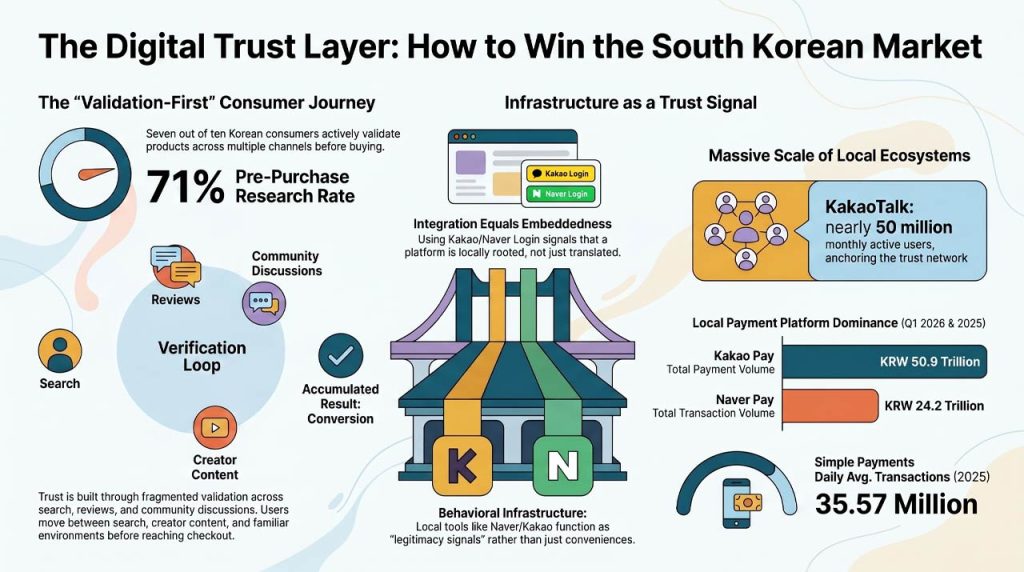
A 2024 Korea Consumer Agency survey found that 71% of consumers actively search for product information before making a purchase decision. Consumers frequently compare prices, evaluate quality, read reviews, and seek additional information across multiple channels before committing to a transaction.
And today, this verification behavior has become a defining characteristic of Korea’s digital economy.

Validation Often Happens Before Conversion
For many global startups, conversion is treated as the final stage of a user journey. But in South Korea, the decision process often begins long before checkout.
Consumers frequently move between search results, review platforms, community discussions, creator content, and payment environments before deciding whether a service deserves their trust. The result is a decision process that can appear fragmented when viewed through traditional analytics dashboards.
Jin Kang, who has advised companies on entering the Korean and Japanese markets and previously led business development at Back Market Korea, has worked closely on localization and growth strategies that exposed how trust is established within Korea’s digital ecosystem.
“In Korea, conversion is not a moment. It is the result of accumulated validation across environments,”
Kang explained during a discussion on global marketplace entry challenges in South Korea.
This means that validation often happens outside the platform seeking the transaction. A startup may invest heavily in product quality and user experience while overlooking the external trust signals consumers rely on before making a decision.

Why Familiar Infrastructure Becomes a Trust Signal
The role of local digital infrastructure becomes particularly visible when users encounter payment systems and login methods they already recognize.
Kang observed that familiar Korean services often influence confidence in ways that go beyond convenience.
“Kakao Login, Naver Login, and Naver Pay were not only convenience tools. They functioned as trust signals,”
she explained.
The logic is simple. Familiar infrastructure reduces uncertainty. When consumers recognize a payment method, login service, or platform environment they already use daily, the service feels less isolated and more connected to the broader ecosystem they trust.
This dynamic is becoming increasingly important as Korean payment platforms continue expanding their influence.
Naver reported that Naver Pay transaction volume reached KRW 24.2 trillion during the first quarter of 2026, up 23.4% year-on-year. The company continues extending its financial ecosystem across shopping, memberships, payments, and external merchant services.
Kakao’s ecosystem shows similar scale. KakaoTalk maintained approximately 49.5 million domestic monthly active users in late 2025, while Kakao Pay reported total payment volume of KRW 50.9 trillion during the first quarter of 2026.
For users, these services are no longer separate utilities. They are familiar digital environments that help reduce uncertainty during decision-making.
Payment Infrastructure Is Becoming Behavioral Infrastructure
The growing influence of local payment systems reflects a broader shift in Korean digital behavior.
According to the Bank of Korea, simple payment services averaged 35.57 million transactions per day in 2025, generating daily transaction value exceeding KRW 1.1 trillion.
Those figures suggest that payment systems are becoming deeply embedded into everyday consumer behavior. As usage becomes routine, expectations around trust, reliability, and familiarity also become stronger.
Kang believes successful companies recognize that local infrastructure helps communicate legitimacy.
“Internally, we viewed these integrations as indicators that the platform was becoming locally embedded rather than remaining a foreign service translated into Korean.”
This pattern is not limited to commerce platforms and increasingly applies across the broader digital economy.
A fintech application asking users to connect financial accounts, an AI service requesting personal data, or a SaaS platform seeking subscription commitments all face the same challenge. Product quality alone may not be enough if the surrounding trust environment feels unfamiliar.
Why This Matters Beyond E-Commerce
Now, this pattern of trust-building does not stop at online shopping. Because the same dynamics also increasingly shape nearly every sector of Korea’s startup ecosystem.
Consumer-facing AI companies increasingly depend on trust before users share information. Fintech startups require confidence before handling payments or financial data. Health technology platforms must reassure users before collecting sensitive information. Subscription businesses need credibility before asking customers to commit recurring spending.
In each case, trust is built through a combination of product experience and surrounding infrastructure.
Korea’s digital environment has evolved into a system where consumers often evaluate not only what a company offers, but also how closely that company appears connected to familiar networks, platforms, payment systems, and support structures.
So, for startups entering Korea, that means localization is no longer only about language, pricing, or design. It increasingly involves understanding the digital signals consumers use to assess credibility.
The Real Product May Be Confidence
Many startups spend significant resources improving features, refining interfaces, and optimizing conversion funnels. Those efforts remain important, but Korea’s digital economy suggests another reality.
Consumers often decide whether a service deserves trust before they decide whether they like the product.
As digital ecosystems become more interconnected, the companies that succeed may not be those with the most sophisticated technology alone. They may be the ones that understand how confidence is built inside the environments where users already live, search, communicate, and pay.
Seen through that lens, South Korea’s digital economy is increasingly organized around trust as a form of infrastructure. And startups that fail to recognize that shift may discover that product quality opens the door, but confidence determines who walks through it.
Key Takeaway
- Korean consumers actively validate information before purchasing, often using multiple platforms, reviews, communities, and search channels.
- Trust infrastructure increasingly shapes conversion behavior across South Korea’s digital economy.
- Kakao Login, Naver Login, and Naver Pay function as trust signals, according to KoreaTechDesk interview source Jin Kang.
- Naver Pay processed KRW 24.2 trillion in Q1 2026, while Kakao Pay reported KRW 50.9 trillion in total payment volume during the same period.
- Digital payment systems have become behavioral infrastructure, with the Bank of Korea reporting 35.57 million simple-payment transactions per day in 2025.
- The lesson extends beyond marketplaces to fintech, AI, SaaS, healthtech, and subscription platforms seeking Korean users’ trust.
- For startups entering South Korea, embedded familiarity can influence credibility as much as product functionality itself.
– Stay Ahead in Korea’s Startup Scene –
Get real-time insights, funding updates, and policy shifts shaping Korea’s innovation ecosystem.
➡️ Follow KoreaTechDesk on LinkedIn, X (Twitter), Threads, Bluesky, Telegram, Facebook, and WhatsApp Channel.
🤝 Looking to connect with verified Korean companies building globally?
Explore curated company profiles and request direct introductions through beSUCCESS Connect.