
A beauty app recommends a product. An AI search engine summarizes the answer. A healthcare platform flags a potential risk. Until recently, most users either accepted the result or rejected it. Increasingly, they are doing something else: investigating the system itself. Screenshots are compared, inconsistencies are shared publicly, and explanations are scrutinized. As artificial intelligence moves deeper into everyday decisions, startups are discovering that users are no longer auditing products alone.
AI Governance Is Moving Into Startup Operations
South Korea entered a new phase of AI regulation when the Framework Act on the Development of Artificial Intelligence and the Creation of a Foundation for Trust took effect in January 2026. The legislation seeks to strengthen the country’s AI competitiveness while establishing a foundation for trustworthy AI deployment.
Yet many startups remain unprepared for the practical implications.
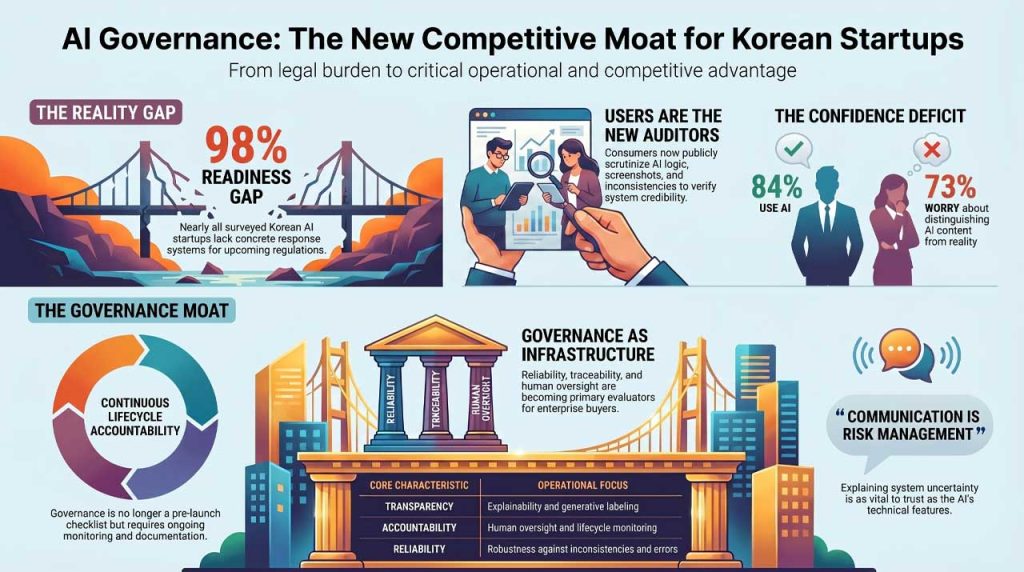
A survey conducted by Startup Alliance involving 101 Korean AI startups found that 98% had not established concrete response systems for the AI Basic Act. Companies identified reliability and safety certification, dataset transparency requirements, high-risk AI obligations, and generative AI labeling rules as some of the most challenging areas.
The findings suggest that governance is no longer an issue reserved for policymakers and legal teams. It is becoming an operational concern for companies building AI-powered products.
And this challenge becomes even more significant as AI moves beyond productivity tools and enters products that influence decisions, recommendations, assessments, and user behavior.

The Emerging Gap Between Compliance and Interpretation
Many governance discussions focus on regulations, reporting obligations, and compliance frameworks.
However, Ilham Lahreche, founder of ingredient intelligence platform Bare Halal and strategic communication consultant at AYM Conseil, believes a different challenge is emerging underneath those requirements.
“I do not think startups underestimate trust risk intentionally. I think many are entering a very new environment where expectations around verification, transparency, and consistency are evolving faster than companies themselves,”
Lahreche told KoreaTechDesk as discussion on Korean consumer AI startup challenges continues.
That distinction matters because many AI products operate in environments where users rarely see the underlying logic behind recommendations, classifications, risk assessments, or generated responses.
As AI becomes increasingly involved in real-world decisions, users are no longer evaluating outputs alone. They are starting to evaluate the credibility of the systems producing them.
Why Confidence Can Become a Risk Factor
The National Institute of Standards and Technology’s AI Risk Management Framework identifies accountability, transparency, explainability, reliability, privacy, and safety as core characteristics of trustworthy AI.
Those principles are becoming increasingly important as AI systems take on more autonomous roles.
According to EY’s 2026 AI Sentiment Index, 84% of respondents across 23 markets used AI during the previous six months, while 16% had already used systems capable of acting on their behalf without direct intervention. At the same time, 66% said human oversight remains essential and 73% expressed concern about distinguishing AI-generated content from reality.
These findings suggest that adoption is accelerating faster than confidence.
Lahreche argues that startups often focus heavily on functionality while underestimating the importance of communicating uncertainty.
“If a startup handles health, beauty, AI, religion, personal data, or safety, the way it explains uncertainty matters as much as the feature itself.”
And this observation extends well beyond consumer applications. After all, financial recommendations, healthcare triage systems, AI search tools, educational assistants, and enterprise decision-support platforms all face similar challenges when users cannot easily assess how conclusions are produced.
Users Are Beginning to Audit Systems Like Institutions
Historically, trust was often directed toward brands, governments, media organizations, or professional institutions.
AI systems are increasingly entering that same territory.
“Consumers today can question, compare, screenshot, share, and challenge information extremely quickly,”
Lahreche said as the shift changes the dynamics of accountability.
A product failure once required significant investigation before attracting public attention. Today, inconsistencies, misleading outputs, unclear disclosures, or contradictory responses can spread rapidly across communities and social platforms.
This practically means that users are beginning to conduct informal audits of AI systems themselves.
And the trend creates pressure that extends beyond regulators. Enterprise customers, partners, investors, and consumers increasingly want to understand how systems classify information, what limitations exist, and who remains responsible when decisions affect users.

Global Governance Is Moving Toward Lifecycle Accountability
The direction of global AI governance reinforces this trend.
The European Union’s AI Act requires high-risk AI systems to maintain appropriate levels of accuracy, robustness, and cybersecurity throughout their lifecycle. NIST’s AI Risk Management Framework similarly emphasizes continuous oversight across design, development, deployment, monitoring, and evaluation stages.
In South Korea, the establishment of AI Basic Act support mechanisms and implementation guidance reflects a similar reality. Compliance is no longer a one-time exercise completed before launch.
Instead, governance increasingly requires ongoing management of data, models, risk assessments, documentation, monitoring, and communication.
This evolution creates a new operational burden for startups. But it also creates a competitive opportunity.
Governance May Become a Competitive Advantage
Many founders still view governance as a cost center.
However, companies operating in regulated industries or trust-sensitive sectors may discover that governance functions as market infrastructure rather than administrative overhead.
Enterprise buyers increasingly evaluate transparency practices. Regulators expect greater accountability. Users demand clearer explanations. Investors are becoming more attentive to operational risk surrounding AI deployment.
Lahreche believes the companies that adapt successfully will be those that treat governance as part of system design.
“The stronger companies will be those that build systems with structure, traceability, classification rules, human oversight, and clear limits.”
So for Korean startups seeking international expansion, that capability may become increasingly important as AI regulations emerge across multiple jurisdictions and enterprise customers demand stronger assurances.

The Next AI Moat May Not Be the Model
The first phase of AI competition focused heavily on capability. Faster models, larger datasets, and more powerful outputs dominated industry conversations.
Today, the next phase may revolve around something less visible.
As AI systems become embedded in everyday decisions, users, regulators, and business partners are paying greater attention to reliability, transparency, oversight, and accountability. Startups that can demonstrate those qualities may earn trust more easily than competitors that rely solely on technical performance.
“Good communication is not decoration. It is risk management.”
That observation captures a broader shift taking place across the AI economy.
The future winners may not simply be the companies that generate the most impressive answers. They may be the companies that can explain how those answers were produced, where the limitations exist, and who remains accountable when decisions matter.
Key Takeaway
- South Korea’s AI Basic Act is pushing governance closer to startup operations, creating new expectations around transparency, accountability, and oversight.
- Startup Alliance found that 98% of surveyed Korean AI startups lacked practical preparation for the new framework, highlighting a readiness gap.
- Governance challenges increasingly revolve around verification, consistency, and accountability, not only legal compliance.
- Users are beginning to evaluate the credibility of AI systems themselves, creating new pressure on startups operating in healthcare, finance, search, recommendation, and consumer-facing AI.
- Global frameworks such as NIST AI RMF and the EU AI Act are moving toward lifecycle accountability, requiring continuous monitoring and risk management.
- Structure, traceability, human oversight, and clear operational limits may become competitive advantages for Korean AI startups expanding globally.
- The next durable AI moat may come from governance execution and system credibility, not model performance alone.
– Stay Ahead in Korea’s Startup Scene –
Get real-time insights, funding updates, and policy shifts shaping Korea’s innovation ecosystem.
➡️ Follow KoreaTechDesk on LinkedIn, X (Twitter), Threads, Bluesky, Telegram, Facebook, and WhatsApp Channel.
🤝 Looking to connect with verified Korean companies building globally?
Explore curated company profiles and request direct introductions through beSUCCESS Connect.