KoreaTechDesk | Korean Startup and Technology News

Mon, January 19, 2026

Sign in

Virtual Demo Day
Menu
  • Home
  • Startup News
    • AI & Big Data
    • AR & VR
    • Blockchain
    • Clean Technology
    • Content & Games
    • Cybersecurity
    • Enterprise & SaaS
    • FinTech
    • Gadgets & Electronics
    • Health & Bio
    • Manufacturing
    • Press Release
    • IoT
    • Marketplaces & E-commerce
    • Robotics
    • Transportation
    • Investments
    • Ecosystem & Lists
  • Governments
    • Artificial Intelligence Industry Cluster Agency
    • Daegu Technopark
    • GANGNAM-GU
    • Gyeonggido Business & Science Accelerator
    • Hwaseong Industry Promotion Agency
    • Invest Seoul
    • Korea Creative Content Agency
    • Korea Internet & Security Agency
    • Korea Information Security Industry Association
    • Korea Institute of Startup & Entrepreneurship Development
    • Korea Tourism Organization
    • Korea Trade-Investment Promotion Agency
    • Ministry of Culture, Sports and Tourism
    • Ministry of SMEs & Startups
    • National IT Industry Promotion Agency
    • Pangyo Techno Valley
    • Seoul Business Agency
    • Seoul FinTech Lab
    • South Gyeongsang Province
    • Seoul Metropolitan Government
  • Events
    • COMEUP
    • Korea Fintech Week
    • K-Content Expo
    • NextRise
    • Try Everything
  • Interviews
    • Investors’ interviews
    • Founders’ interviews
  • Programs
    • Asan Voyager
    • CAPA Global Program
    • Campus Town Program
    • SGSC Global Bootcamp
    • Gangnam-gu Global Roadshow
    • Global SaaS Marketplace Support Project
    • LAUNCHPAD
    • COMEUP STARS 120
    • K-Startup Grand Challenge
    • TIPS X beSUCCESS Global Project
    • SFL Global Program
    • KTO Global Showcase
    • Yonsei Univ Global Class
    • KOSME Global Program
  • Partner With Us
    • Press Release
    • Startup Scouting
    • Business Agencies
    • Global Mentorship Program
    • Investment Opportunities
    • K-Scouter Program
  • Lists
  • Home
  • Startup News
    • AI & Big Data
    • AR & VR
    • Blockchain
    • Clean Technology
    • Content & Games
    • Cybersecurity
    • Enterprise & SaaS
    • FinTech
    • Gadgets & Electronics
    • Health & Bio
    • Manufacturing
    • Press Release
    • IoT
    • Marketplaces & E-commerce
    • Robotics
    • Transportation
    • Investments
    • Ecosystem & Lists
  • Governments
    • Artificial Intelligence Industry Cluster Agency
    • Daegu Technopark
    • GANGNAM-GU
    • Gyeonggido Business & Science Accelerator
    • Hwaseong Industry Promotion Agency
    • Invest Seoul
    • Korea Creative Content Agency
    • Korea Internet & Security Agency
    • Korea Information Security Industry Association
    • Korea Institute of Startup & Entrepreneurship Development
    • Korea Tourism Organization
    • Korea Trade-Investment Promotion Agency
    • Ministry of Culture, Sports and Tourism
    • Ministry of SMEs & Startups
    • National IT Industry Promotion Agency
    • Pangyo Techno Valley
    • Seoul Business Agency
    • Seoul FinTech Lab
    • South Gyeongsang Province
    • Seoul Metropolitan Government
  • Events
    • COMEUP
    • Korea Fintech Week
    • K-Content Expo
    • NextRise
    • Try Everything
  • Interviews
    • Investors’ interviews
    • Founders’ interviews
  • Programs
    • Asan Voyager
    • CAPA Global Program
    • Campus Town Program
    • SGSC Global Bootcamp
    • Gangnam-gu Global Roadshow
    • Global SaaS Marketplace Support Project
    • LAUNCHPAD
    • COMEUP STARS 120
    • K-Startup Grand Challenge
    • TIPS X beSUCCESS Global Project
    • SFL Global Program
    • KTO Global Showcase
    • Yonsei Univ Global Class
    • KOSME Global Program
  • Partner With Us
    • Press Release
    • Startup Scouting
    • Business Agencies
    • Global Mentorship Program
    • Investment Opportunities
    • K-Scouter Program
  • Lists
Home Government Policies

With Korea’s New AI Basic Act, Can Innovation Coexist with Regulation?

by Richard Park
January 19, 2026
in Government Policies
0

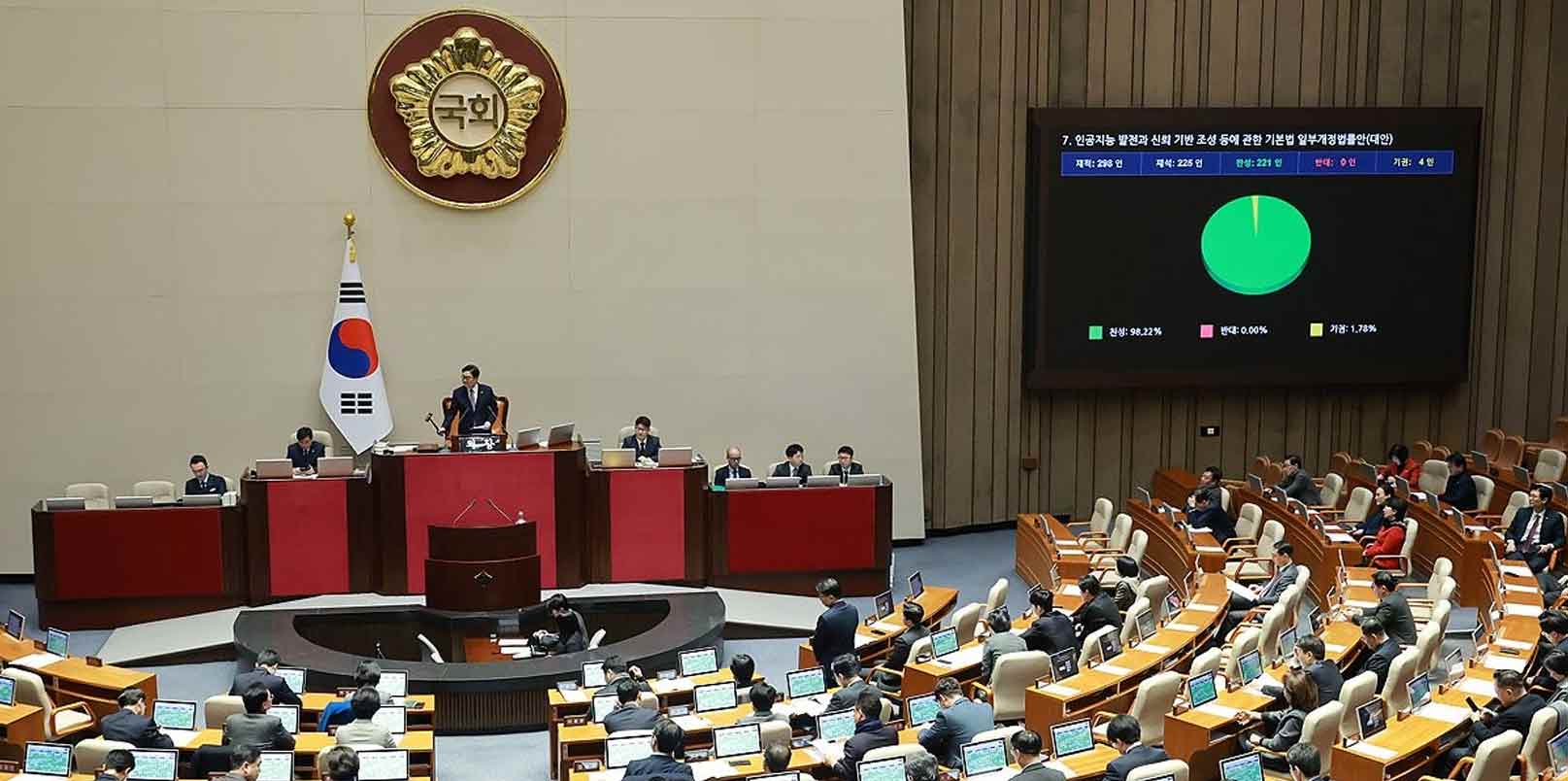
South Korea is stepping into uncharted territory. On January 22, 2026, the world’s first fully enforced AI Basic Act (or AI Basic Law) will take effect, turning years of policy debate into law. The move is a global milestone—but also a stress test for Korea’s capacity to align regulation with innovation, trust with growth, and law with technological speed.

Korea Officially Enforces the AI Basic Act

The Ministry of Science and ICT (MSIT) confirmed that the AI Basic Act , formally titled the Act on the Promotion of Artificial Intelligence Development and the Establishment of a Trust-Based Foundation, will come into force this week.

The AI Basic Act requires AI developers and service providers to meet defined standards of safety, transparency, and accountability, especially for systems classified as “high-impact AI.” It also introduces labeling obligations for generative AI outputs, requiring either visible or invisible notices indicating AI-generated content.

While penalties can reach KRW 30 million (~USD 22,000), the government has announced a one-year guidance period, prioritizing education and adaptation over immediate enforcement.

Foreign AI firms operating in Korea—those exceeding KRW 1 trillion in global revenue, KRW 10 billion in local AI sales, or one million daily users—must designate a local representative. This currently includes platforms like OpenAI and Google.

Korea Becomes the First to Implement Fully

The European Union drafted its AI Act earlier but chose gradual enforcement. Korea, by contrast, is enforcing all provisions simultaneously, effectively becoming the first country worldwide to apply a national AI regulatory regime in full.

The AI Basic Act requires the MSIT to revise a national AI Master Plan every three years, establishes a National AI Safety Research Institute, and introduces a legal foundation for long-debated AI explainability—the ability to trace how an algorithm arrived at a decision.

This approach represents more than rulemaking. It formalizes a new governance model in which AI is treated not merely as a technology but as a matter of public trust and human rights.

A Divided Ecosystem on AI Basic Act

The policy’s intent is clear: to promote safe innovation. The reception, however, remains deeply split.

Industry surveys by Startup Alliance show that 98% of Korean AI startups lack full compliance systems for the new law. Small firms fear being overburdened by documentation and unclear standards, particularly around “high-impact” classifications.

One startup executive said,

“Even large corporations can hire legal teams to interpret the Act. For startups, every compliance document can mean a delayed launch or a lost investor.”

An official from domestic AI industry also added,

“The government says it will implement fines slowly after a guidance period, but what companies truly fear is the act of violating the law itself.”

In response, the Ministry of Science and ICT reiterated that the law’s goal is not punitive.
A ministry official clarified,

“The AI Basic Act is meant to serve as a compass for safe and responsible growth, not a barrier. We will continue to refine detailed guidelines with industry feedback.”

Still, questions persist about enforceability beyond Korea’s borders. Global firms with servers or AI models trained abroad fall largely outside Korean jurisdiction, exposing asymmetries that domestic firms see as potential reverse discrimination.

A Governance Experiment for the AI Era

For investors and founders, Korea’s AI Basic Act is more than a national policy—it is an experiment in live governance.

By legislating transparency and accountability, Korea signals to the global market that trustworthiness may soon define competitive advantage as much as performance. Startups that successfully operationalize compliance early could become preferred partners for international collaborations, especially as foreign regulators seek interoperable frameworks.

However, risk remains that the speed of regulation could outpace institutional readiness. While the Act sets a framework for safe AI deployment, its execution still depends on human interpretation—ministries, auditors, and developers who must translate legal text into workable procedures.

This tension mirrors a broader challenge across Asia: how to govern emerging technologies without throttling their evolution. Korea’s approach, if refined through continuous dialogue, could become a template for adaptive AI regulation across the region.

AI Basic Act: Regulation as Catalyst or Constraint?

And so, the world is watching Korea’s next step. Its AI Basic Act may become either a blueprint for responsible innovation or a cautionary tale of ambition racing ahead of readiness.

For Korea’s startup ecosystem, the real opportunity lies not in resisting regulation but in shaping how it is interpreted and applied. The firms that engage now—building verifiable, transparent, and auditable systems—will set the tone for Asia’s next decade of AI leadership.

If governance can evolve as quickly as the technology it seeks to oversee, Korea’s regulatory leap could redefine what global innovation accountability looks like.

– Stay Ahead in Korea’s Startup Scene –
Get real-time insights, funding updates, and policy shifts shaping Korea’s innovation ecosystem.
➡️ Follow KoreaTechDesk on LinkedIn, X (Twitter), Threads, Bluesky, Telegram, Facebook, and WhatsApp Channel.

Tags: adaptive AI governanceAI accountability KoreaAI Basic ActAI Basic Act KoreaAI Basic LawAI Basic Law KoreaAI governance frameworkAI innovation policy AsiaAI law enforcement KoreaAI regulation challengesAI regulation South Koreadigital trust regulation Asiagenerative AI transparencyglobal AI competitiveness KoreaHigh Impact AIhigh-impact AI complianceKorean startup ecosystemMinistry of Science and ICTMinistry of Science and ICT (MSIT)MSITresponsible AI development
Previous Post

Korea’s Next Cyber Crisis Won’t Come From Tech — It’s Already Hiding in the Funeral Industry

Next Post

KIBO’s Venture Camp Evolves into a National Accelerator Platform — Adding ESG and Global Growth Tracks

Next Post

KIBO’s Venture Camp Evolves into a National Accelerator Platform — Adding ESG and Global Growth Tracks

MOST READ ARTICLE OF THE WEEK

1.
The Kyowon Ransomware Breach and Korea’s Reputation: The Next Economic Risk Isn’t Finance but Trust
13 Jan 2026
2.
From Nobel Materials to AI CareTech, Investors Return to Fundamentals: Korea’s Deep Tech and AI Startups Capture Early 2026 Momentum
13 Jan 2026
3.
Restoring the Growth Ladder Is No Longer About Funding—It’s About Fixing the Executors
13 Jan 2026
4.
The Day Before Korea’s Fractional STO Market Decides What “Innovation” Really Means
14 Jan 2026
5.
CES 2026: Korea’s Innovation Stage Is Global, Its Homework Still Local
14 Jan 2026
Register for Event

[the_ad id=”18508″]

List Article

1.
6 Reasons Why Seoul Is Poised to Become a Top 5 Global Economic Hub by 2030
20 Aug 2024
2.
Top Co-working Spaces for Startups & Companies to Explore in South Korea
3 Apr 2024
3.
Top Accelerators in South Korea Shaping Startup Success
29 Nov 2023
4.
Top Korean Venture Capital Firms Backing Startup Success
26 Oct 2023
5.
Top Apps for Seamless Korean to English Translation
14 Aug 2023

Similar Articles

Government Policies

Fair Trade vs. Startup Trust: Yanolja and Yeogi Eottae Case Exposes Korea’s Tightrope on Innovation Governance

More
Government Policies

Korea’s Ministries Clash Over DoctorNow Bill, Pulling in Opposite Directions

More
Government Policies

Failure Is No Longer Fatal: Korea Builds a Re-Challenge Ecosystem for Its Next Startup Wave

More

Topics

Menu
  • AI & Big Data
  • AR & VR
  • Blockchain
  • Clean Technology
  • Content & Games
  • Cybersecurity
  • Enterprise & SaaS
  • FinTech
  • Gadgets & Electronics
  • Health & Bio
  • IoT

Program

Menu
  • Asan Voyager
  • CAPA Global Program
  • SGSC Global Bootcamp
  • LAUNCHPAD
  • COMEUP STARS 120
  • K-Startup Grand Challenge
  • TIPS X beSUCCESS Global Project
  • SFL Global Program
  • KTO Global Showcase
  • Yonsei Univ Global Class
  • KOSME Global Program

About

Menu
  • About Us
  • all articles
  • Terms of Use
  • Privacy
  • Cookie-policy
  • twitter

Subscribe and be informed first hand about actual Korean startup news.

All the day’s headlines and highlights, direct to you every morning.

Contact us : [email protected]

Topics

Menu
  • AI & Big Data
  • AR & VR
  • Blockchain
  • Clean Technology
  • Content & Games
  • Cybersecurity
  • Enterprise & SaaS
  • FinTech
  • Gadgets & Electronics
  • Health & Bio
  • IoT

Program

Menu
  • Asan Voyager
  • CAPA Global Program
  • SGSC Global Bootcamp
  • LAUNCHPAD
  • COMEUP STARS 120
  • K-Startup Grand Challenge
  • TIPS X beSUCCESS Global Project
  • SFL Global Program
  • KTO Global Showcase
  • Yonsei Univ Global Class
  • KOSME Global Program

About

Menu
  • About Us
  • all articles
  • Terms of Use
  • Privacy
  • Cookie-policy
  • twitter

Subscribe and be informed first hand about actual Korean startup news.

All the day’s headlines and highlights, direct to you every morning.

© 2023 Koreantech News & Media Korea Zrt. All rights reserved.

Our Spring Sale Has Started

You can see how this popup was set up in our step-by-step guide: https://wppopupmaker.com/guides/auto-opening-announcement-popups/

Our Spring Sale Has Started

You can see how this popup was set up in our step-by-step guide: https://wppopupmaker.com/guides/auto-opening-announcement-popups/

We hope you enjoy our content, May you please give us Feedback regarding our website!

Single Post Feedback

dgdfgfdgdf

What you think about Koreatechdesk, Share your idea with us!

feedback popup

Invitation submission has been closed

Insert/edit link

Enter the destination URL

Or link to existing content

    No search term specified. Showing recent items. Search or use up and down arrow keys to select an item.