

Healthcare diagnostics are becoming smaller, faster, and increasingly decentralized. Startups across the world are building point-of-care biosensors, home-testing systems, and low-cost diagnostic platforms designed to expand healthcare access. Yet many technologies that appear inexpensive during early development still struggle to become truly affordable healthcare products once manufacturing, quality assurance, distribution, and long-term deployment enter the equation.
Affordable Diagnostics Often Become Expensive Outside the Prototype Stage
The global healthcare industry continues searching for affordable diagnostics capable of reaching underserved populations and decentralized care environments.
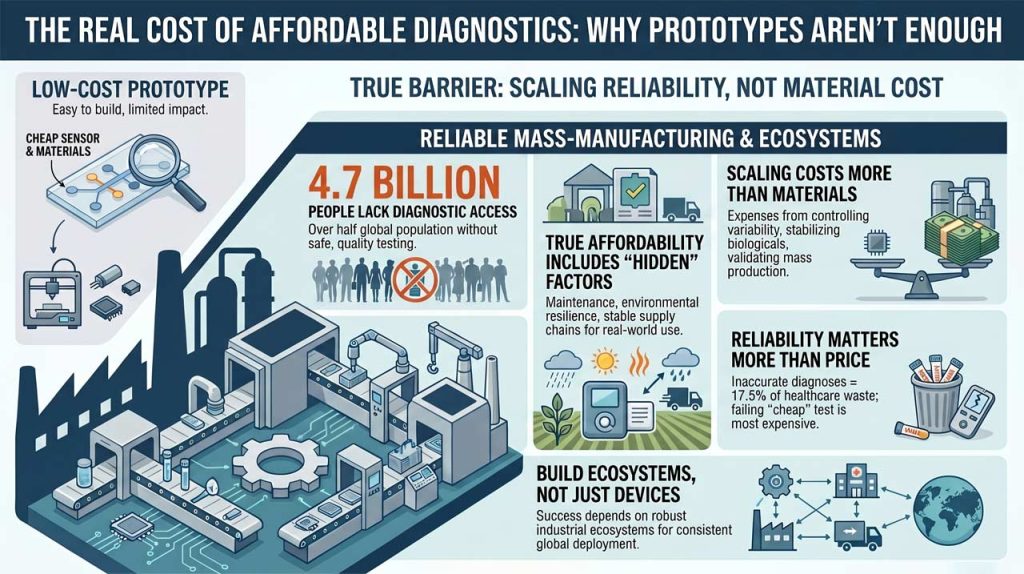
The World Health Organization (WHO) estimates that around 4.7 billion people worldwide still lack access to safe, affordable, and quality-assured diagnostic services.
As healthcare systems push testing closer to clinics, pharmacies, and homes, low-cost diagnostics have become one of the most heavily discussed areas in healthcare deep-tech. However, diagnostics experts increasingly argue that reducing material cost alone does not automatically create affordable healthcare systems.
“The biggest barrier behind truly low-cost diagnostics is not simply the material cost of the product itself,”
Hyou-Arm Joung, CTO and Co-Founder of Kompass Diagnostics, told KoreaTechDesk during discussions surrounding diagnostic commercialization and manufacturing scalability.
Joung has been profoundly experienced in diagnostic commercialization work across Korea and the United States, including biosensor research, point-of-care diagnostic systems, and healthcare manufacturing operations. He believes many healthcare startups underestimate how dramatically costs expand once a prototype moves toward large-scale deployment.
“A prototype can often be made relatively cheaply,”
he explained.
“But building a system that can manufacture millions of reliable devices consistently at low cost is an entirely different problem.”
Diagnostic Affordability Depends on More Than Cheap Sensors
Point-of-care diagnostics are often promoted as solutions for improving healthcare accessibility in lower-resource environments. Yet healthcare affordability depends on far more than simply reducing cartridge or sensor cost.
The WHO has repeatedly emphasized that diagnostic access requires products that are not only inexpensive, but also safe, reliable, quality-assured, and operationally suitable for real healthcare environments.
Research published this year in PLOS Global Public Health examining tuberculosis diagnostic target product profiles highlighted that affordability calculations increasingly include service contracts, maintenance support, operating conditions, environmental resilience, and long-term deployment practicality alongside test pricing itself.
That distinction is becoming increasingly important as diagnostic systems move into environments with limited infrastructure, unstable electricity, extreme temperatures, inconsistent logistics, or reduced laboratory support.
Joung believes many hidden costs emerge long after a prototype appears technically successful.
“Many hidden costs come not from the sensor itself, but from controlling variability, maintaining reproducibility, stabilizing biological materials, validating manufacturing processes, and ensuring long-term reliability at scale.”
The challenge becomes particularly difficult in diagnostics because healthcare systems cannot tolerate inconsistent performance simply to reduce price.
Unlike consumer electronics or ordinary hardware products, diagnostic systems directly influence clinical decisions, treatment pathways, and patient outcomes. As a result, affordability must coexist with reliability, validation, and quality control simultaneously.
Manufacturing Reliability Has Become a Global Healthcare Access Problem
The affordability debate is also becoming increasingly connected to healthcare infrastructure resilience and global supply-chain stability.
During the COVID-19 pandemic, countries worldwide experienced shortages involving diagnostic kits, reagents, laboratory supplies, and manufacturing capacity. The disruption exposed how healthcare access can collapse when production systems fail to scale consistently under global demand pressure.

The WHO now describes local and regional production capacity as an important component of improving access to safe and affordable medical products. However, expanding manufacturing alone does not eliminate the need for strict quality-management systems and reliable production maturity.
Joung argues that industrial reproducibility remains one of the least understood barriers in healthcare deep-tech.
“The real challenge is the absence of fully mature, highly reliable manufacturing systems capable of producing diagnostic devices consistently at large scale.”
That problem becomes even more severe when biological materials enter the manufacturing process. Diagnostic systems often depend on reagents, antibodies, enzymes, and other sensitive biological components that require long-term stability across production, transportation, storage, and clinical use.
Healthcare systems therefore face a difficult balancing act. Lower prices are important for expanding access, but poorly controlled manufacturing can increase failure risk, reduce reliability, and create downstream healthcare costs.
The Organisation for Economic Co-operation and Development (OECD) estimated this year that inaccurate, delayed, or incorrect diagnoses may account for healthcare losses equivalent to roughly 17.5% of total healthcare expenditure across OECD systems. This report highlighted how diagnostic reliability directly affects treatment quality, patient safety, and long-term healthcare efficiency.
Korea’s Diagnostic Startups Are Also Facing the Affordability Reality
Yes, Korea’s diagnostics industry demonstrated strong manufacturing and export capability during the pandemic era, particularly in rapid test production and point-of-care systems. And Korean startups continue expanding globally across biosensors, in vitro diagnostics, and digital healthcare devices.
The Korean government has also continued supporting international commercialization efforts for diagnostics and medical-device companies.
Programs operated through the Korea Health Industry Development Institute (KHIDI) now include export assistance, global market-entry support, and international certification programs targeting in vitro diagnostics and digital medical devices.
Still, Joung believes the affordability discussion must move beyond simple price reduction strategies.
“The true cost barrier is not the product alone.
It is the long and difficult process of establishing a robust industrial-scale manufacturing ecosystem around the product.”
That ecosystem includes regulatory compliance, manufacturing validation, process control, quality monitoring, supply-chain stability, and deployment support across multiple healthcare environments simultaneously.
Therefore, this distinction may become increasingly important for Korean healthcare startups entering global diagnostics markets. International buyers, healthcare systems, and regulators are not only evaluating whether a diagnostic test works. They are evaluating whether it can remain reliable, supportable, and economically sustainable over time.
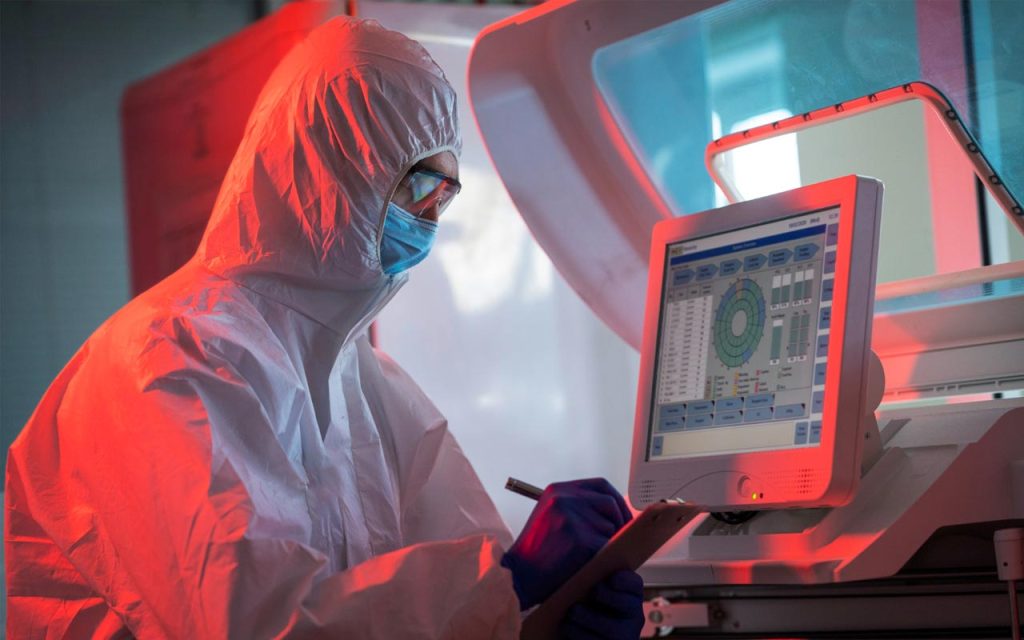
Affordable Healthcare May Depend More on Reliability Than Price Alone
Finally, healthcare systems are unlikely to stop pursuing lower-cost diagnostics. Demand for decentralized testing, home healthcare, and point-of-care diagnostics continues expanding globally as healthcare access pressures increase.
However, the industry may now be entering a more difficult stage where affordability depends less on building cheaper prototypes and more on building reliable deployment systems capable of surviving real-world healthcare conditions.
And that challenge extends beyond engineering alone. It includes manufacturing maturity, quality assurance, logistics, clinical trust, supply-chain resilience, environmental stability, and operational simplicity under large-scale use.
The diagnostics sector has already proven that low-cost prototypes can be built. Now, the harder challenge may be proving that affordable diagnostics can remain reliable even after they reach millions of patients.
Key Takeaways
- Affordable diagnostics are not defined by low material cost alone. Healthcare systems also require reliability, quality assurance, manufacturing stability, and long-term deployment support.
- The biggest barrier behind low-cost diagnosticsis not the sensor itself, but the difficulty of building highly reliable industrial-scale manufacturing systems.
- WHO estimates that around 4.7 billion people still lack access to safe, affordable, quality-assured diagnostic services globally.
- Diagnostic affordability increasingly includes maintenance, environmental resilience, supply-chain stability, service support, and manufacturing reproducibility.
- Healthcare access depends on reliable deployment systems, not simply cheaper test cartridges.
- Korean diagnostics companies continue expanding globally, but long-term competitiveness depends on building durable commercialization and manufacturing ecosystems alongside technical innovation.
- The real cost barrier in diagnostics is establishing a robust industrial ecosystem capable of producing reliable devices consistently at scale.
– Stay Ahead in Korea’s Startup Scene –
Get real-time insights, funding updates, and policy shifts shaping Korea’s innovation ecosystem.
➡️ Follow KoreaTechDesk on LinkedIn, X (Twitter), Threads, Bluesky, Telegram, Facebook, and WhatsApp Channel.
🤝 Looking to connect with verified Korean companies building globally?
Explore curated company profiles and request direct introductions through beSUCCESS Connect.