
Korea and France are making it easier for startups to enter each other’s markets. Public programs, ecosystem platforms, and corporate partnerships are opening more doors than before. But entry is no longer the hardest part.
Because for many founders, the real challenge begins after the first meetings, after the accelerator ends, and after the initial visibility fades. This gap between access and actual business outcomes remains one of the least understood risks in cross-border expansion.
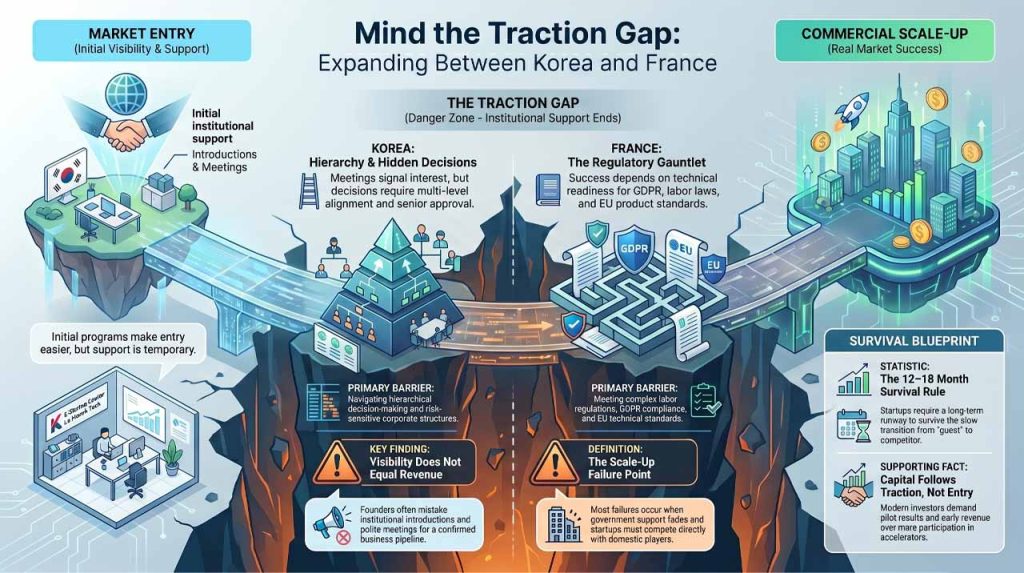
“Traction Gap” Is Where Korea – France Startup Expansion Breaks
The most critical failure point in Korea – France startup expansion is not in the market entry. It is what happens after instead.
Following the previous Korea – France startup corridor discussion, Kian Ban, Global Partner at MYSC and Senior Expert at Impulse Partners, describes this disconnect clearly.
“The largest disconnect lies in the mismatch between initial visibility and final execution.
Founders often expect that high-level institutional support will fast-track business deals, but the reality is a much slower ‘Traction Gap’.”
The term captures a pattern seen across cross-border startup ecosystems. Founders secure meetings, join government-backed programs, and gain exposure. Yet many struggle to convert that momentum into contracts, revenue, or sustained growth.
While this may not be unique to Korea and France only, the structural differences between the two markets make the gap more visible and more costly.
Public institutions have focused on improving access. So, the next phase of Korea – France startup corridor depends on whether innovators can close the gap between introduction and execution.
Soft-Landing Programs Open Doors, but Not Deals
Korea has built a structured outbound expansion system through programs such as the K-Startup Center (KSC), including its Paris hub.
According to the Korea Institute of Startup and Entrepreneurship Development (KISED), these programs provide business matching, localization mentoring, and financial support for overseas expansion.
The Ministry of SMEs and Startups (MSS) has also emphasized turning international exchange into practical outcomes, with initiatives designed to connect startups with global corporates and investors.
These programs are working as intended at the entry level.
They provide:
- incorporation support
- market education
- introductions to potential partners
- access to local ecosystems
But still, they do not guarantee commercial results.
Kian Ban points to a recurring misunderstanding among founders.
“Soft-landing programs are highly effective at providing market ‘literacy’ like incorporation, networking, and visas, but they often struggle to deliver sustained traction.”
The issue is not the absence of support. It is the assumption that support equals pipeline.
“Founders frequently mistake ‘institutional introductions’ for a confirmed business pipeline… only to find those leads go cold once the program’s official support ends.”
This gap becomes even more visible when startups transition from ecosystem participants to market competitors.
In Korea, Meetings Do Not Equal Decisions
Meanwhile, for French startups entering Korea, one of the most common execution failures lies in misreading how decisions are made.
Business practice studies consistently show that Korean companies operate within structured hierarchies, where decisions require alignment across multiple levels and senior approval plays a central role. Santander Trade and Asialink Business both highlight how hierarchy, formality, and internal consensus shape how partnerships are evaluated.
For external partners, however, this structure is not always easy to interpret. As global relationship strategist Valerie Won Lee previously told KoreaTechDesk as well,
“Hierarchy, indirect communication, and risk sensitivity can make it difficult to know who can truly decide, how far a conversation has progressed, and whether apparent openness still leaves room for change.”
In practice, this creates a critical gap between perceived progress and actual commitment. Early meetings may signal interest, but they rarely represent a final decision.
Kian Ban points to how this misunderstanding translates into execution risk.
“Startups that fail to navigate this hierarchy often misinterpret a polite meeting as a definitive yes, leading to failed GTM projections.”
The consequence is not immediate rejection, but a slower breakdown. Founders build projections based on early signals, while internal decision processes move at a different pace. Delays accumulate, expectations diverge, and commercial traction fails to materialize.
The issue, ultimately, is not access to companies. It is understanding where authority sits and how decisions are reached.
In France, Entry Is Structured, but Execution Is Regulated
On the other hand, the challenge looks different for Korean startups entering France.
France is positioned as a gateway to Europe, supported by initiatives such as La French Tech and programs like Next40/120. Business France reports that the country attracted 1,878 foreign investment decisions in 2025, creating or maintaining over 47,000 jobs.
The ecosystem is active and internationally connected. But operating inside requires regulatory and technical readiness.
Foreign startups must navigate:
- work authorization requirements for non-EU hires
- labor regulations and employment structures
- GDPR compliance for data handling
- product adaptation to European standards
Official French government resources, including Welcome to France, confirm that hiring foreign employees requires prior authorization in most cases. At the policy level, the European Commission has also moved to simplify aspects of digital regulation, including GDPR, acknowledging the complexity faced by companies.
For startups, these are not peripheral issues. They directly affect hiring speed, product deployment, and customer acquisition.
Kian Ban highlights a common oversight.
“Programs make startups ‘pitch-ready,’ but they often overlook the ‘technical readiness’ required for local integration.”
In other words, being ready to present is not the same as being ready to operate.
The Real Failure Point Appears at Scale-Up
Early-stage startups often navigate entry with institutional support. But the real risk only emerges later.
“Scaling companies must transition from being ‘guests’ in the ecosystem to actual competitors.”
At the entry stage, startups often benefit from institutional support. Grants, accelerator programs, and ecosystem visibility help reduce initial friction and make market access more achievable.
But the dynamics change quickly once that phase ends. As startups move into scale-up, expectations shift from participation to performance. The focus moves toward closing contracts, integrating with local systems, building recurring revenue, and competing directly with domestic players.
This transition exposes gaps that are not visible at entry. Localization, sales execution, and operational readiness begin to determine whether expansion can sustain itself.
So the cost of these gaps rises rapidly. Without revenue, burn rate accelerates. Without local traction, investor confidence weakens. Without integration, early partnerships fail to convert into long-term business.
Most failures do not occur when startups enter a market. They emerge when institutional support fades and execution becomes the only factor that matters.

Capital Follows Traction, Not Entry
Investor behavior is reinforcing this shift. As global venture markets move toward efficiency and measurable performance, capital is increasingly tied to demonstrated traction rather than signals of market entry.
Kian Ban frames this transition directly.
“A good idea is no longer sufficient for cross-border expansion. Investors and partners now demand demonstrable traction.”
In practice, this means evidence such as pilot results, early revenue, validated partnerships, or localized products. Entry into a new market or participation in a program may signal potential, but it is no longer enough to unlock meaningful funding.
This is where the Korea – France corridor still faces a structural limitation. Entry pathways are improving, but capital allocation ultimately depends on what happens after.
What Founders Must Get Right Before Expanding
Expanding between Korea and France requires more than access to programs or initial market entry. The conditions that determine success are operational, not symbolic, and they tend to surface only after the early support phase ends.
Kian Ban points to a recurring pattern in failed expansions,
“Without a 12-to-18-month runway to survive the ‘Traction Gap,’ institutional support alone is rarely enough.”
In practice, this means startups need to prepare for execution before they enter the market. That includes understanding how decisions are made locally, securing on-the-ground operators or partners who can navigate those structures, and ensuring that products are already aligned with regulatory and technical requirements.
It also requires realistic expectations around timing. Sales cycles in both Korea and France tend to move more slowly than founders anticipate, particularly when multiple layers of approval or compliance are involved. Without that adjustment, early momentum can quickly translate into missed projections and rising burn.
Expansion driven primarily by access to government programs or soft-landing incentives carries higher risk. Programs can reduce entry barriers, but they do not replace the need for a viable commercial pathway.
In the end, the difference is not access to opportunity, but the ability to execute within each market’s constraints. Startups that treat expansion as an operational challenge tend to sustain growth. Those that rely on entry alone often struggle to convert it into lasting traction.
Access Is Expanding, Execution Still Decides
Finally, Korea–France startup cooperation is evolving, with more structured entry pathways and expanding institutional support across both ecosystems.
What is becoming clearer, however, is that access is no longer the main constraint. The challenge lies in converting that access into sustained business outcomes.
The gap between introduction and execution remains the defining risk for founders entering this corridor, and until it is addressed, expansion is likely to produce uneven results regardless of how strong the institutional framework becomes.
Key Takeaway
- Korea–France startup programs are improving access, with initiatives like K-Startup Center and La French Tech supporting market entry
- The main risk lies in the “Traction Gap”, where startups fail to convert visibility into contracts, revenue, and growth
- In Korea, decision-making hierarchy slows deal conversion, and early meetings do not represent final commitment
- In France, regulatory, labor, and technical compliance requirements create operational barriers after entry
- Soft-landing programs provide access, not commercial outcomes, especially after program completion
- The highest failure rate occurs at scale-up stage, when startups must transition into real market competitors
- Capital follows traction, not entry, with investors requiring proof of revenue, pilots, and local validation
- Successful expansion requires local execution capability, regulatory readiness, and 12–18 months runway, not just program participation
– Stay Ahead in Korea’s Startup Scene –
Get real-time insights, funding updates, and policy shifts shaping Korea’s innovation ecosystem.
➡️ Follow KoreaTechDesk on LinkedIn, X (Twitter), Threads, Bluesky, Telegram, Facebook, and WhatsApp Channel.
🤝 Looking to connect with verified Korean companies building globally?
Explore curated company profiles and request direct introductions through beSUCCESS Connect.