
KoreaTechDesk | Korean Startup and Technology News

Sat, February 28, 2026

Sign in

Virtual Demo Day
Menu
  • Home
  • Startup News
    • AI & Big Data
    • AR & VR
    • Blockchain
    • Clean Technology
    • Content & Games
    • Cybersecurity
    • Enterprise & SaaS
    • FinTech
    • Gadgets & Electronics
    • Health & Bio
    • Manufacturing
    • Press Release
    • IoT
    • Marketplaces & E-commerce
    • Robotics
    • Transportation
    • Investments
    • Ecosystem & Lists
  • Governments
    • Artificial Intelligence Industry Cluster Agency
    • Daegu Technopark
    • GANGNAM-GU
    • Gyeonggido Business & Science Accelerator
    • Hwaseong Industry Promotion Agency
    • Invest Seoul
    • Korea Creative Content Agency
    • Korea Internet & Security Agency
    • Korea Information Security Industry Association
    • Korea Institute of Startup & Entrepreneurship Development
    • Korea Tourism Organization
    • Korea Trade-Investment Promotion Agency
    • Ministry of Culture, Sports and Tourism
    • Ministry of SMEs & Startups
    • National IT Industry Promotion Agency
    • Pangyo Techno Valley
    • Seoul Business Agency
    • Seoul FinTech Lab
    • South Gyeongsang Province
    • Seoul Metropolitan Government
  • Events
    • COMEUP
    • Korea Fintech Week
    • K-Content Expo
    • NextRise
    • Try Everything
  • Interviews
    • Investors’ interviews
    • Founders’ interviews
  • Programs
    • Asan Voyager
    • CAPA Global Program
    • Campus Town Program
    • SGSC Global Bootcamp
    • Gangnam-gu Global Roadshow
    • Global SaaS Marketplace Support Project
    • LAUNCHPAD
    • COMEUP STARS 120
    • K-Startup Grand Challenge
    • TIPS X beSUCCESS Global Project
    • SFL Global Program
    • KTO Global Showcase
    • Yonsei Univ Global Class
    • KOSME Global Program
  • Partner With Us
    • Press Release
    • Startup Scouting
    • Business Agencies
    • Global Mentorship Program
    • Investment Opportunities
    • K-Scouter Program
  • Lists
  • Home
  • Startup News
    • AI & Big Data
    • AR & VR
    • Blockchain
    • Clean Technology
    • Content & Games
    • Cybersecurity
    • Enterprise & SaaS
    • FinTech
    • Gadgets & Electronics
    • Health & Bio
    • Manufacturing
    • Press Release
    • IoT
    • Marketplaces & E-commerce
    • Robotics
    • Transportation
    • Investments
    • Ecosystem & Lists
  • Governments
    • Artificial Intelligence Industry Cluster Agency
    • Daegu Technopark
    • GANGNAM-GU
    • Gyeonggido Business & Science Accelerator
    • Hwaseong Industry Promotion Agency
    • Invest Seoul
    • Korea Creative Content Agency
    • Korea Internet & Security Agency
    • Korea Information Security Industry Association
    • Korea Institute of Startup & Entrepreneurship Development
    • Korea Tourism Organization
    • Korea Trade-Investment Promotion Agency
    • Ministry of Culture, Sports and Tourism
    • Ministry of SMEs & Startups
    • National IT Industry Promotion Agency
    • Pangyo Techno Valley
    • Seoul Business Agency
    • Seoul FinTech Lab
    • South Gyeongsang Province
    • Seoul Metropolitan Government
  • Events
    • COMEUP
    • Korea Fintech Week
    • K-Content Expo
    • NextRise
    • Try Everything
  • Interviews
    • Investors’ interviews
    • Founders’ interviews
  • Programs
    • Asan Voyager
    • CAPA Global Program
    • Campus Town Program
    • SGSC Global Bootcamp
    • Gangnam-gu Global Roadshow
    • Global SaaS Marketplace Support Project
    • LAUNCHPAD
    • COMEUP STARS 120
    • K-Startup Grand Challenge
    • TIPS X beSUCCESS Global Project
    • SFL Global Program
    • KTO Global Showcase
    • Yonsei Univ Global Class
    • KOSME Global Program
  • Partner With Us
    • Press Release
    • Startup Scouting
    • Business Agencies
    • Global Mentorship Program
    • Investment Opportunities
    • K-Scouter Program
  • Lists
Home Trends

Low Fear of Failure, High Barriers to Re-Entry: What Korea’s 2026 Startup Data Reveals About Capital Friction

by Daehyun Song
February 28, 2026
in Trends
0

South Korea now ranks among the world’s least failure-averse societies in entrepreneurship. One in four adults plans to start a business within three years, and fear of failure sits at the lowest level among 53 countries surveyed. Yet fresh data on re-start firms tells a more complicated story. Cultural confidence is rising. Capital continuity remains fragile.

Korea’s 2025 GEM Results: High Entrepreneurial Intent, Low Fear of Failure

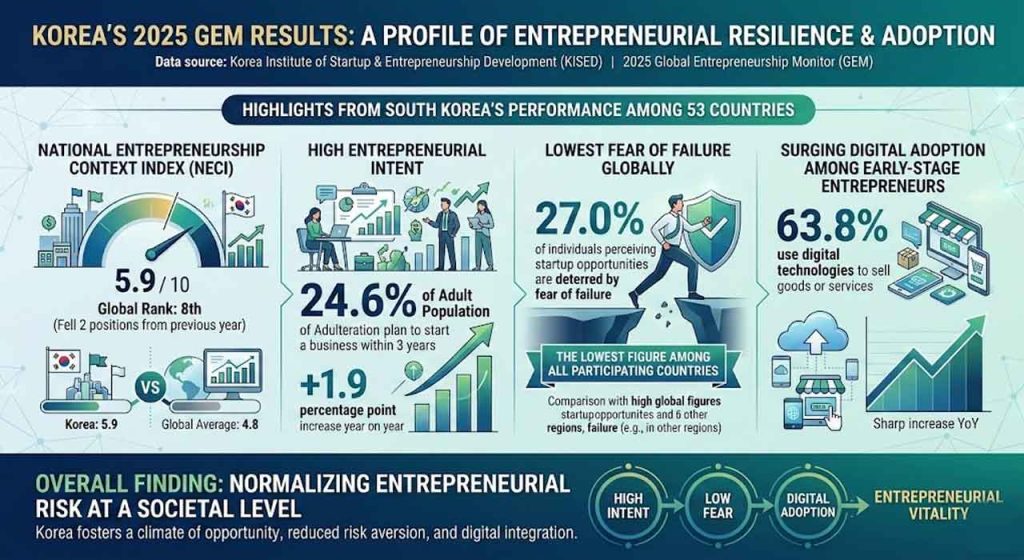
On February 27, the Korea Institute of Startup & Entrepreneurship Development (KISED) announced the results of the 2025 Global Entrepreneurship Monitor survey. The study, conducted across 53 countries, evaluates national entrepreneurship conditions and public attitudes.

Korea recorded a National Entrepreneurship Context Index score of 5.9 out of 10, ranking 8th globally. The score exceeds the participating country average of 4.8. However, the ranking fell two positions compared to the previous year.

In the adult population survey, 24.6 percent of respondents said they plan to start a business within three years. This marks a 1.9 percentage point increase year on year.

Most notably, only 27.0 percent of individuals who perceive startup opportunities said fear of failure would deter them from launching a business. This is the lowest figure among all participating countries.

Digital adoption among early-stage entrepreneurs also surged. 63.8 percent reported using digital technologies to sell goods or services, a sharp increase compared to the previous year.

On the surface, Korea appears to be normalizing entrepreneurial risk at a societal level.
Korea’s 2026 startup data shows record-low fear of failure, yet capital and credit barriers still choke re-entry. A structural look at venture friction and re-challenge limits.

Re-Entry Reality: Survival Without Scale

Yet separate reporting on re-start companies paints a different picture.

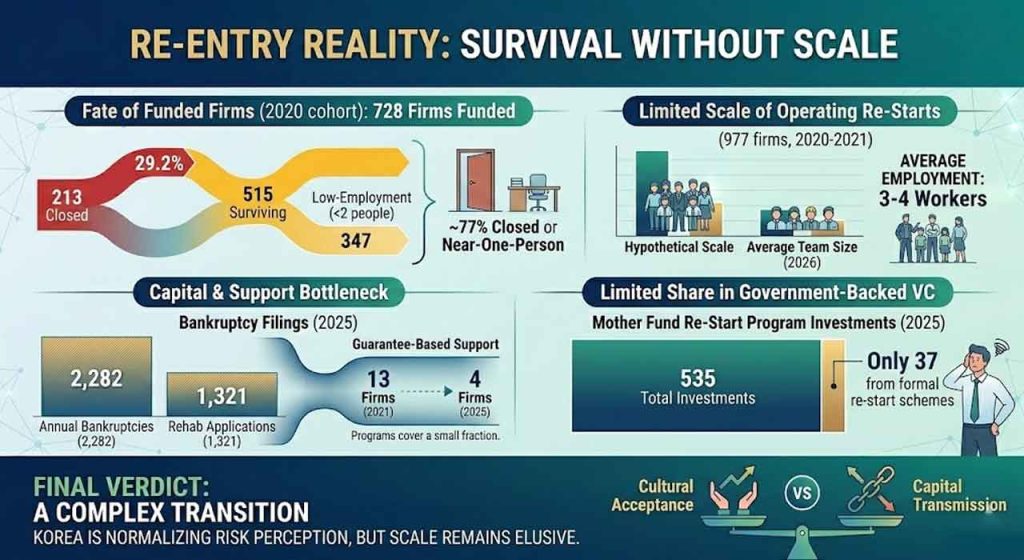
An analysis of 728 firms that received government re-launch support funding in 2020 found that, as of January 2026, 213 had already closed again. Among surviving firms, 347 employ two or fewer people. Taken together, nearly 77 percent of supported firms either shut down or operate effectively as one-person businesses.

Average employment among 977 operating firms that received re-launch support between 2020 and 2021 stands at only three to four workers.

Annual corporate bankruptcy filings reached 2,282 in 2025, with 1,321 corporate rehabilitation applications. However, guarantee-based re-start support programs cover only a small fraction of those cases.

The Korea Credit Guarantee Fund supported 13 re-start firms in 2021. But in 2025, that number fell to four.

Even within government-backed venture capital, re-start founders represent a small share. Of 535 investments made by the Mother Fund under re-start-related programs, only 37 went to firms that had participated in formal re-start support schemes.

Cultural acceptance has improved. But capital transmission remains constrained.
Korea’s 2026 startup data shows record-low fear of failure, yet capital and credit barriers still choke re-entry. A structural look at venture friction and re-challenge limits.

Ministerial Position: Re-Challenge Headquarters Moves into Execution Phase

Meanwhile, at the February 26 meeting of the 2026 Re-Challenge Support Headquarters Steering Committee, the Ministry of SMEs and Startups (MSS) detailed this year’s implementation plan under the re-challenge framework launched in December and previously outlined at the January National Startup Era strategy meeting.

The government confirmed plans to form a KRW 200 billion re-challenge fund. It will also deploy KRW 115 billion through the Re-Challenge Success Package and re-start loan programs to support roughly 750 companies. An additional KRW 5 billion has been allocated exclusively for firms that receive court-approved rehabilitation this year.

Alongside financing measures, the ministry will expand programs designed to shift public perception and improve access to information. These include “Failure Concerts,” a regional-to-national Re-Challenge IR League, community programs for entrepreneurs who have closed and restarted businesses, and the upgrade of the existing re-challenge support website into a dedicated platform offering case studies and closure guidance.

Minister Han Seong-sook stated,

“The Re-Challenge Support Headquarters will record failure not merely as experience but as entrepreneurial achievement, accumulating it as data that becomes an asset for future success.
We will strengthen customized, stage-based support so that entrepreneurs preparing for re-challenge can attempt again, while continuing efforts to improve social perceptions of failure.”

The policy emphasis is clear. The state is attempting to institutionalize second attempts. The framework introduced earlier this year is now entering active deployment

Korea’s Entrepreneurship Restart: Cultural Shift Without Capital Fluidity

The 2025 GEM results confirm that Korea has made measurable progress in social perception. Fear of failure is no longer the dominant psychological barrier.

However, re-entry capital access remains structurally tight.

Guarantee programs remain limited in scale relative to bankruptcy volume. Investment allocation into re-start founders remains modest. The average firm size among re-start beneficiaries remains small.

This suggests a mismatch between cultural reform and financial intermediation.

Globally, mature venture ecosystems often differentiate between social stigma and capital risk pricing. The United States, for example, has normalized repeat entrepreneurship within venture capital circles, even if credit markets remain conservative. Israel’s ecosystem similarly tolerates high failure rates in technology startups.

Korea appears to be moving culturally toward these models. Yet credit evaluation practices, guarantee thresholds, and public-to-private capital handoffs continue to act as filters.

The friction is not psychological. It is structural.

This distinction carries weight when assessing Korea’s position as a venture capital hub within the Asia-Pacific startup ecosystem. A society that increasingly tolerates failure can generate a larger pool of first-time founders. Yet if capital providers remain cautious in backing repeat entrepreneurs, the cycle of reinvestment and cumulative innovation slows.

The implications also extend beyond Korea with clear lessons for emerging ecosystems watching the transition: the changing cultural perception that normalizes failure does not automatically unlock liquidity at the point of re-entry.

What ultimately shapes outcomes are guarantee systems, credit evaluation practices, and the continuity between public funding and private investment. These mechanisms decide whether failure becomes part of an iterative growth process or a final exit from the market.

Testing the KRW 200 Billion Re-Challenge Fund

The newly announced KRW 200 billion re-challenge fund is positioned as a critical financial instrument within Korea’s second-attempt ecosystem. Its real impact, however, will hinge on how it is deployed, how much private capital it can attract alongside public money, and whether re-start firms gain access to sustained follow-on investment.

If the fund functions as catalytic capital that encourages venture investors to participate, re-entry barriers could gradually ease. Capital would begin to circulate rather than stall at the first rehabilitation stage.

Yet if the vehicle operates in isolation, disconnected from guarantee programs and private financing channels, structural scale limits are likely to remain. Public funding alone cannot resolve systemic bottlenecks.

The indicators to watch are clear: five-year survival rates, employment growth within re-start firms, and the share of venture investment directed toward repeat founders.

Social fear has receded. The decisive question now concerns capital continuity.

Key Takeaways on Korea’s Entrepreneurship Restart and Re-Challenge Program 2026

  • Korea ranks 8th in the 2025 Global Entrepreneurship Monitor with a NECI score of 5.9, above the global average.
  • Only 27.0% of Koreans cite fear of failure as a barrier, the lowest rate among 53 surveyed countries.
  • 24.6% of adults plan to start a business within three years.
  • Among 728 firms receiving 2020 re-launch funding, 213 closed again; nearly 77% either shut down or remain micro-sized.
  • Annual corporate bankruptcies exceed 2,200 cases, yet guarantee-based re-start support remains limited.
  • The government plans a KRW 200 billion re-challenge fund and KRW 115 billion in re-start financing for 2026.
  • The structural challenge lies not in social stigma, but in credit guarantees, capital continuity, and venture allocation to repeat founders.

🤝 Looking to connect with verified Korean companies building globally?
Explore curated company profiles and request direct introductions through beSUCCESS Connect.


– Stay Ahead in Korea’s Startup Scene –
Get real-time insights, funding updates, and policy shifts shaping Korea’s innovation ecosystem.
➡️ Follow KoreaTechDesk on LinkedIn, X (Twitter), Threads, Bluesky, Telegram, Facebook, and WhatsApp Channel.

Tags: Asia-Pacific startup ecosystementrepreneurshipEntrepreneurship in South KoreaGlobal Entrepreneurship Monitor KoreaKISEDKorea corporate bankruptcy statisticsKorea entrepreneurship index 2025Korea entrepreneurship policyKorea fear of failure rateKorea Institute of Startup & Entrepreneurship DevelopmentKorea Mother Fund investment dataKorea re-challenge fund 2026Korea repeat foundersKorea SME rehabilitation supportKorea startup credit guarantee systemKorea startup ecosystem 2026Korea startup ecosystem trendsKorea startup re-entry barriersKorea startup survival ratesKorea venture capital accessKorea venture policy analysisKorean entrepreneurshipKorean entrepreneurship policyKorean entrepreneurship trendsKorean startup ecosystem trendsKorean startup trendsMinistry of SMEs and Startups (MSS)Re-Challenge Fundre-challenge fund Koreare-entrepreneurship supportRestart FundSMEs and StartupsSMEs and Startups PolicySMEs and Startups supportSMEs and Startups TrendstrendsVenture Trends
Previous Post

Inside Korea’s Startup Lobby Shift: KOSPO Names a New Chair and Targets Emerging-Industry Rule Reform

Next Post

AroundX Scaled to 403 Startups with OpenAI, HP, and More: Turning Global Collaboration into Policy-Backed Infrastructure

Next Post

AroundX Scaled to 403 Startups with OpenAI, HP, and More: Turning Global Collaboration into Policy-Backed Infrastructure

MOST READ ARTICLE OF THE WEEK

1.
Korea’s AI Goes Global Under a New Rulebook: 5 Verified Companies Already Scaling Overseas
23 Feb 2026
2.
Korea Moves to Shield 6,000 Exporters After U.S. Supreme Court Tariff Ruling
22 Feb 2026
3.
MRO and AI Safety: What the Netform R&D Pre-IPO Push Reveals About Korea’s Industrial Tech Shift
23 Feb 2026
4.
Stable Factory Jobs Shrinking, Wage Gaps Widen: Startups May Feel the Pressure Next
23 Feb 2026
5.
Korea Bets ₩87B on Field-Ready AI: What Manufacturing Startups and Global Investors Should Watch
24 Feb 2026
Register for Event

[the_ad id=”18508″]

List Article

1.
Inside Korea’s Startup Funding Machine: From Government Budget to Venture Capital to Bank Account
27 Feb 2026
2.
How Korea’s Startup Support System Actually Works: A Map for Foreign Readers
25 Feb 2026
3.
6 Reasons Why Seoul Is Poised to Become a Top 5 Global Economic Hub by 2030
20 Aug 2024
4.
Top Co-working Spaces for Startups & Companies to Explore in South Korea
3 Apr 2024
5.
Top Accelerators in South Korea Shaping Startup Success
29 Nov 2023

Similar Articles

Trends

Stable Factory Jobs Shrinking, Wage Gaps Widen: Startups May Feel the Pressure Next

More
Trends

Women’s Share in Korea’s Startup Workforce Has Doubled in a Decade: What Changed Inside the Ecosystem?

More
Trends

Korea’s Startup Risk Has Changed: Profitability and IPO Credibility Now Decide the Price

More

Topics

Menu
  • AI & Big Data
  • AR & VR
  • Blockchain
  • Clean Technology
  • Content & Games
  • Cybersecurity
  • Enterprise & SaaS
  • FinTech
  • Gadgets & Electronics
  • Health & Bio
  • IoT

Program

Menu
  • Asan Voyager
  • CAPA Global Program
  • SGSC Global Bootcamp
  • LAUNCHPAD
  • COMEUP STARS 120
  • K-Startup Grand Challenge
  • TIPS X beSUCCESS Global Project
  • SFL Global Program
  • KTO Global Showcase
  • Yonsei Univ Global Class
  • KOSME Global Program

About

Menu
  • About Us
  • all articles
  • Terms of Use
  • Privacy
  • Cookie-policy
  • twitter

Subscribe and be informed first hand about actual Korean startup news.

All the day’s headlines and highlights, direct to you every morning.

Contact us : [email protected]

Topics

Menu
  • AI & Big Data
  • AR & VR
  • Blockchain
  • Clean Technology
  • Content & Games
  • Cybersecurity
  • Enterprise & SaaS
  • FinTech
  • Gadgets & Electronics
  • Health & Bio
  • IoT

Program

Menu
  • Asan Voyager
  • CAPA Global Program
  • SGSC Global Bootcamp
  • LAUNCHPAD
  • COMEUP STARS 120
  • K-Startup Grand Challenge
  • TIPS X beSUCCESS Global Project
  • SFL Global Program
  • KTO Global Showcase
  • Yonsei Univ Global Class
  • KOSME Global Program

About

Menu
  • About Us
  • all articles
  • Terms of Use
  • Privacy
  • Cookie-policy
  • twitter

Subscribe and be informed first hand about actual Korean startup news.

All the day’s headlines and highlights, direct to you every morning.

© 2023 Koreantech News & Media Korea Zrt. All rights reserved.

Our Spring Sale Has Started

You can see how this popup was set up in our step-by-step guide: https://wppopupmaker.com/guides/auto-opening-announcement-popups/

Our Spring Sale Has Started

You can see how this popup was set up in our step-by-step guide: https://wppopupmaker.com/guides/auto-opening-announcement-popups/

We hope you enjoy our content, May you please give us Feedback regarding our website!

Single Post Feedback

dgdfgfdgdf

What you think about Koreatechdesk, Share your idea with us!

feedback popup

Invitation submission has been closed

Insert/edit link

Enter the destination URL

Or link to existing content

    No search term specified. Showing recent items. Search or use up and down arrow keys to select an item.