Global investors have long watched Korea’s AI healthcare sector evolve from promising innovation to measurable performance. The latest financial and strategic results from Korean AI health tech company Lunit show how that transition is finally materializing. Behind the record numbers lies a deeper signal, showcasing that Korea’s medical AI ecosystem is entering a phase of global validation, where scientific credibility and commercial traction now move in tandem.
Lunit Reports Record Revenue Amid Global Expansion and AI Clinical Validation
Korean medical AI leader Lunit Inc. has reported its highest-ever cumulative Q3 revenue in 2025, reflecting strengthened global footprint and expanding adoption of Korean AI healthcare technologies.
The company’s performance signals that Korean AI healthcare firms are maturing into globally recognized, data-driven players capable of scaling their technologies and governance to international standards.
Record Financial Results and Integration Success by Lunit
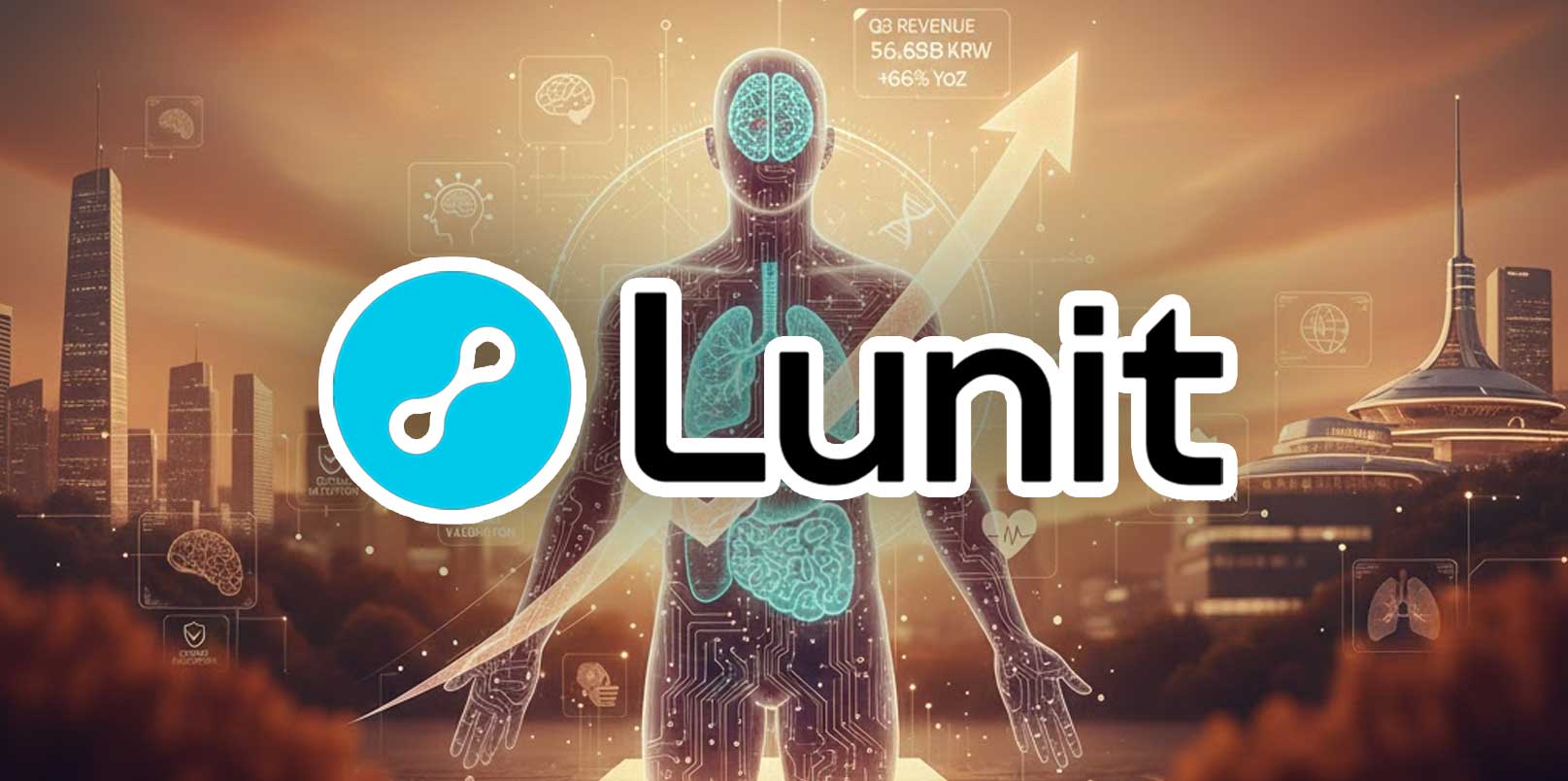
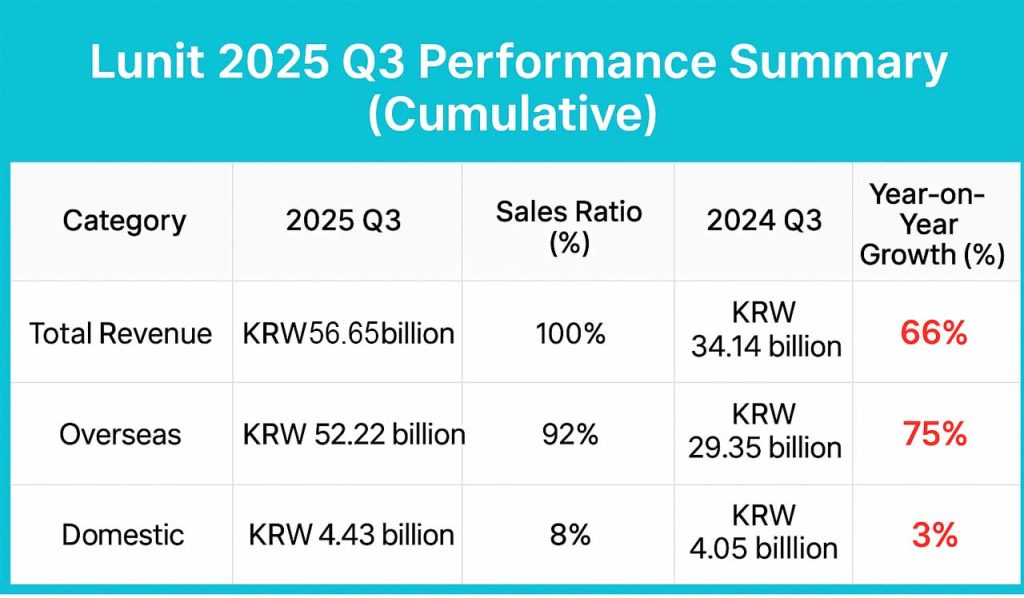
Lunit recorded KRW 56.65 billion (~ USD 42 million) in cumulative revenue for the third quarter of 2025, a 66% year-on-year increase and the company’s highest Q3 performance to date.
Operating loss ratio improved by 32 percentage points, reflecting stronger margins from scale efficiencies, the completion of its Volpara Health Technologies integration, and the growth of its AI biomarker platform Lunit SCOPE, which saw demand surge 182% compared with the previous year.
The integration of Volpara, a New Zealand–based breast health software company acquired in May 2024, consolidated Lunit’s North American operations and expanded its digital breast tomosynthesis (DBT) product sales for five consecutive quarters. Post-merger, the company unified its subsidiaries under a single “Lunit” brand—Lunit International and Lunit Americas—strengthening operational coherence and brand visibility across regulated markets.
Expanding Global Research and Industry Partnerships
Lunit’s November updates revealed rapid progress in research partnerships and clinical validation.
The company presented 14 AI research abstracts at the 2025 Radiological Society of North America (RSNA) meeting—8 selected for oral presentation—and showcased three new studies using Lunit SCOPE at the 2025 Society for Immunotherapy of Cancer (SITC) conference, reaffirming the platform’s role in AI-powered biomarker discovery and drug development.
Strategic collaborations deepened across major healthcare markets. In the United States, Lunit signed a partnership with Labcorp, the global diagnostics leader, to co-develop AI-driven tumor microenvironment analyses and immunotherapy response prediction.
Meanwhile, in the Middle East, the company joined the Korea–UAE enterprise MOU ceremony, forming a collaboration with ARJ Group to pilot a pilot a medical AI foundation model specialized for clinical application across UAE and Middle Eastern hospitals.
These moves demonstrating Korea’s expanding health-tech collaborations in high-growth international markets.
From AI Diagnostics to Multimodal Clinical Intelligence
Founded by engineers in Seoul, Lunit has evolved into a global cancer AI ecosystem spanning 10,000 medical institutions in 65 countries.
Its modular AI platform connects radiology, pathology, and biomarker insights, covering the entire cancer care pathway.
Core products include:
- Lunit INSIGHT for screening and imaging diagnostics (CXR, DBT, MMG).
- Lunit SCOPE for precision oncology and AI biomarker development.
The company’s technology is trained on millions of annotated medical images—including X-ray, mammography, and tissue scans—and some of the products are FDA-cleared and CE-marked under the EU MDR, ensuring reliability for hospital-scale deployment.
Lunit’s long-term roadmap focuses on developing foundation models capable of integrating imaging, clinical, and molecular data for precision treatment optimization.
Governance and ESG Reinforce Investor Confidence
Lunit’s corporate governance framework mirrors that of mature public enterprises, featuring independent and non-executive oversight, transparent reporting, and consistent shareholder resolutions. The 2025 Annual General Meeting approved all major agenda items, including director appointments, stock option management, and remuneration limits.
Its ESG reporting aligns with Global Reporting Initiative (GRI) Standards 2021 and SASB guidelines, integrating K-IFRS financial disclosures. Environmental and social data focus primarily on headquarters operations, extending selectively to subsidiaries. The company positions ESG as an extension of its mission to “conquer cancer through responsible AI,” ensuring its growth aligns with ethical innovation and global compliance expectations.
Investment Perspective: Lunit and the Maturing Economics of Korean Deep Tech
This trajectory, along with Lunit’s record Q3 revenue also offers valuable signals for global investors tracking the Korean startup ecosystem’s evolution:
Proof of Scale for Korean Deep Tech
Lunit’s global clinical adoption demonstrates that Korea’s health-tech companies can achieve regulatory credibility and operational scale in markets long dominated by Western incumbents.
Shift Toward AI Foundation Models in Medicine
The company’s pilot in the UAE and RSNA 2025 research confirm that Korea is moving toward cross-domain, multimodal AI capable of reshaping cancer diagnostics and treatment planning.
AI Hardware Convergence and Korea’s Vertical AI Momentum
Also, Lunit’s partnership with Rebellions, a Korean AI semiconductor company, adds another dimension to its strategy. While not formally part of any government program, this move reflects Korea’s broader transition toward vertical AI ecosystems—a pillar of the nation’s AI transformation roadmap that emphasizes domain-specific innovation over general-purpose models.
Such cross-sector synergy between AI software and semiconductor design underscores Korea’s potential to build self-sustaining deep tech verticals with global relevance.
Alignment with Global ESG and Governance Standards
Lunit’s transparent governance structure and global-standard reporting reflect a maturing corporate culture that aligns with institutional investor requirements, improving Korea’s deep tech investment profile.
Strategic Bridge Between Policy and Market
Finally, the firm’s international collaborations—spanning Microsoft, Labcorp, and the U.S. National Cancer Institute to the UAE’s ARJ Group—mirror the type of global connectivity encouraged by Korea’s innovation policies, which emphasize cross-border cooperation through programs and state-led engagements.
Lunit: Toward Scalable, Responsible Cancer AI
Now, with the 2025 November performance report, Lunit has showcased not just strong financial results, but also signaled the rise of Korea’s health AI sector as a credible investment class in the global deep tech economy.
With continued momentum in clinical validation, foundation model development, and ESG integration, Lunit is shaping the next phase of precision oncology innovation.
And ultimately, for global investors evaluating Korea’s health-tech market, Lunit’s sustained growth and disciplined governance offer a measurable case study of how deep tech startups can transition into globally trusted enterprises.
🤝 Looking to connect with verified Korean companies building globally?
Explore curated company profiles and request direct introductions through beSUCCESS Connect.
– Stay Ahead in Korea’s Startup Scene –
Get real-time insights, funding updates, and policy shifts shaping Korea’s innovation ecosystem.
➡️ Follow KoreaTechDesk on LinkedIn, X (Twitter), Threads, Bluesky, Telegram, Facebook, and WhatsApp Channel.