

South Korea is rapidly building one of Asia’s most structured digital health ecosystems, backed by strong data infrastructure, rising market growth, and tightening regulation. Yet one question is becoming harder to ignore. If access, awareness, and technology are improving, why are users still not consistently acting? The answer is shifting attention toward a deeper issue that now defines the sector’s next phase.
Korea’s Digital Health: Market That Works on Paper, Not Always in Practice
The digital health ecosystem in South Korea is moving quickly. Market size is expanding, regulation is becoming more defined, and data infrastructure continues to deepen.
Yet adoption tells a different story.
Although the nation indicates high awareness regarding digital health platforms, the usage percentage remains low. And even when users engage, sustained behavior remains difficult to maintain.
This gap between access and action is becoming one of the defining constraints in digital health. It signals that the next phase of growth will depend less on building new tools and more on whether users continue to use them.
Despite Expanding Market, Korea’s Digital Health Usage Still Lags
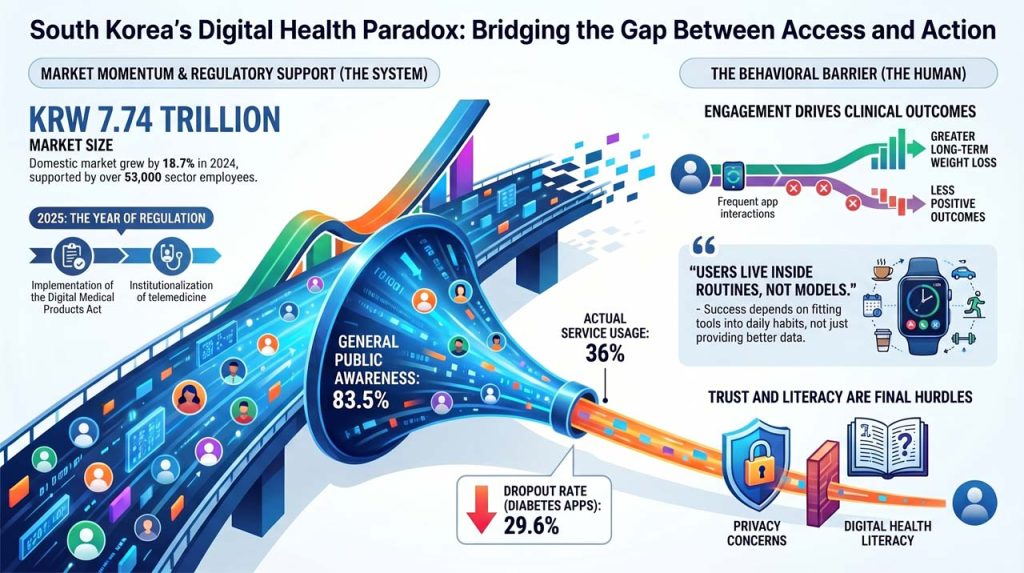
According to findings based on the Korea Digital Health Industry Association, the domestic digital health market reached approximately KRW 7.74 trillion in 2024, growing 18.7 percent year over year. Employment in the sector rose to over 53,000, while exports reached KRW 2.56 trillion.
However, user-side indicators show a gap. A 2025 survey cited in Korean industry reporting found that 83.5 percent of respondents were aware of digital health services, yet only around 36 percent had used them. Among those who had used such services, 75.7 percent expressed willingness to use them again.
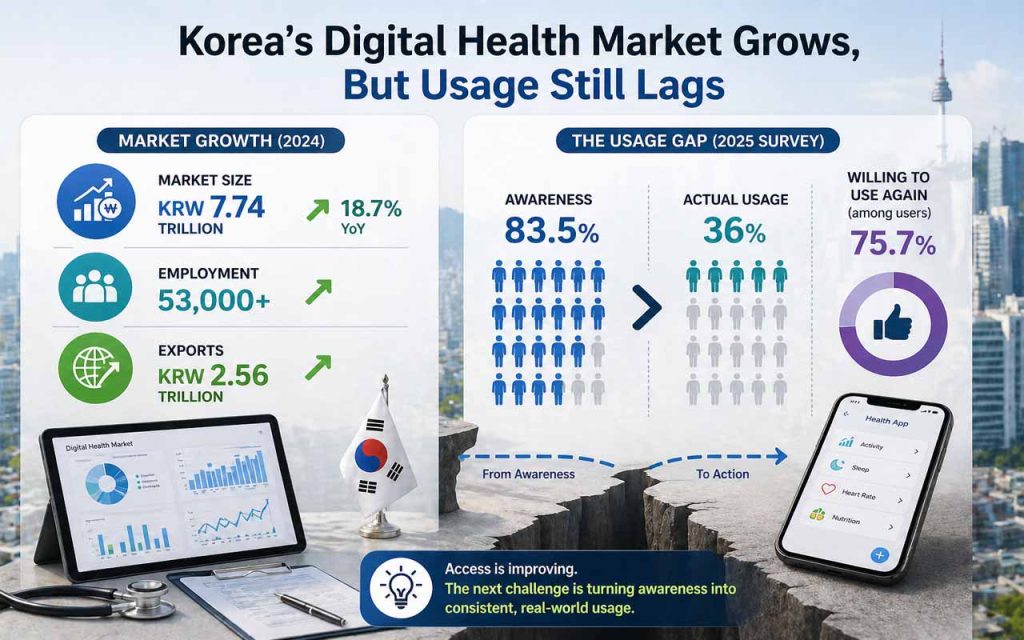
The difference between awareness and actual use remains significant.
This suggests that access alone is not enough. Digital health products must move beyond discovery and into repeated, routine usage.
Policy and Regulation Are Catching Up to Innovation
The Digital Medical Products Act took effect on January 24, 2025, establishing a formal framework for digital health-related products. The Ministry of Food and Drug Safety has positioned the law as a foundation for evaluation, commercialization, and industry development.
Telemedicine has also moved closer to institutionalization. In December 2025, the Ministry of Health and Welfare announced that amendments to the Medical Service Act had passed the National Assembly after years of pilot operation during and after the pandemic period. The law is expected to take effect after a transition period, with safeguards around patient safety and platform oversight.
These developments indicate that Korea is entering a more structured phase of digital health deployment.
However, regulation addresses safety, standards, and access. It does not automatically solve user behavior.
Engagement, Not Access, Determines Real Outcomes
Research continues to show that digital health outcomes depend heavily on how users engage over time.
A large real-world study published in JMIR involving 19,211 patients in a blended-care weight management program found that higher early app engagement was associated with greater weight loss at three months. The study reported an average weight reduction of 3.24 percent at three months and 5.22 percent at six months, with stronger outcomes among more engaged users.
This clearly shows that tools can support outcomes, but only when users interact with them consistently.
At the same time, retention remains a challenge. A 2024 meta-analysis of smartphone-based diabetes management applications reported an average dropout rate of 29.6 percent, highlighting persistent engagement issues even in clinically important use cases.
These findings reinforce a broader pattern. Digital health systems are effective under conditions of sustained use. Unfortunately, many users do not reach that point.
Why Users Still Struggle to Follow Through
Apparently, the gap between availability and consistent use is not purely technical. It also reflects how people actually manage health decisions in daily life.
Extending the earlier KoreaTechDesk discussion on personalized nutrition, Claudia Minji Kim, Founder and CEO of Wellthrive Inc., pointed to a common industry blind spot.
“Many companies overestimate the value of information and underestimate the difficulty of action.”
Her observation reflects how digital health products are often designed. Systems assume that better analysis will lead to better decisions. In practice, users must navigate routines, time constraints, cost considerations, and competing priorities.
“Users do not live inside optimization models.
They live inside routines, constraints, habits, uncertainty, and competing priorities.”
Now, the gap between system logic and real-life behavior is the one that shapes the adoption itself.
Even when users understand a recommendation, they may not act on it if it does not fit into their daily context or if it requires additional effort to interpret and execute.

Trust, Usability, and Literacy Still Shape Adoption
Korean research adds further context.
A study by the Korea Institute for Health and Social Affairs found that users of non-face-to-face health services cited benefits such as support for health management, time savings, and reduced effort. However, the same research highlighted the importance of digital health literacyin determining how effectively users could engage with these services.
Other studies on digital health adoption among older adults point to privacy concerns, data security worries, and lack of trust as barriers to continued use.
These factors reinforce a consistent pattern.
Positive perception does not guarantee sustained engagement. Users may recognize value but still hesitate to rely on digital systems for ongoing health decisions.
Global data reflects similar concerns. Surveys by organizations such as KFF and Pew Research Center indicate that trust in AI-generated health information remains limited, even as usage grows.
A Market Entering Its Execution Phase
Taken together, these signals suggest a shift in how digital health should be evaluated.
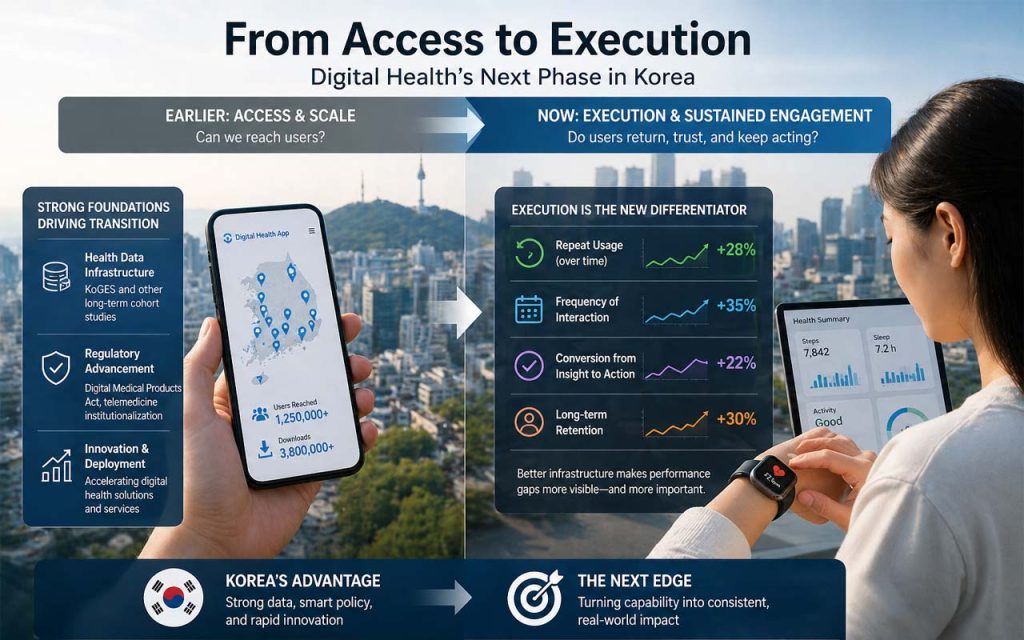
Earlier growth was driven by access, with the primary question centered on whether digital tools could reach users at scale. Today, the focus is moving toward execution, where the more pressing question is whether users return, trust the system, and continue acting on it over time.
South Korea offers a clear lens into this transition. The country has invested heavily in health data infrastructure, including long-term cohort studies such as KoGES, while also advancing regulatory frameworks for digital medical products and telemedicine. These developments are accelerating both innovation and deployment.
At the same time, stronger infrastructure is making performance gaps more visible. As access improves, the difference between initial use and sustained engagement becomes harder to overlook, placing greater emphasis on how digital health products function in real-world conditions.
What Founders and Investors Should Watch Next
The implications are becoming clearer as the market matures.
Advanced analytics and expanding data inputs alone do not ensure adoption. Real impact depends on how well a product fits into everyday routines and how easily users can act without added effort. Design choices around usability, clarity, and timing often influence outcomes more than additional layers of intelligence.
Investment perspectives are also shifting. Early-stage growth driven by user acquisition no longer provides a complete picture of product viability. Greater attention is now placed on behavioral indicators such as repeat usage, interaction frequency, and the consistency with which users act on recommendations.
These signals offer a more accurate view of whether a product is becoming embedded in daily life, which ultimately determines long-term sustainability.
The Next Constraint Is Behavioral, Not Technical
South Korea has built much of what digital health needs to grow. The market is expanding, regulation is becoming more defined, and the data foundation continues to deepen.
What remains unresolved is how these systems translate into everyday use.
Access is no longer the main hurdle. The real test is whether digital health becomes part of a user’s routine, not just something they try once and leave behind.
Until that shift happens consistently, advances in data, policy, and technology will continue to outpace real-world adoption.
Key Takeaways
- Korea’s digital health market reached ~KRW 7.74 trillion in 2024, showing strong growth, but user adoption still lags behind awareness.
- 83.5% awareness vs ~36% usage highlights a clear gap between access and real-world adoption.
- Regulation is advancing, including the Digital Medical Products Act (2025) and telemedicine institutionalization, but policy does not guarantee user engagement.
- Engagement drives outcomes: studies show higher app usage leads to better health results, while dropout rates remain significant (~29.6%).
- User behavior constraints remain central, including trust, routines, decision effort, and digital health literacy.
- As Korea’s ecosystem matures, the key challenge shifts toward retention, repeated action, and long-term usage, not just access or innovation.
– Stay Ahead in Korea’s Startup Scene –
Get real-time insights, funding updates, and policy shifts shaping Korea’s innovation ecosystem.
➡️ Follow KoreaTechDesk on LinkedIn, X (Twitter), Threads, Bluesky, Telegram, Facebook, and WhatsApp Channel.
🤝 Looking to connect with verified Korean companies building globally?
Explore curated company profiles and request direct introductions through beSUCCESS Connect.