
In developer tools, pricing changes often reveal deeper shifts in strategy. The decision from UModeler to make its core 3D engine free, alongside launching an AI assistant, reflects a broader repositioning around workflow control and long-term monetization. For founders and investors tracking the evolution of creation tools, this move highlights how scale, not software licenses, is becoming the foundation of value in the AI-driven 3D ecosystem.
A Pricing Decision That Points to a Deeper Strategic Shift
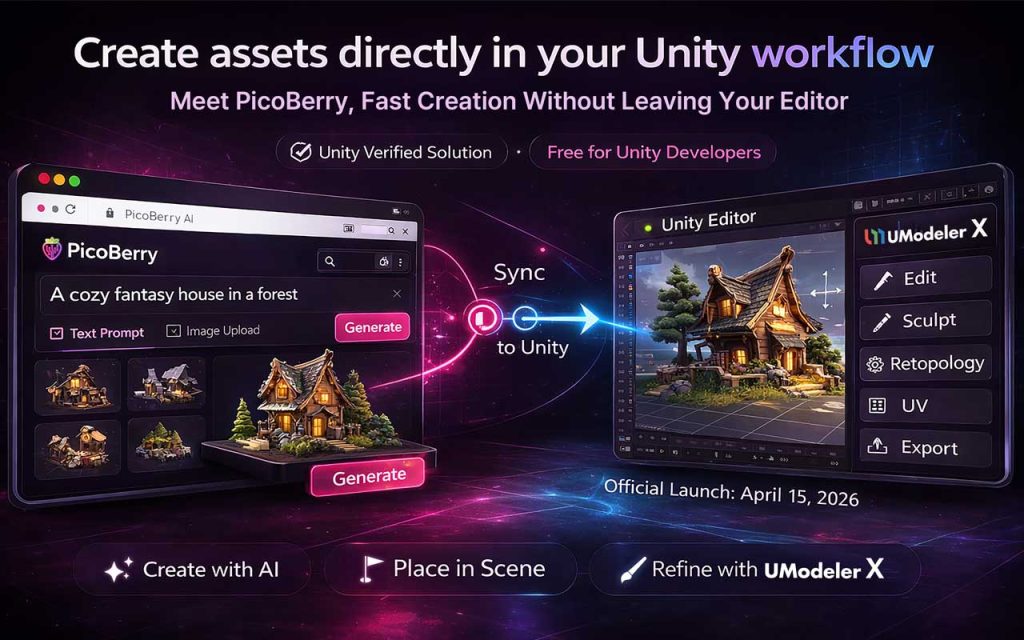
UModeler, Inc., a South Korea–based developer of 3D creation tools, has announced that its flagship engine, UModeler X, will become fully free on April 15, 2026, alongside the launch of its AI assistant PicoBerry.
On the surface, the move lowers access barriers for developers and creators working inside Unity-based workflows. But in context, it is a structural signal that UModeler is redefining how its product is distributed, how value is captured, and where monetization is expected to occur.
Inside UModeler’s Product Strategy: Building Within the Unity Workflow
UModeler X is positioned as an all-in-one 3D creation tool operating directly inside the Unity editor. It supports modeling, UV editing, rigging, and skinning within a single environment, reducing reliance on external digital content creation tools.
The launch of PicoBerry extends this workflow. The AI assistant is designed to generate 3D assets from text or images, which can then be refined inside UModeler X. The company describes this as an “AI-to-Edit” workflow, where generation and refinement occur in a continuous loop within the same environment.
CEO Jaesik Hwang framed the shift in a company statement, noting that tools should “expand creativity, not limit it,” and that removing cost barriers is central to enabling broader adoption.
Taken together, the product direction shows that UModeler is not positioning itself as a standalone modeling tool. It is attempting to become part of the core production workflow inside Unity-based development.
From Subscription Software to Platform Logic
The more important shift sits in the company’s business model.
In direct correspondence with KoreaTechDesk, UModeler confirmed that it is moving away from a license-driven approach toward what it describes as a platform-centric model.
“Our long-term monetization is anchored in AI-powered services like PicoBerry and enterprise offerings. UModeler X becoming free isn’t a step back—it’s a deliberate platform play.”
The logic follows a familiar sequence seen in other developer ecosystems:
- Remove friction at entry
- Expand the user base
- Introduce paid services at the workflow level
In UModeler’s case, monetization is expected to come from two sources:
- AI-based services such as PicoBerry
- Enterprise-level plans for studios requiring additional capabilities
The company further clarified its approach to user growth and conversion:
“By removing the price barrier, we’re optimizing for deep adoption first… the conversion path is organic, not forced.”
This places UModeler’s strategy closer to infrastructure or platform models than traditional software sales.
Why This Move Is Happening Now
The timing of the shift reflects both internal and external signals.
UModeler pointed to two key factors:
- The increasing role of AI in shaping expectations around 3D creation
- Changes in the competitive landscape within Unity-based tools
At the same time, the company emphasized that the decision was not purely reactive.
“We chose to move proactively rather than reactively.”
This combination of market pressure and internal conviction is consistent with how early-stage platform strategies typically emerge. The window to establish default workflows is often narrow, particularly in ecosystems where developer habits form quickly.
What This Signals for the 3D Creation Ecosystem
UModeler’s move reflects a broader shift in how value is created and captured in developer tools.
Free Access as Distribution Strategy
The removal of subscription pricing does not eliminate monetization. It shifts it instead.
Instead of charging for access to the tool, UModeler is using free access to expand its distribution across developers, students, and creators. The assumption is that scale will enable monetization later through services layered on top of usage.
Workflow Control as Competitive Position
By focusing on creation inside Unity, UModeler is competing at the level of workflow, not features.
If developers model, edit, and iterate within a single environment, switching costs increase. Control of workflow can translate into long-term retention and monetization opportunities.
AI as a Monetization Layer
PicoBerry is positioned not just as a feature, but as a separate layer of value.
Rather than selling the core tool, UModeler is aligning revenue with speed, automation, and efficiency gains provided by AI. This reflects a growing pattern where AI is used to justify incremental or usage-based pricing within otherwise free systems.
The Opportunity—and the Unanswered Questions
The strategic direction is clear, but its long-term impact will depend on how it unfolds in execution.
With user conversion rates, enterprise plan adoption levels, and AI-generated workflow usage metrics still developing, several important indicators are yet to fully take shape.
The model will likely hinge on a few key dynamics. UModeler X needs to reach meaningful scale in adoption. PicoBerry must demonstrate consistent value that encourages paid usage. Enterprise offerings will need to establish clear differentiation within existing workflows.
How these elements evolve over time will play an important role in determining how sustainable this approach becomes as the platform matures.
A Broader Signal from South Korea’s Startup Ecosystem
UModeler’s shift also reflects a wider pattern among Korean startups targeting global markets.
Rather than focusing on localized SaaS models, companies are increasingly building tools designed for global developer ecosystems. This requires competing not only on features, but on integration, workflow, and positioning within established platforms.
In this case, UModeler is not attempting to replace existing 3D tools outright. It is attempting to embed itself within a widely used development environment and expand from that position.
For global founders and investors, this signals a shift in how Korean startups approach software distribution and scaling. The emphasis is moving toward ecosystem positioning and long-term workflow ownership, rather than direct feature competition.
A Platform Bet Still in Progress
UModeler’s decision to make UModeler X free marks a clear departure from traditional software monetization models. It is a calculated move to trade short-term revenue for long-term positioning within the Unity ecosystem.
The company is betting that control over workflow, combined with AI-driven services, will create a sustainable path to monetization.
That outcome may not be guaranteed.
But what is clear is that the company has moved beyond incremental product updates. It is now operating on a different strategic level, where success depends less on individual features and more on how effectively it can become part of the default way developers create in 3D.
Key Takeaway
- UModeler, Inc. will make UModeler X free on April 15, 2026, alongside launching AI assistant PicoBerry
- The company is shifting from subscription-based software to a platform model
- Monetization is expected through AI services and enterprise offerings, not core tool access
- Strategy focuses on user adoption first, revenue later, within Unity-based workflows
- UModeler aims to embed itself as a default 3D creation layer inside Unity
- Key risks remain around conversion, AI value, and enterprise adoption
- The move reflects a broader trend of Korean startups targeting global ecosystems through workflow ownership
– Stay Ahead in Korea’s Startup Scene –
Get real-time insights, funding updates, and policy shifts shaping Korea’s innovation ecosystem.
➡️ Follow KoreaTechDesk on LinkedIn, X (Twitter), Threads, Bluesky, Telegram, Facebook, and WhatsApp Channel.
🤝 Looking to connect with verified Korean companies building globally?
Explore curated company profiles and request direct introductions through beSUCCESS Connect.