
South Korea is once again promising to reset its regulatory framework for startups—this time to “zero.” President Lee Jae-myung’s latest directive to rebuild entrepreneurship rules from the ground up signals a national push to transition into a startup-centered economy. But for founders and investors, the question remains: can a true startup nation be built without confronting the entrenched systems that have long defined Korea’s innovation limits?
President Lee Orders ‘Zero-Base’ Overhaul of Startup Regulations
During a Cabinet meeting on February 3, President Lee Jae-myung called for a complete reexamination of Korea’s startup regulations, saying:
“We must lower the threshold for entrepreneurship so that anyone with an idea can start a business, and we must back this with bold institutional reforms and funding support.”
The directive follows growing concern over structural job losses in the age of artificial intelligence. Lee’s administration sees entrepreneurship as both an economic and societal response—encouraging citizens to build new businesses amid labor automation and market transformation.
The President’s remarks have been met with cautious optimism across the venture and startup community, which hopes that this time, Korea’s reform pledges will move beyond political rhetoric and deliver structural change.
A History of Regulatory Reform Fatigue
For decades, each Korean administration has pledged to “free innovation” through deregulation, yet founders say those efforts rarely survive beyond the policy announcement phase.
The regulatory sandbox system, once promoted as a symbol of innovation, has faced mounting criticism for being too temporary and bureaucratic. Delayed approvals, short exemption periods, and conditional reviews have left many startups struggling to scale beyond the pilot stage. Not to mention the lack of protection and guaranteed path beyond experimental phase once these sandboxes proved a success.
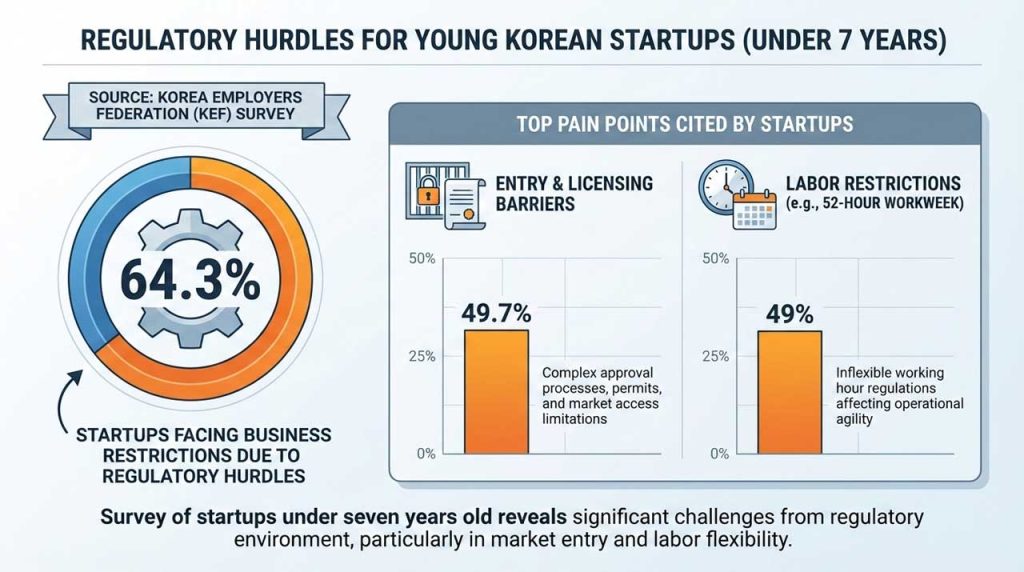
According to a recent survey by the Korea Employers Federation (KEF), 64.3% of startups under seven years old said they faced business restrictions due to regulatory hurdles. The top pain points were entry and licensing barriers (49.7%) and labor restrictions such as the 52-hour workweek (49%).
This pattern of limited follow-through has eroded confidence in Korea’s policy execution. Founders describe a “cycle of declaration and disappointment,” where regulatory reform is announced as vision but implemented as procedure.
Startups Demand Sustainable Change
Industry voices stress that real reform must move beyond temporary exemptions toward permanent institutional redesign.
A senior startup association member noted:
“If zero-base regulation is to mean anything, it must produce tangible results—actual law amendments and lasting system reforms. Otherwise, it risks becoming another symbolic slogan.”
The Korea Startup Forum (KOSPO) and the Korea Venture Business Association (KOVA) have repeatedly called for a shift from positive to negative regulation—a model that allows all activities except those explicitly banned. They also advocate for the institutionalization of sandbox rules, ensuring continuous operational rights for verified innovators rather than time-limited permits.
Without such structural safeguards, industry leaders warn that new ventures will continue to face barriers once their business models collide with established sectors.
Why Zero-Base Regulation Matters Now
The timing of Lee’s initiative is critical. Korea’s innovation momentum has been shaken by a string of high-profile cases where policy failed to protect early innovators.
Mobility startup TADA, legal-tech platform LawTalk, STO sandbox Lucentblock, and telemedicine provider DoctorNow each became symbols of how vested interests can outmaneuver reform efforts.
Their setbacks highlighted how government and legislative bodies often side with established associations—such as taxi, legal, or medical lobbies—when innovation challenges existing order.
The “zero-base regulation” framework could serve as Korea’s structural correction: an attempt to replace fragmented policy with a foundation that reflects convergence-era realities, where software, AI, and data cross traditional industry boundaries.
Globally, this moment positions Korea alongside other innovation-driven economies attempting regulatory resets—mirroring Japan’s “Digital Garden City” deregulation drive and Singapore’s continuous regulatory sandboxes.
However, experts caution that without measurable follow-through, Korea risks another short policy cycle. The country’s ambition to become a “startup-centered nation” hinges not just on rhetoric but on execution fidelity—building legal and financial environments where risk-taking can sustain itself.
“Zero-based” Startup Regulation Overhaul: Reform Requires Breaking Old Habits
The zero-base regulation initiative could mark the most ambitious policy reset in Korea’s startup history. But as the ecosystem has learned through past cycles, the difference between a promise and a paradigm shift lies in institutional will.
For founders, investors, and global partners watching Korea’s innovation narrative, the challenge is not whether the country can draft new rules—it is whether it can let go of the old ones.
If this overhaul leads to codified startup protection laws, negative regulation adoption, and a redefined sandbox system, Korea may yet rebuild credibility as a model of agile innovation governance.
Key Takeaway on President Lee Jae-myung’s “Zero-based” Startup Regulation Overhaul
- Event: President Lee Jae-myung announced a “zero-base” regulatory overhaul for startups at a Cabinet meeting on February 3, 2026.
- Objective: Lower barriers to entrepreneurship and redesign Korea’s innovation framework.
- Industry Response: Optimism tempered by skepticism due to repeated reform failures.
- Core Issues: Short-term sandbox exemptions, slow regulatory processes, and protectionism for vested interests.
- Policy Debate: Startups demand negative regulation and institutionalized reform.
- Ecosystem Impact: Could reshape Korea’s startup governance, aligning with global innovation standards if implemented fully.
- Risks: Without legislative follow-through, the initiative risks becoming another symbolic policy cycle.
– Stay Ahead in Korea’s Startup Scene –
Get real-time insights, funding updates, and policy shifts shaping Korea’s innovation ecosystem.
➡️ Follow KoreaTechDesk on LinkedIn, X (Twitter), Threads, Bluesky, Telegram, Facebook, and WhatsApp Channel.
🤝 Looking to connect with verified Korean companies building globally?
Explore curated company profiles and request direct introductions through beSUCCESS Connect.