

In fast-moving startup ecosystems, strong teams are often seen as a reliable signal of better outcomes. Yet across South Korea’s expanding collaboration landscape, decision quality is not always keeping pace with team capability. As cross-border partnerships and open innovation grow, a quieter issue is emerging: how capable teams interpret information, assign ownership, and translate input into decisions is becoming a defining factor in execution.
Strong Teams Are Not the Same as Strong Decisions
Startup ecosystems often assume that better teams produce better outcomes. More experience, broader perspectives, and deeper expertise are expected to improve decision-making.
Global data supports part of that assumption. A 2026 March summary paper from the National Bureau of Economic Research (NBER) shows that startups founded by mixed native and immigrant teams outperform more homogeneous groups. Three years after founding, these companies are about 20 percent larger by employment and significantly more likely to secure funding.
Yet that advantage does not come automatically. The same research suggests that diversity improves outcomes only when differences are effectively translated into decisions.
This is where many teams begin to struggle.
More Input Does Not Always Improve Judgment
The assumption that more perspectives improve decision quality is widely reflected in management practice and startup team design. However, recent research suggests the relationship is less straightforward.
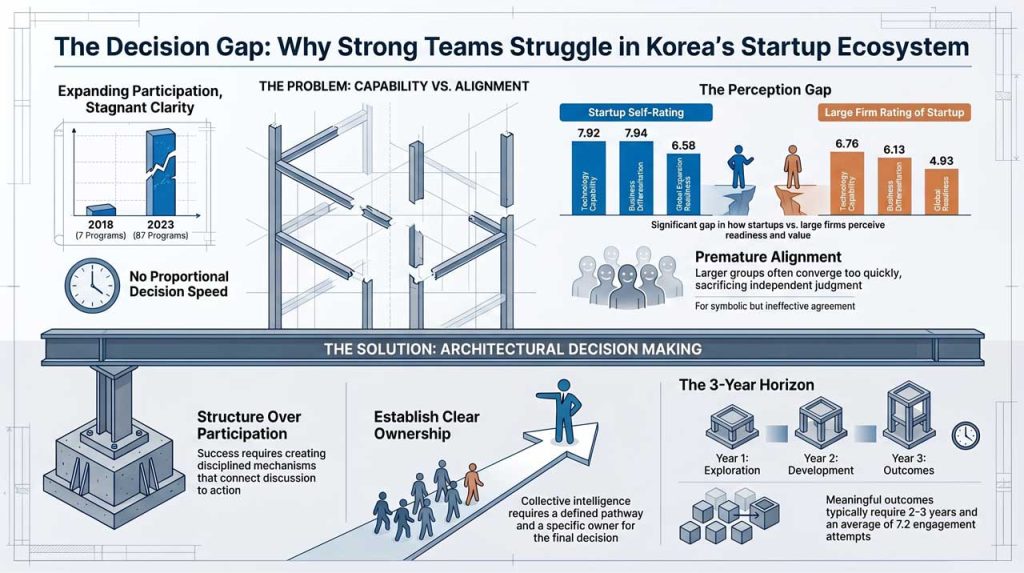
Recent research published in Scientific Reports finds that larger groups can produce less accurate decisions when participants rely on overlapping or socially influenced information. As discussions progress, independent judgment tends to converge too quickly, reducing the diversity of viewpoints that initially strengthened the group.
While this may not result in complete disagreement, it still produces premature alignment.
Valerie Won Lee, an award-winning Global Impact Strategist and former Head of Communications for the UN Global Platform on Big Data, explains this limitation in practical terms.
In her written interview with KoreaTechDesk, she explained that what most teams lack is simply a shared understanding,
“People may have access to the same information but not give it the same meaning or priority.”
Some focus on speed, others on risk, long-term impact, or internal alignment. Without a clear structure to reconcile those differences, decision quality weakens rather than improves.
Korea’s Open Innovation Push Is Expanding Faster Than Decision Alignment
South Korea’s startup ecosystem has rapidly expanded collaboration between large corporations and startups. According to the Korea International Trade Association (KITA), open innovation programs involving major companies increased from 7 programs with 18 firms in 2018 to 87 programs with 361 firms in 2023.
This means that participation is no longer the constraint.
However, the same KITA report highlights a deeper issue. In a survey of 234 companies, including startups and large corporations, both sides evaluated the same collaboration environment differently.
Startups rated their own technology capabilities at 7.92 out of 10, while large firms rated them at 6.76. On business differentiation, the gap was wider at 7.94 versus 6.13. For global expansion readiness, startups gave themselves 6.58, compared to 4.93 from corporate partners.
The differences are significant, but more importantly, they reveal a deeper issue: both sides are evaluating the same collaboration using different measures of value, readiness, and success.
Where Decisions Actually Break: Ownership, Not Discussion
As more stakeholders enter the decision process, the structure behind that process becomes critical.
Won Lee emphasizes that collective intelligence only improves decisions under specific conditions. It requires clear ownership, defined decision pathways, and a direct link between input and action.
Won Lee cautioned,
“If there is no structure, no clear ownership, or no way to turn discussion into decisions, collective intelligence can quickly become symbolic rather than useful.”
Yet, in many cases, those conditions are not fully established.
Open innovation data in Korea reflects this. KITA reports that successful collaboration outcomes typically take two to three years to materialize, while even arranging meaningful engagement can require an average of 7.2 attempts.
This does not mean that they lack efforts, it points instead to a gap in how input is filtered and translated into decisions.
Teams are able to generate ideas and sustain discussion but often struggle to convert that momentum into clear ownership and execution. As a result, collaboration continues to expand, while decision clarity does not always keep pace.
Cross-Border Teams Amplify Internal Misalignment
Cross-border startup teams bring additional layers of complexity. Differences in communication style, decision expectations, and risk tolerance shape how information is interpreted.
According to Won Lee, individuals can interpret the same situation through multiple layers, including experience, cultural background, and institutional pressure. And these differences multiply in cross-cultural environments.
“In a cross-cultural environment, where you also have different generations, sectors, and communication styles involved, that complexity becomes even greater.”
Teams may appear aligned at the level of strategy but remain divided on the assumptions that shape actual decisions, including timelines, trade-offs, ownership, and acceptable risk.
These differences often stay hidden during early discussions, where agreement is easier to maintain. Once execution begins, however, those underlying gaps surface, revealing that alignment on direction did not extend to how decisions were meant to be made.

Execution Does Not Fail First. It Reveals Earlier Gaps
Breakdowns are often attributed to execution issues. In practice, the underlying issue tends to emerge earlier, within how teams align on priorities, ownership, and trade-offs before implementation begins.
Won Lee describes this dynamic clearly,
“When execution diverges, it is often not because the strategy suddenly failed. It is because the deeper alignment was never fully there in the first place.”
This pattern is also reflected in broader business sentiment. The European Chamber of Commerce in Korea (ECCK) reported that satisfaction among European companies operating in Korea declined from 68 percent in 2022 to 45 percent in 2024. Companies cited regulatory complexity and inconsistency in implementation as key concerns.
These challenges are often experienced during execution. But they actually originate earlier, in how expectations are formed and decisions are structured.
Decision Structure Is Becoming a Competitive Factor
This shift carries direct implications across the startup ecosystem. Strong teams alone are no longer enough. What determines decision quality is how authority is defined, how input is filtered, and at what point alignment turns into actual commitment.
Furthermore, extended timelines do not always signal hesitation or deal risk. In many cases, they reflect internal processes that require multiple layers of validation before a decision can be finalized.
And in corporate–startup collaboration, participation in discussions does not automatically translate into influence. The critical question is where decisions are actually made, and who ultimately holds the authority to move them forward.
From Participation to Judgment: The Next Phase of Korea’s Ecosystem
South Korea’s startup ecosystem has reached a stage where collaboration is widespread and accessible. The next phase of development now depends less on increasing participation and more on improving decision quality.
And this requires moving beyond inclusion toward structured judgment.
Won Lee highlights that collective intelligence must be designed with discipline. It depends on the right mix of perspectives, sufficient trust to challenge assumptions, and clear mechanisms that connect discussion to action.
Without these elements, more voices do not strengthen decisions. They dilute them.
“The goal is not simply to hear more voices, but to create the conditions in which different perspectives improve judgment.”
Clarity in Decisions, Not Just Capability, Defines Outcomes
Finally, Korea’s startup ecosystem is not limited by talent, capital, or collaboration. It continues to attract global interest and expand its innovation capacity.
The emerging challenge today lies in how effectively teams convert diverse perspectives into clear, actionable decisions.
In complex environments, strong teams can still produce weak outcomes if decision structures are unclear.
That is why better decisions do not come from more participation alone. Instead, they come from knowing how to interpret input, how to prioritize it, and who ultimately decides.
Key Takeaway for Global Founders, Investors, and Operators
- Mixed and cross-border startup teams can outperform, but only when differences are translated into structured decisions.
- Larger groups can reduce decision accuracy if independent judgment is lost too early.
- Korea’s open innovation ecosystem is expanding rapidly, with programs growing from 7 in 2018 to 87 in 2023.
- Startups and large firms often evaluate the same collaboration differently, reflecting deeper alignment gaps.
- Successful collaboration typically takes 2–3 years, with repeated engagement required before decisions are formed.
- Execution challenges often reflect earlier decision-stage misalignment rather than operational failure.
- Decision clarity, ownership, and structure are becoming key factors in startup and cross-border success in South Korea
– Stay Ahead in Korea’s Startup Scene –
Get real-time insights, funding updates, and policy shifts shaping Korea’s innovation ecosystem.
➡️ Follow KoreaTechDesk on LinkedIn, X (Twitter), Threads, Bluesky, Telegram, Facebook, and WhatsApp Channel.
🤝 Looking to connect with verified Korean companies building globally?
Explore curated company profiles and request direct introductions through beSUCCESS Connect.