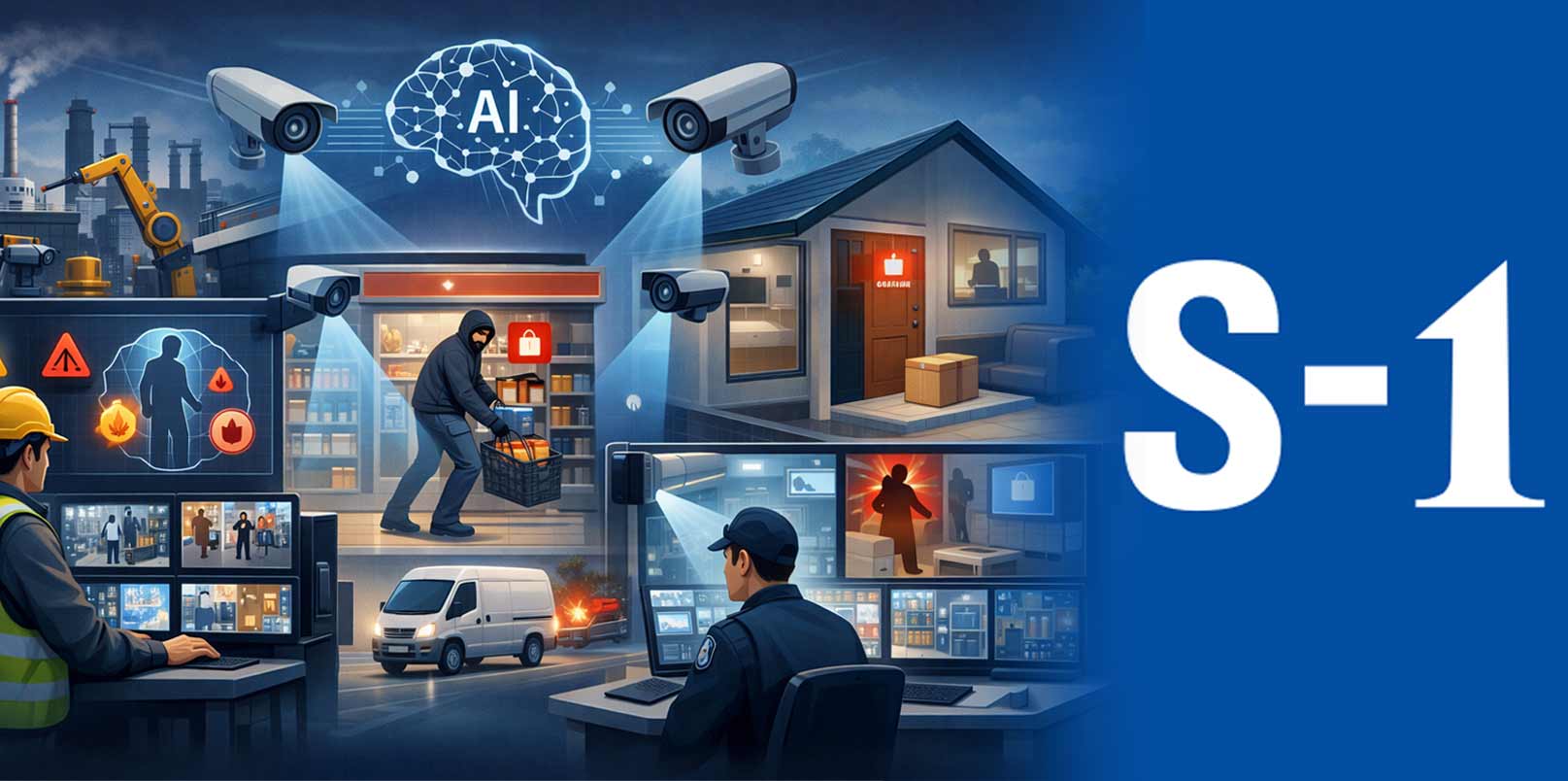
In global security, a quiet revolution is unfolding. Artificial intelligence is no longer confined to analytics or automation—it’s learning to anticipate danger before it happens. From factories to homes, Korea’s S-1 is proving that safety can be predictive, not reactive. Its latest findings reveal how algorithms, data, and human vigilance are converging into the next frontier of intelligent infrastructure.
AI-Powered Prediction Redefines the Global Security Landscape
Korea’s leading security firm S-1 has identified artificial intelligence (AI)-driven prediction as the defining trend for 2026.
Based on a nationwide survey of over 27,000 customers, the company found a decisive shift across industries—from responding to incidents after they occur, to anticipating and preventing them before they happen.
The report, titled “2026 Security Trends,” highlights that demand for AI-powered preemptive detection is rising sharply in factories, unmanned retail stores, public facilities, and homes. This signals a structural shift not only in Korea’s domestic security market but also in how intelligent safety systems will shape global smart infrastructure.
Industrial Safety Adopts Predictive AI as Core Infrastructure
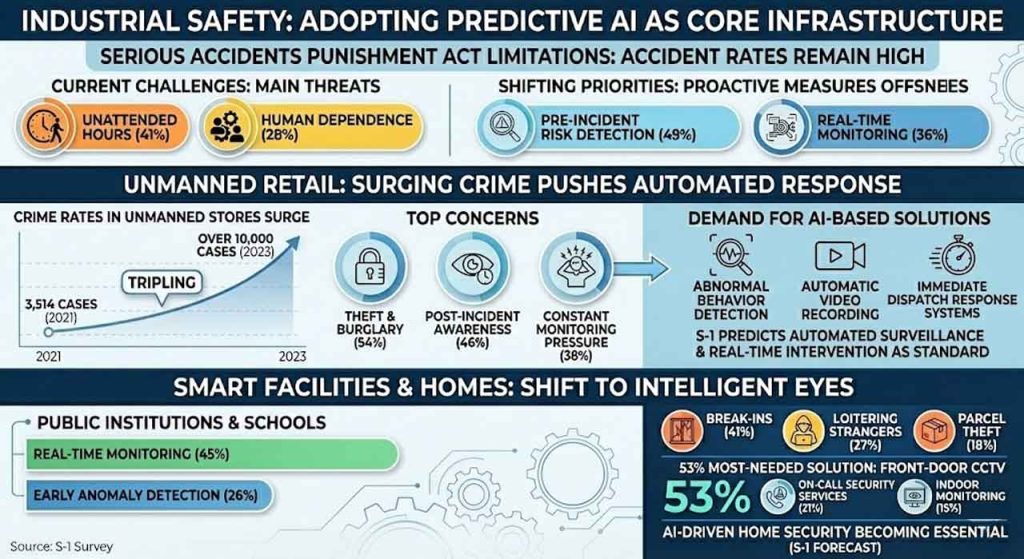
In manufacturing and logistics, the emphasis is moving from passive monitoring to AI-powered predictive safety management. Despite the Serious Accidents Punishment Act, accident rates remain high—revealing the limitations of post-incident measures.
According to S-1’s survey, the main threats in industrial environments are unattended hours (41%), human dependence (28%), and delayed recognition after incidents (27%). Nearly half of respondents prioritized pre-incident risk detection (49%), and over a third emphasized real-time monitoring (36%).
Notably, 83% supported adopting AI-based real-time danger detection solutions—a 25-point jump from the previous year. This marks a fundamental transition toward autonomous safety infrastructure powered by machine learning.
Unmanned Stores Push Demand for Automated, Real-Time Response
As unmanned retail expands, crime rates have surged—tripling from 3,514 cases in 2021 to over 10,000 in 2023. Store operators identified theft and burglary (54%) as their top concerns, followed by post-incident awareness (46%) and constant monitoring pressure (38%).
This has accelerated demand for AI-based abnormal behavior detection, automatic video recording, and immediate dispatch response systems. S-1 predicts that automated surveillance and real-time intervention will become standard features for unmanned retail operations, reshaping retail risk management across Asia’s digital economies.
Smart Facilities and Homes Shift from Lock-and-Key to Intelligent Eyes
Public institutions and schools are now adopting preventive smart facility management, emphasizing real-time monitoring (45%) and early anomaly detection (26%).
At home, the paradigm is changing just as quickly. Korean households are moving from mechanical locks to AI-integrated surveillance systems, as concerns grow about break-ins (41%), loitering strangers (27%), and parcel theft (18%).
Over half of respondents (53%) identified front-door CCTV as their most-needed home security solution, followed by on-call security services (21%) and indoor monitoring (15%). S-1 forecasts that AI-driven home security will soon become as essential as electricity or broadband, blending convenience with protection.
AI Security’s Strategic Impact on Korea’s Startup and Investment Ecosystem
The transformation toward predictive AI security opens new frontiers for Korea’s deep-tech startups.
AI-driven safety platforms now overlap with robotics, IoT sensors, edge computing, and data analytics, giving rise to cross-sector collaboration opportunities. Startups developing real-time risk analytics, automated incident detection, and anomaly forecasting can tap into both industrial and residential markets.
For investors, this evolution redefines security as a data-driven intelligence industry, not just physical protection. The convergence of AI, automation, and IoT positions Korea as an emerging hub for predictive safety technology, with global scalability across manufacturing, smart cities, and infrastructure sectors.
This alignment between market reality and policy ambition may not be accidental
Korea’s national AI strategy, which aims to position the country among the world’s top three AI powerhouses, adds further significance to this trend. Over the years, a growing portion of venture capital and government-backed policy finance has shifted toward deep tech and predictive AI solutions.
If trends like S-1’s predictive security model translate into tangible startup pipelines, they could become a vital pathway toward that national ambition—turning Korea’s AI policy vision into measurable industrial capacity.
From Defense to Foresight
S-1’s 2026 report encapsulates a pivotal global transition: the age of security that merely reacts is ending.
Korea’s ecosystem is now anchoring safety in data foresight and algorithmic intelligence, shaping a model for future-ready urban environments.
As AI becomes the invisible sentinel across industries and households alike, Korea’s predictive security innovation underscores one message: the future of safety lies not in defense, but in foresight.
– Stay Ahead in Korea’s Startup Scene –
Get real-time insights, funding updates, and policy shifts shaping Korea’s innovation ecosystem.
➡️ Follow KoreaTechDesk on LinkedIn, X (Twitter), Threads, Bluesky, Telegram, Facebook, and WhatsApp Channel.
🤝 Looking to connect with verified Korean companies building globally?
Explore curated company profiles and request direct introductions through beSUCCESS Connect.