Korea is taking another decisive step toward deepening the link between finance and innovation. The Ministry of SMEs and Startups (MSS) and the Financial Supervisory Service (FSS) have signed a new agreement that could reshape how institutional funds, including pensions and retirement capital, flow into venture investment. This move has shown Korea’s determination to strengthen the foundations of its venture ecosystem and support its global startup ambitions.
MSS and FSS Forge Alliance to Expand Venture Investment Channels
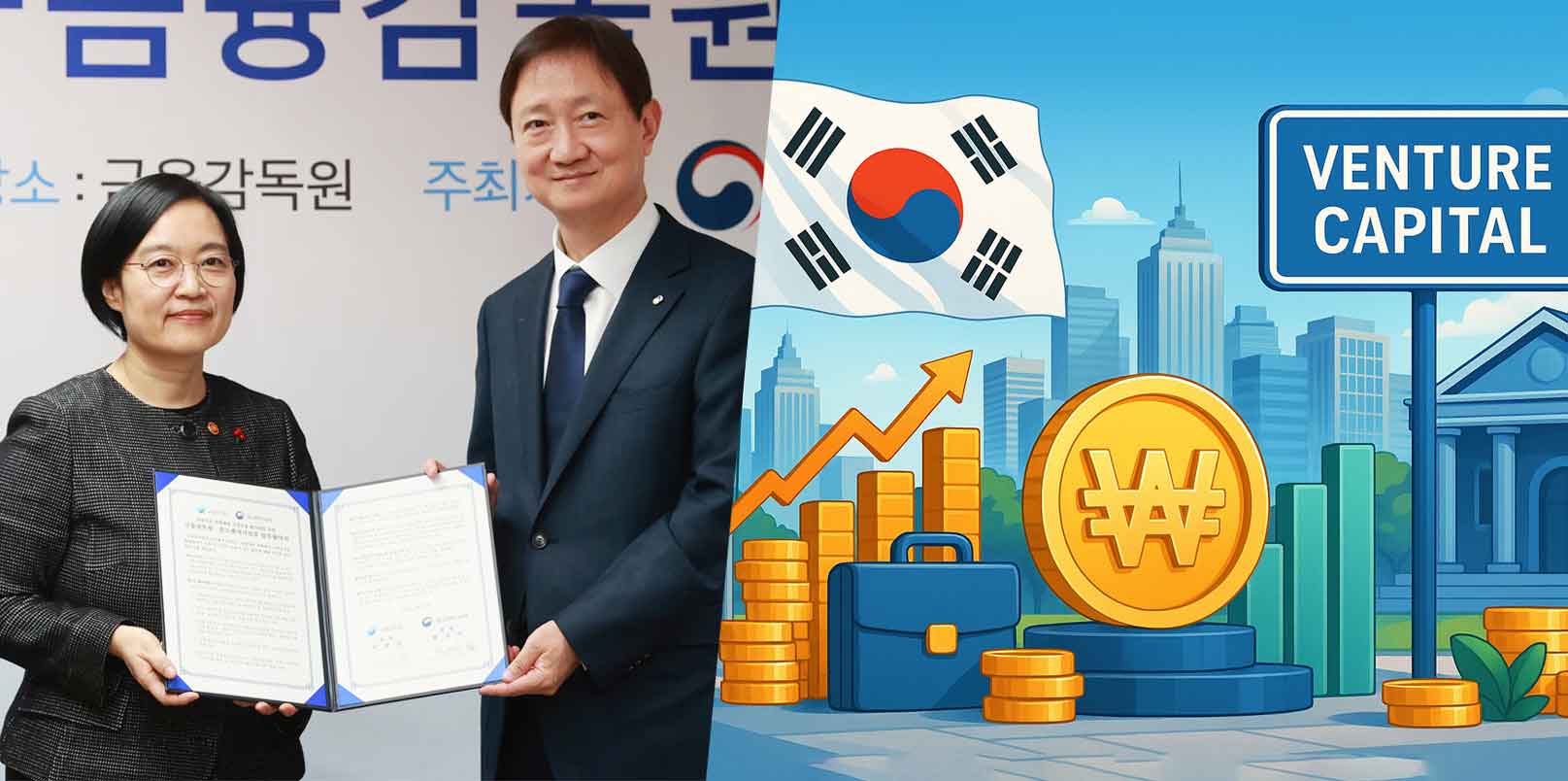
The MSS and FSS signed a memorandum of understanding on November 28 at the FSS headquarters in Yeouido, Seoul. The agreement, titled “Promotion of the Adventure-Capital Ecosystem and Mutual Finance,” seeks to enhance cooperation between financial markets and innovative SMEs and startups.
The initiative focuses on improving prudential regulations — such as risk-weighting rules that limit financial institutions’ participation in venture investment — and easing financing challenges that restrict SME access to capital. Both agencies plan to explore strategies for pension and retirement funds to achieve stable returns while participating in Korea’s venture economy.
They will also strengthen supervision to protect investors and investee companies, while building systems for data sharing between the Korea Technology Finance Corporation (KIBO) and venture capital firms. This structure will enable financial institutions to identify high-potential SMEs and coordinate follow-on investment and lending.

Linking Financial Policy with Startup Growth
The MOU reflects Korea’s policy shift toward “productive finance” — a model designed to channel national capital into innovation and technology rather than low-yield asset markets. It also comes as the government moves to meet its strategic target of nurturing a KRW 40-trillion annual venture investment market and positioning the country among the world’s top four venture powerhouses.
As part of the collaboration, the two institutions plan to roll out the Mutual Finance Index in 2026. The index will measure how effectively financial institutions contribute to SME co-growth through inclusive lending and partnership programs.
Expansion of “shared growth loans,” in which large corporations deposit funds at low interest rates to reduce borrowing costs for suppliers, is also under review.
Industry participants at the signing ceremony voiced optimism but emphasized the need for complementary policy incentives. KB Asset Management CEO Kim Young-sung proposed that long-term venture investment vehicles such as BDCs and funds be eligible for tax benefits to reassure investors.
At the same time, IBK Investment & Securities CEO Seo Jung-hak added that mid-tier securities firms specializing in SME finance can fill capital-supply gaps left by major institutions.
Balancing Innovation and Prudence
The announcement reflects a careful balance between Korea’s ambition to accelerate innovation and its need to maintain financial stability.
Minister Han Seong-sook underscored that venture capital must become the driving force of economic renewal, not merely a speculative market cycle.
“K-ventures and startups are the most powerful growth engines to overcome complex economic challenges. Ensuring sufficient growth capital is essential for them to rise as unicorns and decacorns leading the AI and deep-tech era. Through this agreement, we will continue to strengthen cooperation to achieve Korea’s goal of becoming a top-four global venture powerhouse.”
Governor Lee Chan-jin expanded on that point, stressing that sustainable innovation requires disciplined financial infrastructure and risk management.
“The success of adventure-capital policy depends on building mechanisms that supply and recover funds at each stage of a company’s growth. We will establish a framework that provides adventure capital and win-win finance where they are most needed, ensuring capital flows toward productive, innovation-driven sectors.”
Institutional Capital Meets Innovation
The partnership between MSS and FSS represents a strategic convergence between regulatory policy and venture ecosystem development. Korea’s next growth phase depends on mobilizing long-term domestic capital — particularly from pension and retirement funds — to back the scale-up of innovative companies.
By reinforcing cooperation between regulators and financial markets, the agreement could redefine how institutional money interacts with startups, creating a more sustainable cycle of investment, growth, and reinvestment. This structure also mirrors models seen in mature venture economies, where public oversight and private capital co-drive innovation.
Toward a Global-Scale Venture Economy
As Korea advances its vision of becoming one of the world’s top four venture nations, the challenge lies in aligning risk, regulation, and return. The MSS-FSS partnership signals a willingness to rewire the country’s financial system to better support innovation, while encouraging private-sector confidence through transparency and shared data.
Once this partnership is effectively implemented, it will position South Korea as Asia’s next benchmark for integrating institutional capital into a globally competitive venture investment ecosystem — one where financial discipline and entrepreneurial risk-taking move in tandem.