

Korea’s startup protection framework has reached a turning point. The introduction of the Korean-style Discovery System (K-Discovery) gives small and medium-sized enterprises (SMEs) a long-denied power: the legal means to secure proof when their technology is stolen. It’s more than legal reform—it’s the long-missing bridge between enforcement and fairness in Korea’s innovation economy.
National Assembly Passes K-Discovery to Strengthen Startup Evidence Rights
The National Assembly passed an amendment to the “Act on the Promotion of Win-Win Cooperation Between Large Enterprises and SMEs (Win-Win Cooperation Act)” on January 29, 2026, officially creating the K-Discovery system, according to reports from Newsis, Money Today, News1, and ChosunBiz.
The amendment, led by the Ministry of SMEs and Startups (MSS), enables SMEs affected by technology theft to access evidence through court-approved investigations, document preservation, and recorded testimonies.
The measure is part of the Lee Jae-myung administration’s broader national agenda to eliminate SME technology theft—one of the core goals of the 2025 “SME Technology Theft Eradication Plan.” It follows several earlier government actions, including raising maximum fines for theft from KRW 2 billion to KRW 5 billion and forming a six-ministry joint task force to unify enforcement across agencies.
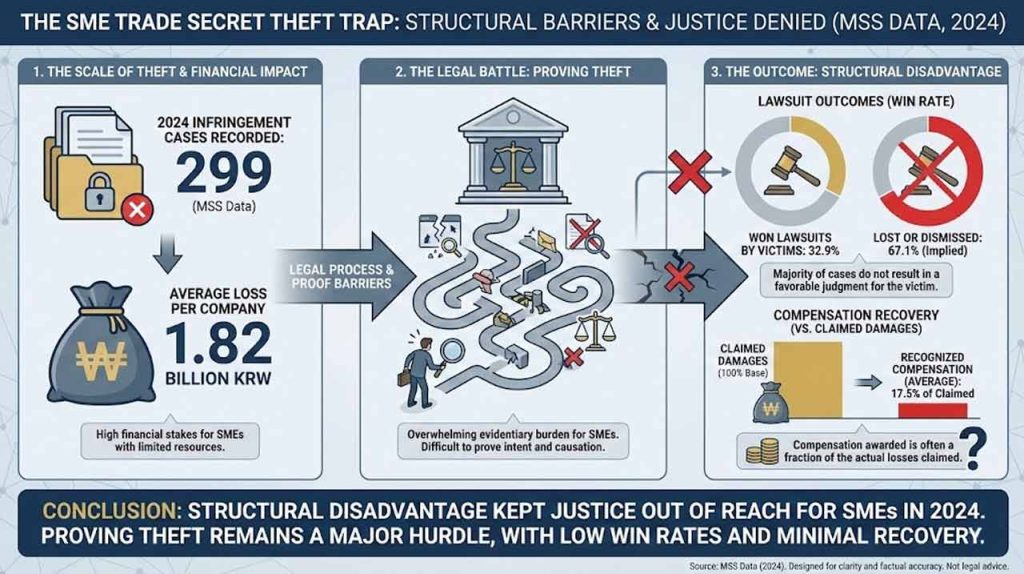
Until now, SMEs faced overwhelming barriers in proving theft. In 2024 alone, 299 infringement cases were recorded, with average losses per company reaching KRW 1.82 billion, according to MSS data. Yet only 32.9% of lawsuits were won by victims, and recognized compensation averaged just 17.5% of claimed damages—numbers that revealed how structural disadvantage kept justice out of reach.
The Core of K-Discovery: Expert Investigation, Testimony, and Data Preservation
The new system introduces three legal instruments that redefine how technology theft cases proceed in Korean courts:
- Expert Fact-Finding — Courts can now appoint independent specialists to investigate alleged misuse, visit company offices or factories, and access records. Their findings are recognized as valid legal evidence.
- Out-of-Court Testimony — Parties may conduct recorded or video-based questioning outside the courtroom, reducing procedural friction.
- Evidence Preservation Orders — Judges can order custodians of critical materials to prevent destruction or alteration of documents and data during trial.
The law also expands the scope of protection to cover pre-contract technology misuse—a gap often exploited in subcontracting—and grants courts the right to demand administrative investigation materials from the MSS for faster case resolution.
Government Statements: A Systemic Turning Point for SME Protection
MSS Minister Han Seong-sook emphasized that the new framework represents a structural breakthrough:
“The Korean-style Discovery System marks an institutional turning point that ensures SMEs gain real access to evidence. We are committed to creating a market environment where technologies developed through the hard work of small enterprises are properly valued and protected.”
Officials from the Presidential Policy Planning Committee highlighted that K-Discovery fulfills one of the 123 key national policy tasks introduced in 2025. The legislation gained momentum after President Lee Jae-myung publicly questioned the deterrence power of existing penalties, pushing ministries to move from rhetoric to measurable enforcement tools.
Ecosystem Impact: From Deterrence to Proof
For Korea’s startup ecosystem, K-Discovery closes the loop between penalty and proof.
Earlier reforms made theft costlier. Now, they make justice attainable.
By granting courts and experts the power to inspect and preserve evidence, K-Discovery addresses what industry stakeholders called the “blind spot” in technology protection—where large firms held all critical records, leaving victims defenseless.
Experts say the reform brings Korea closer to OECD-level IP governance, similar to discovery procedures in the U.S., Germany, and Japan.
Professor Oh Dong-yoon of Dong-A University commented in Newsis that this represents “a completely new dimension in addressing technology theft, providing legal grounds for fair participation.”
Industry groups echo that sentiment. A venture sector representative noted to Newsis that “this system finally levels the playing field—SMEs can now substantiate what they already know to be true.”
However, some policy analysts, including Noh Min-seon of the Korea Small Business Institute, cautioned that real deterrence still depends on sentencing strength and consistent enforcement, saying that without meaningful penalties, the law’s promise could fade into formality.
Global Significance: Aligning Korea with International Legal Standards
For global investors and foreign founders entering Korea, the K-Discovery framework enhances institutional transparency and predictability in intellectual property disputes.
In markets where due diligence increasingly depends on IP integrity, this system signals that Korea is ready to be judged by international legal norms rather than domestic administrative discretion.
It also strengthens the credibility of cross-border partnerships involving AI, deep tech, and manufacturing startups—sectors most vulnerable to unauthorized replication.
By building legal parity between startups and conglomerates, Korea is asserting that innovation ownership is not negotiable, even in a hierarchical industrial landscape.
Epilogue: Justice as the Infrastructure of Innovation
The K-Discovery Act reflects a deeper shift in Korea’s innovation governance—from moral appeal to procedural capability. Enforcement no longer depends on goodwill or bureaucratic discretion but on mechanisms that make evidence accessible and accountability measurable.
Its real test will come in execution: how swiftly courts appoint experts, how rigorously evidence is preserved, and how equitably the system operates across company sizes. But one thing is clear—the rules of engagement in Korea’s innovation economy have changed.
Key Takeaway on Tech Theft K-Discovery System
- The K-Discovery system was officially enacted through the Win-Win Cooperation Act amendment passed by Korea’s National Assembly on January 29, 2026.
- It empowers SMEs to secure and present evidence in technology theft cases through expert-led investigations, recorded questioning, and data preservation orders.
- Reported by Newsis, Money Today, News1, ChosunBiz, Etnews, and Edaily, the law builds on President Lee Jae-myung’s 2025–2026 SME protection agenda.
- The reform aligns Korea’s IP enforcement closer to U.S. and European discovery standards, addressing long-standing evidence asymmetry.
- Experts view it as the final structural piece in Korea’s broader effort to protect startup innovation through legal, administrative, and institutional reforms.
- Its effectiveness will depend on how quickly and consistently the system is implemented by courts, ministries, and expert bodies.
– Stay Ahead in Korea’s Startup Scene –
Get real-time insights, funding updates, and policy shifts shaping Korea’s innovation ecosystem.
➡️ Follow KoreaTechDesk on LinkedIn, X (Twitter), Threads, Bluesky, Telegram, Facebook, and WhatsApp Channel.
🤝 Looking to connect with verified Korean companies building globally?
Explore curated company profiles and request direct introductions through beSUCCESS Connect.