
South Korea has taken a decisive step toward closing one of its startup ecosystem’s most persistent vulnerabilities: technology theft. By launching a six-ministry joint task force, Seoul aims to replace years of fragmented enforcement with a unified system that protects startup innovation, accelerates recovery for victims, and redefines how Korea governs intellectual property in the era of open innovation.
Six-Ministry Task Force Forms to Eradicate Technology Theft
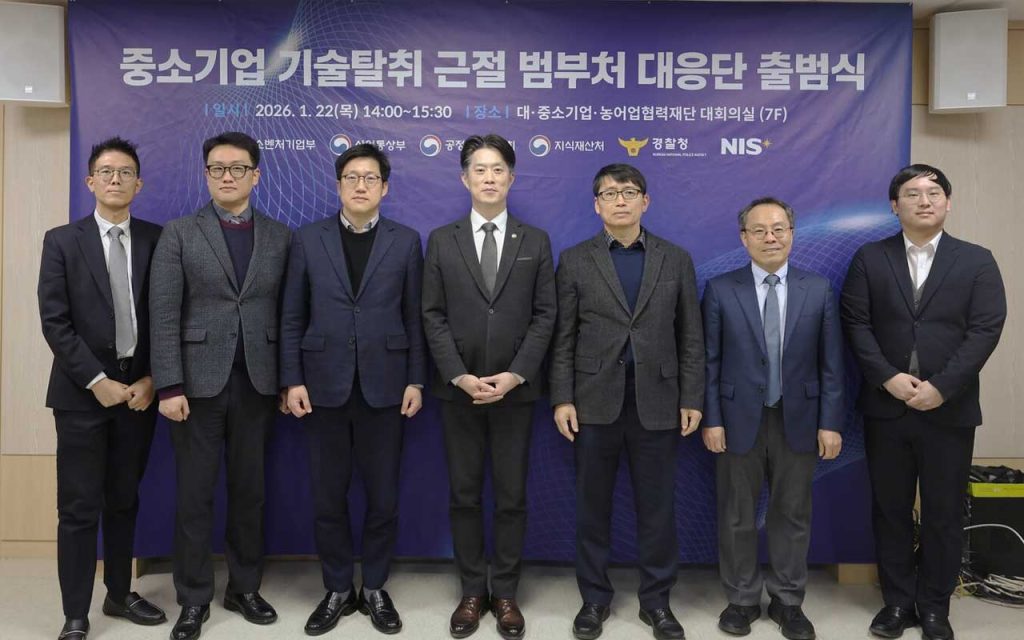
On January 22, 2026, the Ministry of SMEs and Startups (MSS) announced the launch of the Pan-Governmental Response Team for the Eradication of SME Technology Theft, an unprecedented alliance of six key ministries and agencies — the MSS, Ministry of Trade, Industry and Energy (MOTIE), Fair Trade Commission (FTC), Korean Intellectual Property Office (KIPO), National Police Agency, and the National Intelligence Service (NIS).
The new task force establishes a permanent inter-ministerial collaboration platform to close structural gaps in how Korea detects, investigates, and remedies cases of startup technology misappropriation. It follows the “SME Technology Theft Eradication Plan” unveiled in September 2025 and reflects months of political pressure for faster and stronger protection for smaller firms in supply chains dominated by large conglomerates.
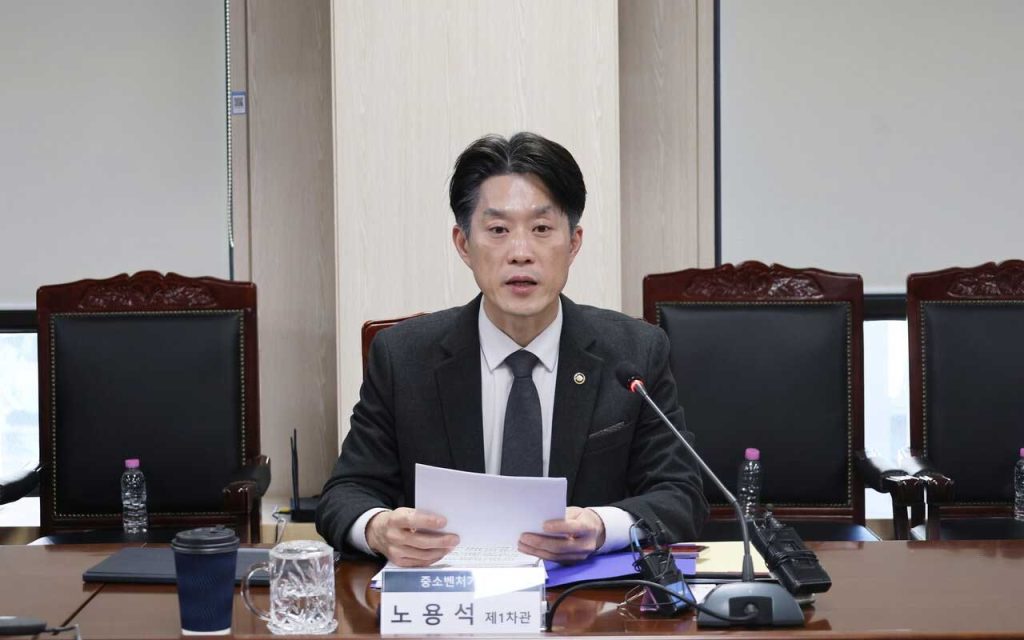
The alliance was officially launched at the Korea Foundation for Cooperation of Large & Small Business, Rural Affairs in Seoul, led by First Vice Minister Noh Yong-seok, with senior representatives from all participating ministries present.
Background and Context: From Fragmented Oversight to Unified Enforcement
Technology theft involving SMEs has become increasingly sophisticated, often involving subtle contract breaches, reverse engineering, and internal data misuse. Until now, companies faced a maze of agencies — each responsible for a narrow segment of the issue — which delayed investigations and diluted accountability.
The new framework resolves this by establishing a single policy and action command structure for prevention, response, and post-incident recovery. A key upcoming initiative under the task force is the “SME Technology Protection Ombudsman” (tentative name), a one-stop online platform to unify reporting, case tracking, and support applications for victimized firms.
Currently, reports of theft are scattered across multiple institutions, including the MSS, FTC, KIPO, and the police. The ombudsman will merge these channels within 2026, simplifying access to both legal and financial recovery support.
At the policy level, the task force will coordinate the rollout of the “Korean-Style Discovery System” — a new legal mechanism that allows court-appointed experts to directly inspect companies accused of technology theft to secure evidence for damages claims. This system, modeled partially on practices in the United States and Europe, is intended to correct Korea’s chronic problem of weak evidence collection in IP disputes.
Stakeholder Statements: A National Commitment to Restore Fairness
First Vice Minister Noh Yong-seok underscored the urgency of collective action, saying:
“Technology theft has become too complex for any single ministry to address. A pan-governmental response is no longer optional but essential.”
He also highlighted the President’s instruction to ensure “strong sanctions, active prevention, and inter-ministerial cooperation” on technology theft cases.
Noh outlined the three immediate priorities for the team:
- Legislative coordination — harmonizing revisions to protection-related laws across ministries.
- Collaborative task identification — linking distinct ministerial capabilities and personnel.
- Integration of victim reporting channels — establishing the unified Technology Protection Ombudsman.
He stressed that the initiative represents more than bureaucratic reform:
“Technology theft can bankrupt companies and distort market order. It is a grave economic crime that undermines fairness and trust across our industrial ecosystem. This task force must operate as a permanent, active ‘One Team’ against technology theft.”
Ecosystem Significance: A Turning Point for Startup Trust and Investor Confidence
For Korea’s startup and venture ecosystem, the new task force signifies a structural shift from reactive regulation to proactive protection.
Until now, startups and SMEs often avoided pursuing justice for stolen technologies due to fears of retaliation and the high cost of legal action. Fragmented oversight made enforcement inconsistent, eroding trust among innovators and investors. The unified task force — with the police, NIS, and KIPO working in tandem — introduces the kind of integrated enforcement model that Korea’s innovation economy has long lacked.
It also aligns with Korea’s broader 2026 economic strategy, which seeks to build a fairer, innovation-driven growth model. By combining administrative authority, investigative power, and legislative alignment, the new governance system could redefine how Korea protects intellectual property — turning deterrence into a credible reality rather than a symbolic gesture.
For global investors and cross-border partners, the reform signals Korea’s intent to align with OECD-standard IP enforcement practices. The establishment of the Technology Protection Ombudsman will also enhance transparency and accessibility for foreign startups operating within Korea, reducing compliance uncertainty and reinforcing the country’s image as a trustworthy innovation hub.
Future Outlook: Rebuilding the Foundation of Fair Innovation
The creation of this six-ministry task force is more than a policy adjustment — it is an institutional reset for how Korea defines innovation governance. It acknowledges that without credible protection, startups cannot scale, and without accountability, investors cannot trust.
If fully executed, the framework could become a blueprint for cross-ministerial technology protection in the Asia-Pacific region. But its real test will come in execution: whether Korea can translate inter-agency coordination into tangible results for the founders and engineers who form the backbone of its next-generation industries.
The government has set a clear target — to eliminate the “technology theft blind spot” and give SMEs the confidence to innovate without fear. Whether this becomes reality will determine how far Korea can advance toward becoming not only a venture powerhouse, but also a country where innovation ownership truly matters.
Key Takeaways
- South Korea launched a six-ministry task force uniting the MSS, MOTIE, FTC, KIPO, National Police, and NIS to eradicate SME technology theft.
- The task force will create the Technology Protection Ombudsman, integrating all reporting and recovery channels by 2026.
- The initiative also coordinates the rollout of the Korean-style Discovery System, enabling direct evidence collection in IP infringement cases.
- The move marks a shift from fragmented oversight to unified governance, reinforcing Korea’s innovation protection framework.
- For startups and global investors, it signals stronger intellectual property enforcement and greater institutional trust in Korea’s venture ecosystem.
– Stay Ahead in Korea’s Startup Scene –
Get real-time insights, funding updates, and policy shifts shaping Korea’s innovation ecosystem.
➡️ Follow KoreaTechDesk on LinkedIn, X (Twitter), Threads, Bluesky, Telegram, Facebook, and WhatsApp Channel.
🤝 Looking to connect with verified Korean companies building globally?
Explore curated company profiles and request direct introductions through beSUCCESS Connect.