
Cross-border research partnerships are becoming more visible across Korea and Europe, driven by new funding access and expanding institutional support. Yet visibility alone does not guarantee outcomes. As more organizations connect through Horizon Europe–linked initiatives, a deeper question is emerging across the ecosystem: why do so many partnerships stop at agreement, without ever becoming funded, operational R&D projects?
Korea – EU Collaboration Is Expanding, but Outcomes Remain Uneven
South Korea’s engagement with Europe’s research ecosystem is no longer limited to policy announcements. Across 2025, activity has accelerated through networking forums, institutional partnerships, and cross-border matchmaking programs tied to Horizon Europe.
Organizations such as Korea – EU Research Centre and the National Research Foundation of Korea have expanded onboarding efforts, including National Contact Points, proposal guidance sessions, and researcher networking events. KERC forums in 2025, for example, brought together Korean and European participants through pitch sessions, panel discussions, and matchmaking programs designed to initiate collaboration.
On the surface, the system is working. Connections are being made, partnerships are being announced, and cross-border engagement is visibly increasing.
Yet a quieter pattern is emerging behind this activity. Many of these connections do not progress into funded, operational research projects.
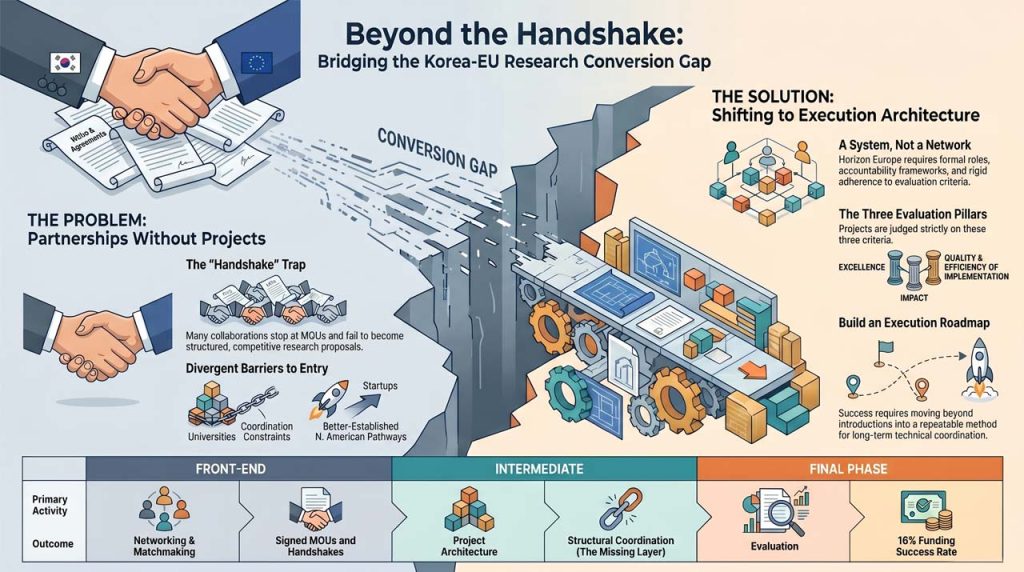
The Conversion Gap: Partnerships Form, Projects Do Not
The gap between partnership formation and execution is not anecdotal. It reflects how the Horizon Europe system itself is structured.
According to the European Commission, proposals under Horizon Europe are evaluated on three criteria: Excellence, Impact, and Quality and Efficiency of Implementation. The process requires detailed project design, defined work packages, and coordinated execution across multiple institutions.
At the same time, competition remains intense. In its April 2025 communication, the European Commission noted that only about 16 percent of submitted proposals were funded during the program’s early years, with many high-quality proposals remaining unsupported due to budget constraints.
This structure creates a clear distinction.
Networking enables entry into the conversation. But execution determines whether a project moves forward.
Paul Conversy, Founder and CEO of InsightMatches, described this gap directly in correspondence with KoreaTechDesk.
“To be candid, the conversion rate is quite low. There are a lot of handshakes and signed MOUs at major events, but few of them turn into real, funded projects.”
The implication is not that partnerships are failing to form. It is that they are not translating into structured, competitive proposals that meet Horizon Europe’s execution requirements.
Why Matchmaking Alone Cannot Deliver Execution
The expansion of matchmaking infrastructure across Korea – EU collaboration reflects a necessary first step. KERC platforms, Euraxess initiatives, and embassy-led programs all support partner discovery and early-stage engagement.
But these mechanisms operate at the front end of the pipeline.
The Horizon Europe process itself separates partner search from project evaluation. Finding collaborators is only one stage. It does not include the structured pathway required to move from initial discussion to submitted proposal.
Conversy pointed to what is missing in practice.
“What’s missing isn’t commitment or goodwill. It’s architecture.”
He described the absence of a clear, step-by-step process connecting early meetings to final proposals. Without that structure, collaboration tends to stall after initial engagement.
This reflects a broader operational reality. Cross-border R&D projects require sustained coordination across multiple organizations, time zones, and legal frameworks. Informal alignment is insufficient. Without a defined execution pathway, momentum fades once initial meetings conclude.
Horizon Europe Operates as a System, Not a Network
The core misunderstanding lies in how collaboration is interpreted.
In many international contexts, partnership begins with mutual interest and evolves organically. Horizon Europe does not operate this way. It is a structured system where collaboration is predefined, documented, and evaluated against strict criteria.
Projects require formal consortium agreements, defined roles, budget allocation, and accountability frameworks. Participation is governed by detailed documentation such as work packages and grant agreements.

Even at the application stage, coordination resembles project execution itself. Teams must align technical contributions, timelines, and deliverables before funding is secured.
This structure explains why early-stage partnerships often fail to progress. A connection between organizations does not automatically translate into a viable consortium.
Execution Breakdowns Occur After the First Step
The failure point is not a lack of intent. It is the absence of a repeatable method to move forward.
Conversy described this challenge in practical terms.
“Beyond having goodwill and wanting to make projects, they lack a comprehensive plan or method to do so.”
For teams without prior experience, the process can appear opaque. Writing a Horizon Europe proposal involves hundreds of hours of coordination and technical documentation. Without a structured methodology, teams struggle to translate ideas into competitive submissions.
This is not a Korea-specific issue alone. The European Commission itself has acknowledged the structural complexity of Horizon Europe. Its main work program includes around 1,060 topics and actions across more than 3,000 pages of documentation, creating a highly demanding environment for proposal development and evaluation.
This level of complexity reinforces that moving from partnership to execution requires far more than initial alignment.
However, for new participants entering from outside established European networks, the barrier is amplified.
Different Players Face Different Execution Constraints
The breakdown in execution is not uniform across Korea’s ecosystem. It varies depending on the type of participant.
Universities and research institutions are not starting from zero in cross-border collaboration. Many already maintain international ties through academic partnerships and exchange programs. The friction emerges later, when these relationships must be translated into structured, fundable projects.
Conversy pointed to a practical constraint that often slows progress.
“They hit a wall when it comes to the ‘how-to’,” he explained, noting that many organizations lack the internal capability to navigate procedures, documentation, and coordination requirements at scale.
Startups, however, face a different dynamic. Their challenge is not execution, but direction. Coversy revealed,
“They aren’t even looking at the EU. They are more often focused on North America because the path there is better established.”
This creates a divergence. Institutions attempt to engage but encounter execution constraints. Startups often do not enter the EU pipeline at all, limiting their exposure to Horizon Europe opportunities.
Activity Without Architecture Limits Ecosystem Impact
The expansion of Korea–EU collaboration infrastructure reflects meaningful progress. Government agencies, research centers, and international platforms have built systems to facilitate connection and participation.
Yet the Horizon Europe model demands more than connection. It requires coordination at a level that transforms partnerships into structured, competitive proposals.
Without this intermediate layer, the ecosystem produces activity without consistent outcomes.
This distinction is critical for global participants. For European consortia, integrating new partners requires early alignment and structured onboarding. As for Korean organizations, success depends on developing internal capabilities that extend beyond networking into execution planning.
What This Means for Global Startup and Research Ecosystems
The Korea – EU R&D corridor is entering a new phase.
The question is no longer how to connect participants. It is how to build systems that enable them to execute together.
Expanding into Europe through research collaboration requires a different operating model than US market entry. It involves structured planning, integration into multi-party consortia, and sustained coordination over long timelines.
Matchmaking programs and networking forums continue to play an important role, but they do not define outcomes on their own. Without execution frameworks, their impact remains limited.
Cross-border collaboration cannot be assessed by the number of partnerships announced. The more relevant measure is how many of those partnerships develop into funded, operational projects.
From Connection to Coordination
South Korea’s Horizon Europe engagement now includes partnerships, platforms, and growing institutional support. The system for connection is in place.
So the remaining challenge today lies in coordination.
After all, cross-border R&D projects do not succeed through introductions alone. They require structured execution across institutions, timelines, and regulatory environments.
The next phase of Korea–EU collaboration will depend on whether the ecosystem can move beyond forming partnerships and begin consistently delivering them.
Key Takeaways
- Korea – EU research partnerships are increasing through KERC, NRF, and Horizon Europe–linked matchmaking programs.
- Horizon Europe evaluates projects based on Excellence, Impact, and Implementation, requiring structured execution beyond initial partnerships.
- Only around 16 percent of proposals are funded, indicating high competition even after partnerships form.
- Many collaborations fail to progress due to lack of execution architecture, not lack of intent or connection.
- Universities face administrative and coordination constraints, while startups often prioritize US expansion over EU collaboration pathways.
- Matchmaking infrastructure exists, but the missing layer is a structured pathway from partnership to proposal execution.
- Global participants must treat cross-border R&D as a system of coordinated execution, not just relationship-building.
– Stay Ahead in Korea’s Startup Scene –
Get real-time insights, funding updates, and policy shifts shaping Korea’s innovation ecosystem.
➡️ Follow KoreaTechDesk on LinkedIn, X (Twitter), Threads, Bluesky, Telegram, Facebook, and WhatsApp Channel.
🤝 Looking to connect with verified Korean companies building globally?
Explore curated company profiles and request direct introductions through beSUCCESS Connect.