KoreaTechDesk | Korean Startup and Technology News

Sun, February 15, 2026

Sign in

Virtual Demo Day
Menu
  • Home
  • Startup News
    • AI & Big Data
    • AR & VR
    • Blockchain
    • Clean Technology
    • Content & Games
    • Cybersecurity
    • Enterprise & SaaS
    • FinTech
    • Gadgets & Electronics
    • Health & Bio
    • Manufacturing
    • Press Release
    • IoT
    • Marketplaces & E-commerce
    • Robotics
    • Transportation
    • Investments
    • Ecosystem & Lists
  • Governments
    • Artificial Intelligence Industry Cluster Agency
    • Daegu Technopark
    • GANGNAM-GU
    • Gyeonggido Business & Science Accelerator
    • Hwaseong Industry Promotion Agency
    • Invest Seoul
    • Korea Creative Content Agency
    • Korea Internet & Security Agency
    • Korea Information Security Industry Association
    • Korea Institute of Startup & Entrepreneurship Development
    • Korea Tourism Organization
    • Korea Trade-Investment Promotion Agency
    • Ministry of Culture, Sports and Tourism
    • Ministry of SMEs & Startups
    • National IT Industry Promotion Agency
    • Pangyo Techno Valley
    • Seoul Business Agency
    • Seoul FinTech Lab
    • South Gyeongsang Province
    • Seoul Metropolitan Government
  • Events
    • COMEUP
    • Korea Fintech Week
    • K-Content Expo
    • NextRise
    • Try Everything
  • Interviews
    • Investors’ interviews
    • Founders’ interviews
  • Programs
    • Asan Voyager
    • CAPA Global Program
    • Campus Town Program
    • SGSC Global Bootcamp
    • Gangnam-gu Global Roadshow
    • Global SaaS Marketplace Support Project
    • LAUNCHPAD
    • COMEUP STARS 120
    • K-Startup Grand Challenge
    • TIPS X beSUCCESS Global Project
    • SFL Global Program
    • KTO Global Showcase
    • Yonsei Univ Global Class
    • KOSME Global Program
  • Partner With Us
    • Press Release
    • Startup Scouting
    • Business Agencies
    • Global Mentorship Program
    • Investment Opportunities
    • K-Scouter Program
  • Lists
  • Home
  • Startup News
    • AI & Big Data
    • AR & VR
    • Blockchain
    • Clean Technology
    • Content & Games
    • Cybersecurity
    • Enterprise & SaaS
    • FinTech
    • Gadgets & Electronics
    • Health & Bio
    • Manufacturing
    • Press Release
    • IoT
    • Marketplaces & E-commerce
    • Robotics
    • Transportation
    • Investments
    • Ecosystem & Lists
  • Governments
    • Artificial Intelligence Industry Cluster Agency
    • Daegu Technopark
    • GANGNAM-GU
    • Gyeonggido Business & Science Accelerator
    • Hwaseong Industry Promotion Agency
    • Invest Seoul
    • Korea Creative Content Agency
    • Korea Internet & Security Agency
    • Korea Information Security Industry Association
    • Korea Institute of Startup & Entrepreneurship Development
    • Korea Tourism Organization
    • Korea Trade-Investment Promotion Agency
    • Ministry of Culture, Sports and Tourism
    • Ministry of SMEs & Startups
    • National IT Industry Promotion Agency
    • Pangyo Techno Valley
    • Seoul Business Agency
    • Seoul FinTech Lab
    • South Gyeongsang Province
    • Seoul Metropolitan Government
  • Events
    • COMEUP
    • Korea Fintech Week
    • K-Content Expo
    • NextRise
    • Try Everything
  • Interviews
    • Investors’ interviews
    • Founders’ interviews
  • Programs
    • Asan Voyager
    • CAPA Global Program
    • Campus Town Program
    • SGSC Global Bootcamp
    • Gangnam-gu Global Roadshow
    • Global SaaS Marketplace Support Project
    • LAUNCHPAD
    • COMEUP STARS 120
    • K-Startup Grand Challenge
    • TIPS X beSUCCESS Global Project
    • SFL Global Program
    • KTO Global Showcase
    • Yonsei Univ Global Class
    • KOSME Global Program
  • Partner With Us
    • Press Release
    • Startup Scouting
    • Business Agencies
    • Global Mentorship Program
    • Investment Opportunities
    • K-Scouter Program
  • Lists
Home Government Policies

Korea’s Anti-Broker Reform Now Proceeds to Enforcement Mode

by Dae-jung Park
February 15, 2026
in Government Policies
0

Trust in public capital rarely collapses overnight. It erodes quietly — through shortcuts, intermediaries, and systems that reward familiarity over fairness. South Korea’s latest move signals that the clean-up phase of its policy finance reform is no longer theoretical. One of the country’s core state-backed finance institutions is now putting anti-broker enforcement tools into daily operation.

KIBO Launches Reporting Rewards and Fast-Track Referrals Against Illegal Brokers

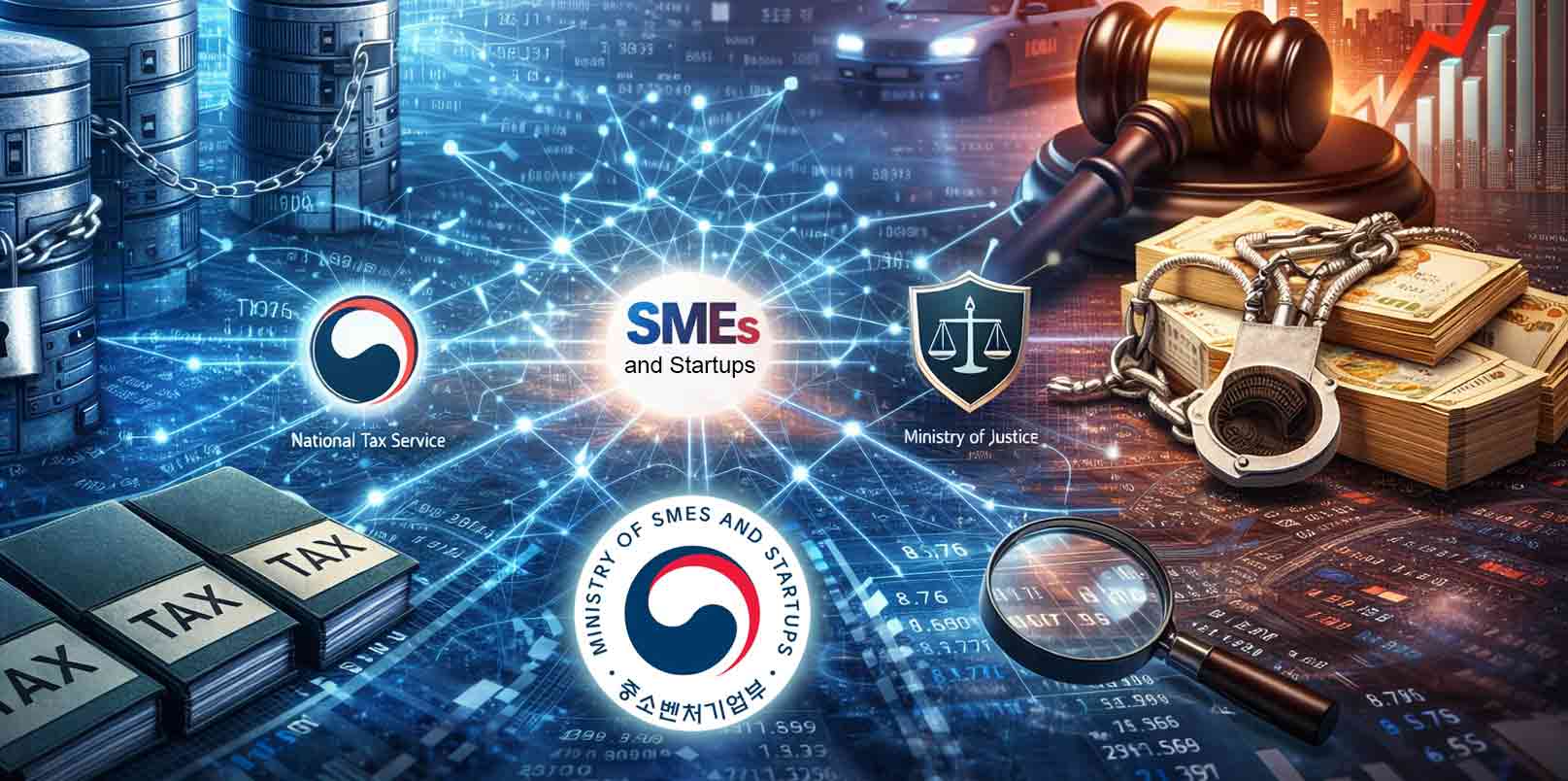
On February 13, the Korea Technology Finance Corporation (KIBO) announced that it has begun full-scale implementation of measures to eradicate improper third-party intervention in policy finance, in cooperation with the Ministry of SMEs and Startups (MSS).

The move follows the interagency “Task Force on Resolving Improper Third-Party Intervention in Policy Finance,” which has operated since late last year with participation from policy finance institutions, the Financial Services Commission, the Financial Supervisory Service, and the National Police Agency.

KIBO confirmed three core enforcement pillars:

  • A fact-finding survey embedded in its online guarantee and technology evaluation application process to identify potential broker involvement, with strict protection of anonymity.
  • A reporting reward system offering expedited small payments for urgent cases and up to KRW 2 million depending on investigation referral and conviction outcomes.
  • An immunity program for companies that voluntarily disclose broker involvement, provided the case does not fall under criminal categories defined by law. In such instances, certain guarantee restrictions may be partially mitigated.

KIBO has also established a separate anonymous reporting channel and introduced a “fast-track” procedure to accelerate referrals to investigative authorities in urgent cases.

Executive Vice President Park Ju-sun stated,

“This response framework is an institutional mechanism to further elevate public trust in policy finance. KIBO will continue to work closely with MSS to thoroughly block improper third-party intervention and create a fair policy finance environment.”

From System Design to Operational Enforcement

Previous reforms focused on defining illegal brokerage, designing whistleblower systems, and restructuring administrative processes. Now, this phase is entirely different. KIBO has embedded enforcement directly into application procedures.

And this resulted in an impactful shift

Policy finance is a foundational liquidity channel for Korean SMEs and early-stage ventures. Guarantee programs and technology evaluations often determine whether a startup secures working capital or stalls. When third-party brokers extract fees or manipulate documentation, the distortion affects not only fairness but also capital allocation efficiency.

By integrating surveys into digital applications and activating reward and immunity systems, the reform enters what policymakers call the “execution phase.” Enforcement is no longer limited to regulatory statements; it is attached to real transactions.

For an ecosystem that relies heavily on state-linked financing at early stages, operational enforcement sends a stronger signal than legislative intent.

The Tension: Enforcement Tools Are Clear, Behavioral Change Is Harder

Introducing reporting channels does not automatically normalize reporting behavior.

KIBO’s system depends on founders and SME managers choosing to disclose broker involvement. Even with anonymity protections and immunity provisions, self-reporting requires confidence that the institution will act fairly and swiftly.

There is also the structural reason brokers emerged in the first place: administrative complexity and limited in-house capacity among smaller firms. While document automation and AI-assisted drafting have been introduced elsewhere in the reform process, enforcement alone does not eliminate informational asymmetry.

If legal consultants replace illegal brokers without sufficient oversight, the ecosystem risks shifting labels without changing incentives. The reform acknowledges this by combining rewards, immunity, and investigative coordination. Whether that triad changes daily behavior remains the practical test.

What Enforcement Enables — and What It Still Leaves Open

The immediate effect is deterrence. Publicly defined rewards and fast-track referrals raise the perceived cost of misconduct. Anonymous channels lower the barrier to reporting.

For compliant founders, the move offers clearer boundaries: advisory support is not automatically suspect, but undisclosed intervention carries risk.

Yet enforcement mechanisms do not resolve every friction point. Companies that lack internal expertise may still seek external guidance. The reform mitigates abuse; it does not remove the administrative learning curve embedded in policy finance systems.

The broader goal is not to eliminate intermediaries entirely but to distinguish lawful consulting from exploitative brokerage — a distinction that remains under legislative refinement.

What Korea’s Anti-Broker Means for Global Founders and Investors

And so, for international founders considering Korea’s policy finance ecosystem, the message is increasingly institutional: access to state-backed guarantees is being monitored with clearer compliance standards.

Meanwhile for global venture funds and cross-border partners, enforcement at the agency level reduces reputational risk associated with co-financing alongside public capital. Clearer investigative pathways and documented reporting systems strengthen audit defensibility.

This is particularly relevant as Korea positions itself as a transparent, governance-aligned innovation economy. Public capital credibility affects private capital confidence.

However, global observers should note that enforcement capacity is only one dimension of competitiveness. Administrative accessibility and founder education will remain equally decisive.

Enforcement Is Not the Finish Line, It Is a Stress Test

The transition from task force discussions to operational enforcement reveals how seriously Korea is treating policy finance integrity.

But enforcement introduces its own stress test. Systems designed to surface misconduct must prove they can do so without slowing legitimate capital flow. Institutions that promise anonymity must protect it. Rewards must translate into action, not paperwork.

In innovation ecosystems, trust compounds slowly. It can reverse quickly.

The next measure of success will not be the number of policy announcements, but the quiet reduction of dependency on gray intermediaries — and whether founders begin to treat reporting as routine rather than risky.

Key Takeaway on Korea’s Anti-Broker Enforcement

  • The Korea Technology Finance Corporation (KIBO) has activated enforcement tools to address improper third-party intervention in policy finance.
  • Tangible measures include embedded surveys in online applications, a whistleblower reward system up to KRW 2 million, voluntary self-report immunity, anonymous reporting channels, and fast-track investigative referrals.
  • The reform marks a shift from policy design to operational enforcement within Korea’s SME guarantee and technology evaluation processes.
  • Behavioral change among founders and intermediaries will determine whether deterrence mechanisms translate into sustained transparency.
  • For global investors, the move strengthens compliance credibility within Korea’s state-linked startup capital ecosystem.

– Stay Ahead in Korea’s Startup Scene –
Get real-time insights, funding updates, and policy shifts shaping Korea’s innovation ecosystem.
➡️ Follow KoreaTechDesk on LinkedIn, X (Twitter), Threads, Bluesky, Telegram, Facebook, and WhatsApp Channel.

Tags: fast-track investigation Koreaillegal brokersimproper third-party intervention KoreaKIBOKIBO policy financeKorea policy fund brokersKorea public venture capital governanceKorea startup compliance policyKorea Technology Finance CorporationKorea Technology Finance Corporation (KIBO)Ministry of SMEs and Startups reformpolicy fund brokerspolicy fund brokers crackdownSME guarantee program Koreathird-party brokerwhistleblower reward system Korea
Previous Post

Startup for All: Korea Is Testing a New Model Where Startup Policy, Media and Private Capital Move Together

MOST READ ARTICLE OF THE WEEK

1.
Korea’s H2O Hospitality Finds Its Place in the UAE’s Stablecoin Revolution – Korean Tech Is Becoming Global Infrastructure
10 Feb 2026
2.
Korea Turns Crisis into Infrastructure: How ‘Trade Barrier 119’ Redefines Export Resilience in a Fragmented Global Market
9 Feb 2026
3.
Korea’s Venture Market Refines Its Focus: Quality, Not Quantity, Defines Early February’s Startup Funding Pulse
9 Feb 2026
4.
Korea’s “Zero-Base Regulation” Moment: Can a Startup Nation Be Built Without Breaking Its Old Rules?
9 Feb 2026
5.
Goodai Global’s IPO Drive Marks K-Beauty’s Shift from Conglomerates to Venture-Built Giants
10 Feb 2026
Register for Event

[the_ad id=”18508″]

List Article

1.
6 Reasons Why Seoul Is Poised to Become a Top 5 Global Economic Hub by 2030
20 Aug 2024
2.
Top Co-working Spaces for Startups & Companies to Explore in South Korea
3 Apr 2024
3.
Top Accelerators in South Korea Shaping Startup Success
29 Nov 2023
4.
Top Korean Venture Capital Firms Backing Startup Success
26 Oct 2023
5.
Top Apps for Seamless Korean to English Translation
14 Aug 2023

Similar Articles

Government Policies

Korea Moves to Bridge Law and AI: LegalTech Debate Tests the Limits of Regulation-Driven Innovation

More
Government Policies

Korea’s “Zero-Base Regulation” Moment: Can a Startup Nation Be Built Without Breaking Its Old Rules?

More
Government Policies

Korea Launches AI Privacy Council to Redefine Data Ethics in the Age of Agentic AI

More

Topics

Menu
  • AI & Big Data
  • AR & VR
  • Blockchain
  • Clean Technology
  • Content & Games
  • Cybersecurity
  • Enterprise & SaaS
  • FinTech
  • Gadgets & Electronics
  • Health & Bio
  • IoT

Program

Menu
  • Asan Voyager
  • CAPA Global Program
  • SGSC Global Bootcamp
  • LAUNCHPAD
  • COMEUP STARS 120
  • K-Startup Grand Challenge
  • TIPS X beSUCCESS Global Project
  • SFL Global Program
  • KTO Global Showcase
  • Yonsei Univ Global Class
  • KOSME Global Program

About

Menu
  • About Us
  • all articles
  • Terms of Use
  • Privacy
  • Cookie-policy
  • twitter

Subscribe and be informed first hand about actual Korean startup news.

All the day’s headlines and highlights, direct to you every morning.

Contact us : [email protected]

Topics

Menu
  • AI & Big Data
  • AR & VR
  • Blockchain
  • Clean Technology
  • Content & Games
  • Cybersecurity
  • Enterprise & SaaS
  • FinTech
  • Gadgets & Electronics
  • Health & Bio
  • IoT

Program

Menu
  • Asan Voyager
  • CAPA Global Program
  • SGSC Global Bootcamp
  • LAUNCHPAD
  • COMEUP STARS 120
  • K-Startup Grand Challenge
  • TIPS X beSUCCESS Global Project
  • SFL Global Program
  • KTO Global Showcase
  • Yonsei Univ Global Class
  • KOSME Global Program

About

Menu
  • About Us
  • all articles
  • Terms of Use
  • Privacy
  • Cookie-policy
  • twitter

Subscribe and be informed first hand about actual Korean startup news.

All the day’s headlines and highlights, direct to you every morning.

© 2023 Koreantech News & Media Korea Zrt. All rights reserved.

Our Spring Sale Has Started

You can see how this popup was set up in our step-by-step guide: https://wppopupmaker.com/guides/auto-opening-announcement-popups/

Our Spring Sale Has Started

You can see how this popup was set up in our step-by-step guide: https://wppopupmaker.com/guides/auto-opening-announcement-popups/

We hope you enjoy our content, May you please give us Feedback regarding our website!

Single Post Feedback

dgdfgfdgdf

What you think about Koreatechdesk, Share your idea with us!

feedback popup

Invitation submission has been closed

Insert/edit link

Enter the destination URL

Or link to existing content

    No search term specified. Showing recent items. Search or use up and down arrow keys to select an item.