Autonomous driving startups often begin with limited pilots or isolated robotaxi programs. In South Korea, one company is testing a different path. Autonomous driving startup Autonomous A2Z has signed a partnership with Busan’s bus industry to explore how Level-4 autonomous systems could operate within existing public transportation networks.
The agreement extends a series of collaborations with bus and taxi operators across the country, offering a view into how Korean startups are experimenting with integrating autonomous technology into real transit systems.
Autonomous A2Z Signs Busan Agreement to Test Autonomous Public Transport
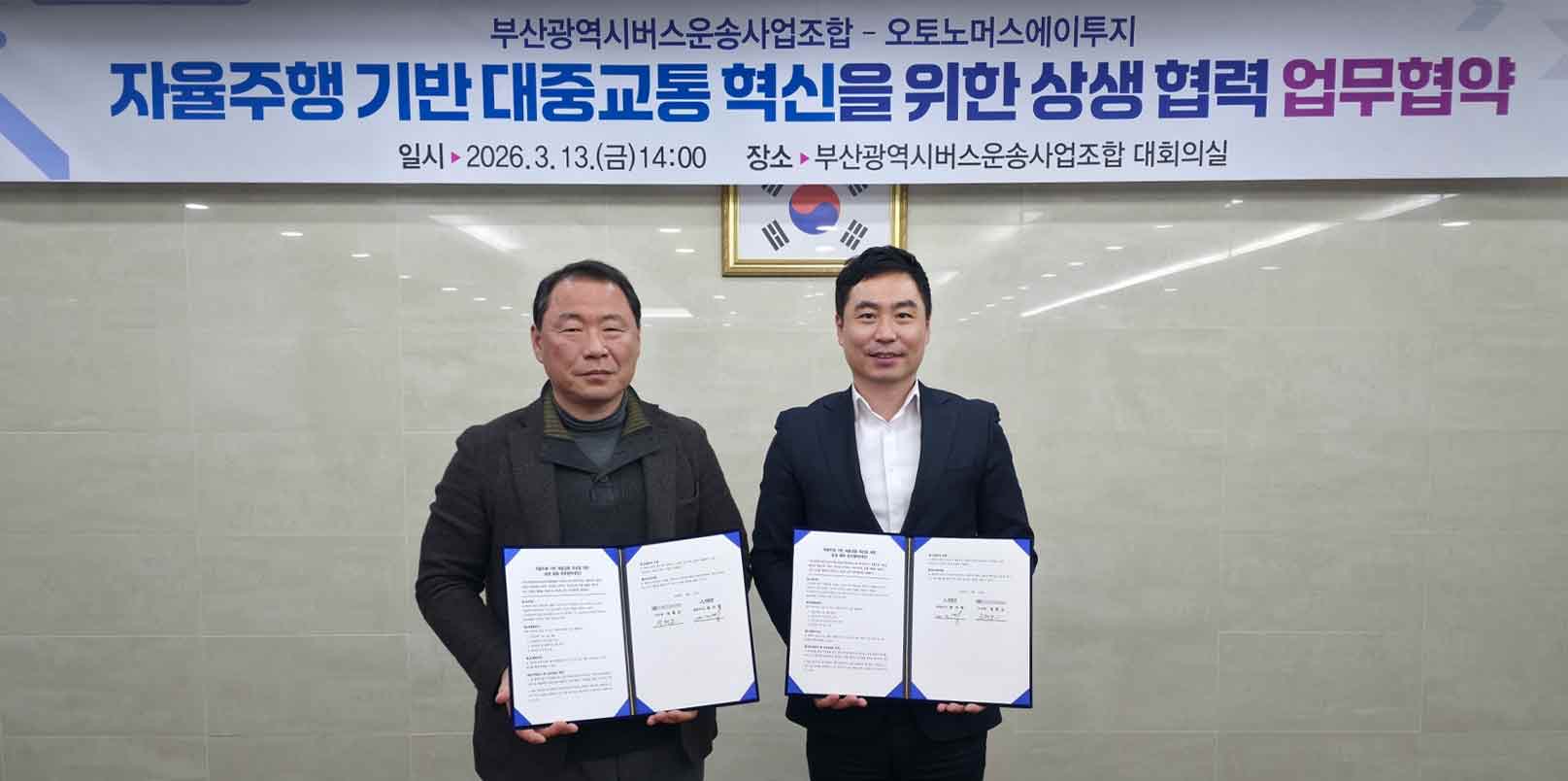
Autonomous A2Z announced that it signed a mutual cooperation agreement on March 13 with the Busan Metropolitan City Bus Transport Business Association to pursue innovation in autonomous driving-based public transportation services.
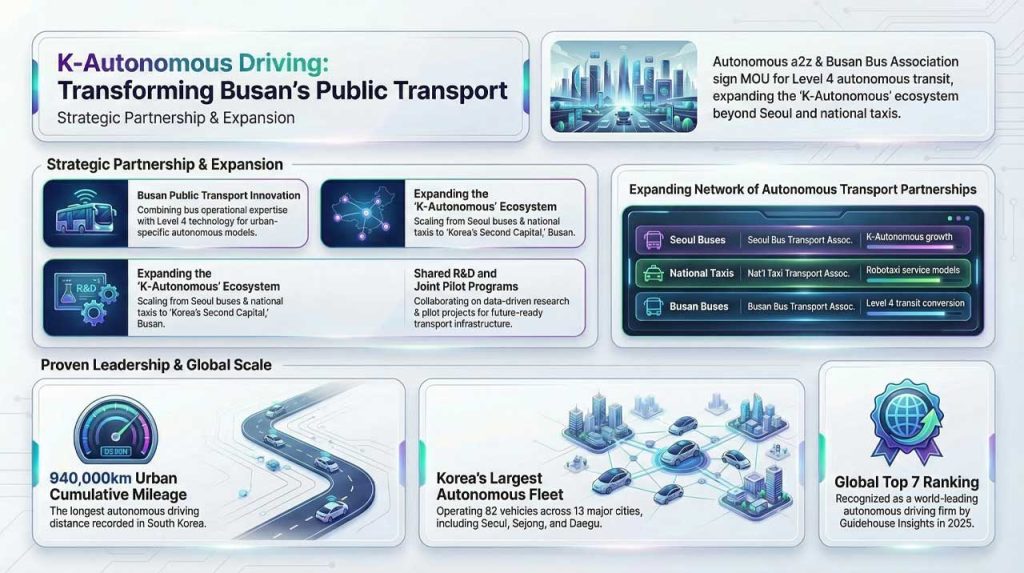
The partnership aims to combine the operational experience of the Busan bus industry with the company’s Level-4 autonomous driving technology to develop services suited to urban traffic conditions.
Under the agreement, the two organizations plan to cooperate in several areas:
- demonstrations of autonomous driving technology
- joint research using operational transportation data
- participation in pilot and demonstration projects
- formation of a joint consultation body.
The partners said the collaboration will focus on building operational systems that can be applied in real transportation environments while improving safety and convenience.
Busan is South Korea’s second-largest city and one of the country’s major metropolitan transport hubs. The partnership therefore represents an expansion of autonomous public transport testing beyond the capital region.
A Strategy Built Around Existing Bus and Taxi Operators
The Busan agreement continues a pattern in Autonomous A2Z’s domestic partnerships.
In September last year, the company signed a similar agreement with the Seoul Metropolitan Bus Transport Business Association and related organizations.
Earlier this year, it also reached an agreement with the National Federation of Taxi Transport Business Associations to explore the transition of corporate taxi fleets to autonomous systems and develop robotaxi service models.
Taken together, these partnerships link the startup with multiple layers of Korea’s existing public transportation sector.
Autonomous A2Z describes the approach as part of building a “Korean-style autonomous driving ecosystem”, where autonomous technology companies cooperate with incumbent transport operators instead of replacing them.
Operational Testing Across Korean Cities
The company’s strategy relies on accumulated testing experience inside Korean cities.
Autonomous A2Z says it develops the entire autonomous driving process internally, including vehicle manufacturing, control systems, and operational platforms.
The startup has conducted demonstrations across 13 cities and provinces, including Seoul, Sejong, Daegu, and Anyang.
It currently operates 82 autonomous vehicles, which the company describes as the largest demonstration fleet in Korea. The vehicles have recorded approximately 940,000 kilometers of cumulative driving distance in urban environments.
The firm’s technology was ranked seventh globally in the 2025 autonomous driving leaderboard published by research firm Guidehouse, according to company disclosures.
Why Korean Autonomous Startups Are Exploring Public Transit Integration
The Busan partnership highlights an operational challenge that autonomous mobility companies face worldwide.
Developing autonomous driving technology is only one part of commercialization. The larger question often involves how those systems integrate into existing transportation networks that already serve millions of passengers.
Autonomous A2Z’s leadership has described autonomous driving as future mobility infrastructure that should work alongside buses and taxis rather than replace them.
That perspective helps explain why the company is focusing on partnerships with bus associations and taxi operators. These organizations already operate large fleets, manage route networks, and handle passenger demand.
Such partnerships can provide access to real operating environments where autonomous technology can be tested under the same conditions as conventional transit services.
A Korean Approach to Autonomous Mobility Deployment
The partnerships also reflect the structure of Korea’s urban transportation systems.
South Korean cities rely heavily on coordinated bus and taxi networks. These systems are tightly integrated into municipal mobility policies and serve as a backbone of daily commuting. For startups developing autonomous driving systems, cooperation with existing transport operators may offer a practical route to deployment.
The Busan agreement therefore adds another testing environment where autonomous technology could eventually operate alongside traditional transit services.
Now, Autonomous A2Z has previously disclosed plans related to a future public listing. Agreements with bus and taxi operators can demonstrate how autonomous technology might integrate into real transit systems.
Still, knowing that these collaborations remain largely at the demonstration stage, it means investors will likely focus on whether pilot projects eventually translate into sustained service revenue.
Integration May Become the Hardest Step in Autonomous Mobility
Autonomous driving technology has advanced rapidly during the past decade. Real-world adoption, however, depends on how well those systems can operate within existing transportation ecosystems.
Autonomous A2Z’s partnerships with bus and taxi organizations suggest that some Korean startups are exploring integration with current transit infrastructure rather than building entirely separate autonomous mobility networks.
If such collaborations succeed, they could offer a pathway for autonomous vehicles to enter urban transportation systems step by step. The Busan agreement represents another experiment in how that transition might unfold.
Key Takeaways on Busan Bus Partnership by Autonomous A2Z
- Autonomous driving startup Autonomous A2Z signed an MOU with the Busan Metropolitan City Bus Transport Business Association on March 13.
- The partnership aims to develop autonomous public transportation services combining bus operational experience with Level-4 autonomous driving technology.
- The Busan agreement follows earlier partnerships with the Seoul bus industry and the National Federation of Taxi Transport Business Associations.
- Autonomous A2Z has conducted testing across 13 regions in Korea, operating 82 autonomous vehicles with about 940,000 km of cumulative driving distance.
- The company ranked seventh globally in Guidehouse’s 2025 autonomous driving leaderboard, according to company disclosures.
- The partnerships reflect an approach in which autonomous mobility startups collaborate with existing public transportation operators to test deployment in real transit networks.
– Stay Ahead in Korea’s Startup Scene –
Get real-time insights, funding updates, and policy shifts shaping Korea’s innovation ecosystem.
➡️ Follow KoreaTechDesk on LinkedIn, X (Twitter), Threads, Bluesky, Telegram, Facebook, and WhatsApp Channel.
🤝 Looking to connect with verified Korean companies building globally?
Explore curated company profiles and request direct introductions through beSUCCESS Connect.