
Japanese startups have looked to Korea for ideas, while Korean startups increasingly see Japan as their next growth market. On paper, the opportunity appears stronger than ever, supported by new government programs, startup centers, investment summits, and growing business activity between the two countries. Yet one assumption continues to create unnecessary friction. Success in Korea is often treated as evidence that success in Japan will naturally follow. Investors on the ground rarely see it that way.
Korea’s Momentum Opens the Door, But It Does Not Close the Deal
Interest in Japan among Korean companies has accelerated over the past two years.
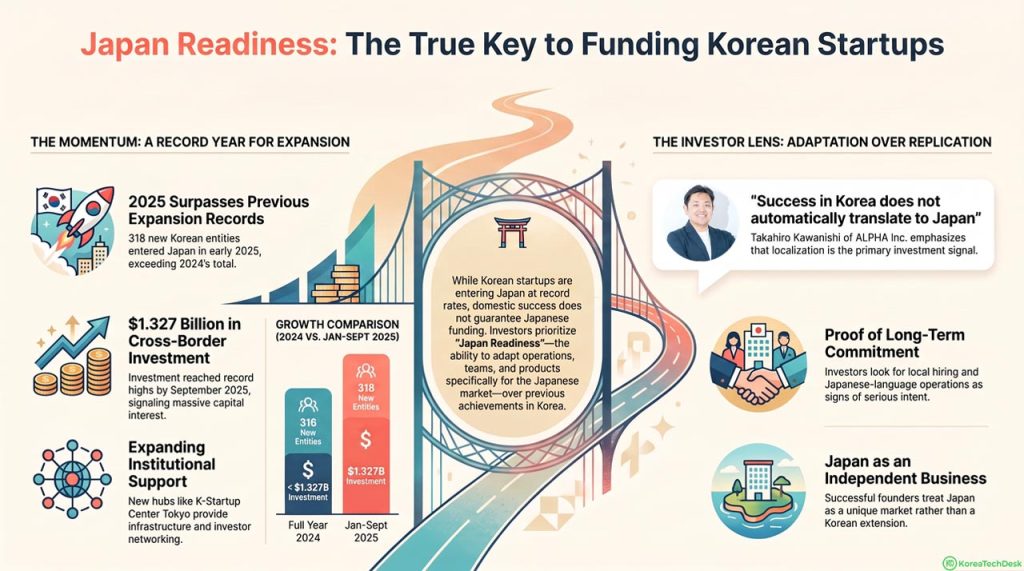
According to data cited by the Korea Economic Daily, 318 new Korean entities were established in Japan during the first nine months of 2025, already surpassing the previous annual record of 316 entities created throughout 2024. Korea-to-Japan investment also reached approximately US$1.327 billion during the same period, exceeding the full-year 2024 total.
Public support has also expanded alongside that momentum.
South Korea’s Ministry of SMEs and Startups established K-Startup Center Tokyo inside CIC Tokyo in 2024 to support Korean startups entering the Japanese market. The ministry has also expanded programs that connect Korean founders with Japanese investors, corporations, and ecosystem partners through initiatives such as the Super Gap Project Global IR in Tokyo.
These developments make it easier for Korean startups to enter Japan and begin exploring opportunities in the market.
However, easier access does not immediately mean lower expectations. Japanese investors still look closely at how well a company can adapt, operate, and grow within Japan over the long term, rather than simply relying on its success in Korea.

Korean Traction Is Only the Starting Point
For many founders, strong performance in Korea naturally becomes the centerpiece of every expansion story.
Revenue growth, customer adoption, successful fundraising, or domestic market leadership all demonstrate execution capability. Those achievements create credibility, but they do not automatically answer the questions Japanese investors ask when evaluating expansion.
Takahiro Kawanishi, General Partner and Head of IR at ALPHA Inc. Japan, believes that distinction deserves far more attention.
“Success in Korea does not automatically translate into success in Japan.”
Kawanishi shared that perspective with KoreaTechDesk during an exclusive interview discussing cross-border investment and startup expansion between Korea and Japan.
His observation reflects years spent evaluating investment opportunities as both an institutional investor and now a venture capital general partner working closely with startups and limited partners.
The issue, he explained, is rarely about whether Korean startups can build strong businesses.
What matters more is whether they can shape those businesses to truly fit the Japanese market.
Japanese Investors Look for Local Adaptation, Not Market Replication
Companies entering Japan often describe expansion as entering a neighboring market. But Japanese investors usually approach the discussion differently.
Kawanishi recalled reviewing an investment opportunity involving a Korean restaurant brand that had already achieved considerable success in Korea before planning its Japanese expansion.
Rather than debating the company’s domestic achievements, the discussion quickly shifted toward practical execution.
- Could the brand adapt to Japanese consumers?
- Would the company recruit local talent capable of operating the business effectively?
- Did management understand the differences between Korean and Japanese customer expectations?
While the example comes from the restaurant industry, Kawanishi noted that the same considerations extend across technology, software, consumer products, and other sectors.
Strong execution in Korea clearly demonstrates a company’s capabilities, but it does not remove the need to prove that the business can truly fit and succeed in the Japanese market.
And this gap is exactly why Japanese investors tend to focus less on past performance and more on how well a company can localize and adapt.

Long-Term Commitment Carries More Weight Than Market Entry
Yes, entering Japan is becoming even easier nowadays. But it’s worth noting that building confidence inside Japan remains considerably more difficult.
Japan’s business support infrastructure continues to expand through organizations such as JETRO, which provides guidance on company establishment, market research, hiring, regulatory procedures, and operational setup for foreign businesses.
Those resources play an important role in helping companies take their first steps into the Japanese market. However, they are only the starting point and cannot substitute for the sustained effort and long-term execution required to build a successful business in Japan.
According to Kawanishi, investors connected to Japan’s startup ecosystem pay close attention to how seriously founders intend to build inside the country.
“Japanese investors care quite a lot about long-term commitment to the market.”
And that commitment appears through practical decisions rather than presentations.
Investors often evaluate whether founders intend to establish local teams, communicate with customers in Japanese, develop operational capabilities inside Japan, and invest the time required to build lasting business relationships.
Because those signals then suggest that Japan is becoming part of the company’s long-term strategy rather than a short-term growth experiment.

Support Programs Create Access. Founders Must Create Proof.
Korea has made significant efforts to support startups expanding into overseas markets.
Programs that connect Korean startups with Japanese investors now offer a wide range of support, including proof-of-concept opportunities, corporate partnerships, legal guidance, intellectual property assistance, and introductions to local ecosystems.
These initiatives reflect an important understanding: gaining access to a new market is only the first step.
The real challenge begins after the initial introductions and investor meetings, when startups must translate opportunity into tangible progress on the ground.
Founders still carry responsibility for demonstrating that customers respond positively, partnerships create measurable value, hiring plans are realistic, and operations can scale within Japan’s business environment.
And no government program or accelerator can replace that evidence.
Japan Should Be Built as Its Own Business
One of the biggest strategic mistakes founders can make is assuming Japan is simply an extension of Korea. Because the two countries are geographically close, it is easy to believe that only minimal adjustments will be needed.
In reality, experience shows that the differences run much deeper.
Consumer expectations, commercial relationships, communication styles, organizational decision-making, and hiring practices all influence how businesses grow inside Japan.
Ignoring those differences increases execution risk long before revenue becomes meaningful.
Kawanishi believes founders benefit from approaching Japan with a different mindset.
“Japan should not simply be viewed as an additional market, but as a market that requires its own local understanding, adaptation, and trust-building.”
That perspective shifts expansion planning away from exporting an existing model toward building one capable of succeeding under different market conditions.
The Real Investment Decision Happens Before the First Check
Cross-border expansion is often measured by funding announcements, new offices, and partnership agreements, and while those milestones do signal progress, the more important question comes much earlier.
Has the company produced enough evidence that its business can succeed inside Japan rather than simply repeat what worked in Korea?
Japanese investors are, in fact, showing growing interest in supporting Korean startups that enter their market, but that interest comes with clear expectations.
They look for real, tangible proof that the business is already evolving into a Japanese operation, not merely a Korean business operating abroad.
And that difference may determine which companies successfully establish themselves in Japan and which remain visitors despite crossing the border.
Key Takeaways
- Strong performance in Korea creates credibility, but it does not automatically establish market readiness in Japan.
- Japanese investors evaluate localization, operational capability, and long-term execution alongside business performance.
- Building local teams, communicating in Japanese, and investing in lasting market presence signal genuine commitment.
- Government programs and startup support initiatives create valuable access, but founders must still prove local market fit through execution.
- Successful expansion begins when startups treat Japan as a business that must be built independently, rather than simply added to an existing Korean operation.
- For founders planning Korea-Japan expansion, local adaptation is not a final adjustment. It is one of the earliest investment signals Japanese stakeholders evaluate.
– Stay Ahead in Korea’s Startup Scene –
Get real-time insights, funding updates, and policy shifts shaping Korea’s innovation ecosystem.
➡️ Follow KoreaTechDesk on LinkedIn, X (Twitter), Threads, Bluesky, Telegram, Facebook, and WhatsApp Channel.
🤝 Looking to connect with verified Korean companies building globally?
Explore curated company profiles and request direct introductions through beSUCCESS Connect.