For years, Korean beauty brands won consumers through innovation, product quality, and the global appeal of K-beauty trends. Yet in Indonesia, one of the world’s largest beauty markets, the next challenge is becoming less about attracting attention and more about sustaining trust. As halal regulations tighten and consumers scrutinize ingredients more closely, brands are discovering that popularity alone does not answer every question buyers want resolved.
K-Beauty’s Growth in Southeast Asia Is Entering a New Phase
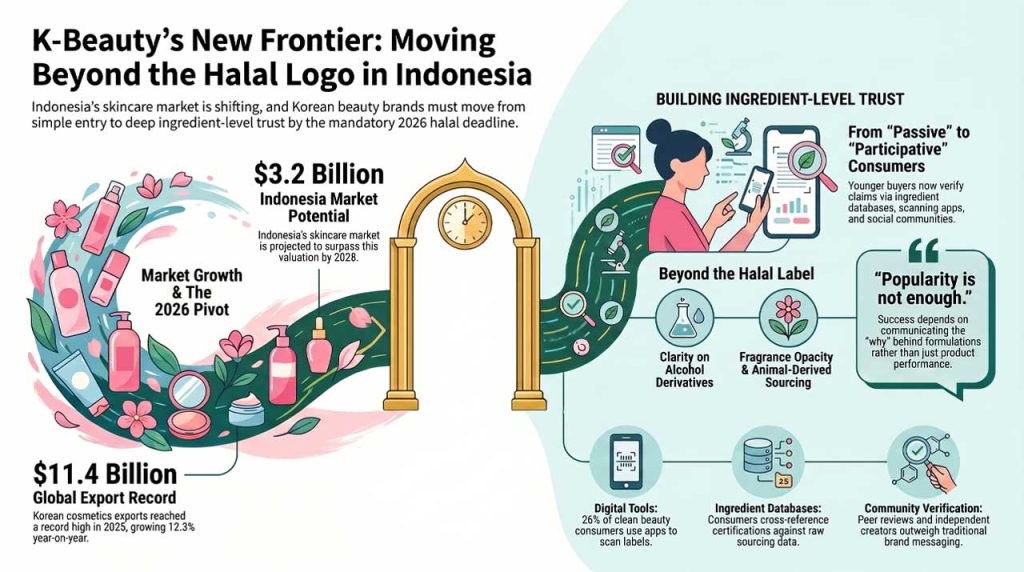
South Korea’s cosmetics industry continues to expand globally. According to the Ministry of Food and Drug Safety, Korean cosmetics exports reached a record USD 11.4 billion in 2025, increasing 12.3% year-on-year.
Indonesia remains one of the most attractive growth markets. The country combines a large and youthful consumer base with strong demand for skincare products, beauty innovation, and international brands. KOTRA data shows Indonesia’s skincare market reached approximately USD 2.65 billion in 2023 and is expected to surpass USD 3.2 billion by 2028.
For Korean beauty companies, these numbers clearly show Indonesia’s potential as one of the biggest international markets for K-beauty products and innovation.
But as the market grows, the more difficult question is how to build durable trust in a market where consumers increasingly examine what is inside products rather than simply responding to branding.
Indonesia’s Halal Deadline Raises the Stakes
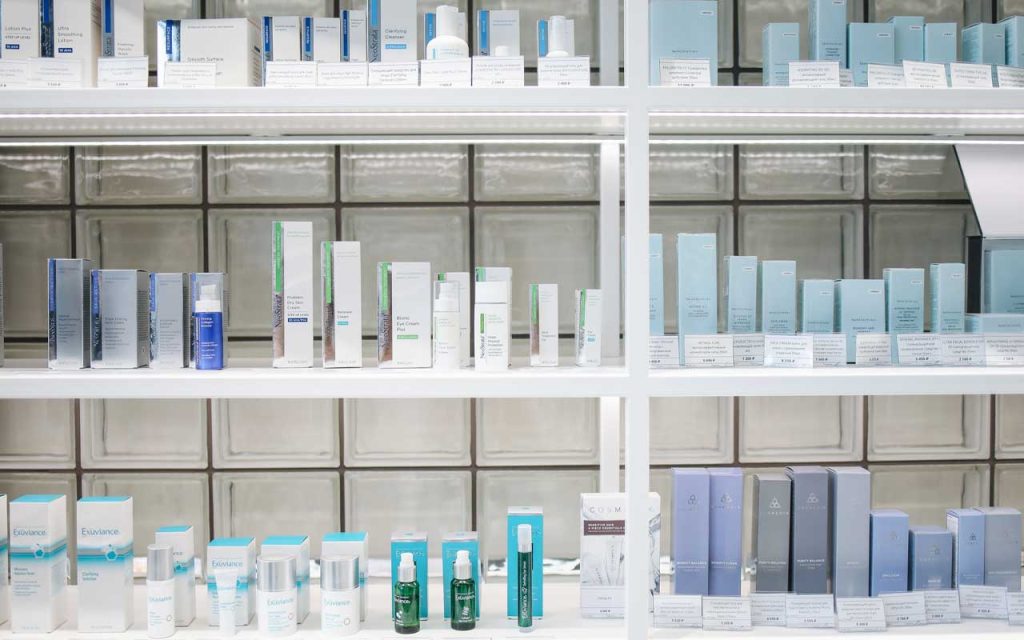
By October 17, 2026, Indonesia’s Halal Product Assurance Agency (BPJPH) requires cosmetic products distributed in the country to obtain halal certification.
Now, for many exporters, compliance may appear to be a mere certification exercise. Yet industry observers increasingly argue that certification alone no longer satisfies consumer expectations.
Ilham Lahreche, founder of ingredient intelligence platform Bare Halal and a strategic communication consultant with nearly three decades of experience across journalism, media, and public-interest communication, believes many companies continue to misunderstand how halal-conscious consumers evaluate products today.
Through her consulting work and the development of Bare Halal, Lahreche has spent years examining how consumers navigate complex questions around ingredient sourcing, transparency, safety, and trust.
“Halal should not be treated as a last-minute compliance step,”
Lahreche told KoreaTechDesk as discussion on Consumer AI startups continues.
In her view, many companies continue to approach halal primarily as a certification requirement.
“Many brands still reduce halal to a label,”
she said.
“But halal-conscious consumers are not only asking for a logo. They want trust, traceability, and clarity. They want to understand alcohol derivatives, animal-derived ingredients, fermentation processes, fragrance opacity, and sourcing.”
Lahreche then argues that consumers increasingly evaluate products through multiple layers of trust rather than certification alone.
“They are not only asking: ‘Is this halal?’ but also: ‘Is it transparent?’ ‘Is it safe?’ ‘Does it align with my values?'”
And that shift is creating a more demanding environment for brands entering Indonesia, Malaysia, and other Muslim-majority markets.
Why Ingredient Transparency Is Becoming a Competitive Advantage
Moreover, the challenge is not always the ingredient itself because more often, it also involves the information surrounding it.
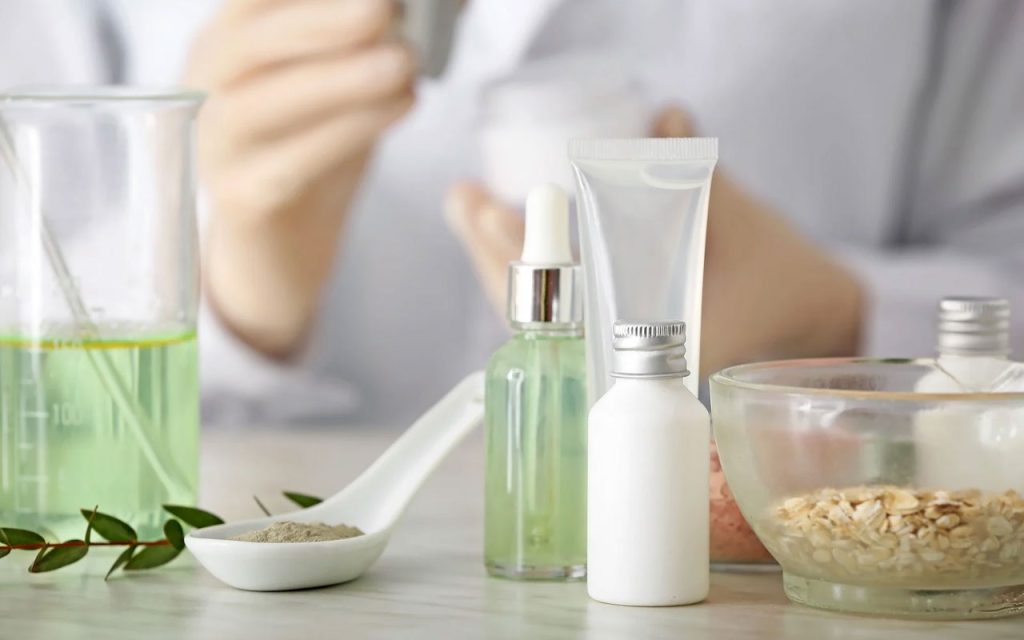
Beauty formulations frequently contain ingredients that require additional context. Fragrance disclosures provide one example. Regulatory frameworks in many markets allow companies to group numerous fragrance components under broad labels such as “Fragrance” or “Parfum” because formulations may qualify as trade secrets.
Legally, that disclosure may be sufficient. But for today’s consumers who are attempting to understand ingredient origin, potential sensitivities, or halal considerations, questions can remain unanswered.
Lahreche said many brands continue relying on broad claims such as vegan, clean, or halal without providing enough supporting transparency for consumers seeking deeper verification.
“A product may technically obtain halal certification while consumers still have questions around fragrance opacity, alcohol derivatives, endocrine-disrupting ingredients, or environmental concerns.”
As a result, ingredient-level clarity is becoming an increasingly important differentiator.
Consumers Are No Longer Passive Recipients of Brand Messaging
This shift in consumer behavior may gradually become even more significant than the regulatory changes.
According to Lahreche, younger consumers increasingly compare information across multiple channels before making purchasing decisions.
“Consumers are moving from passive consumption toward participative verification.”
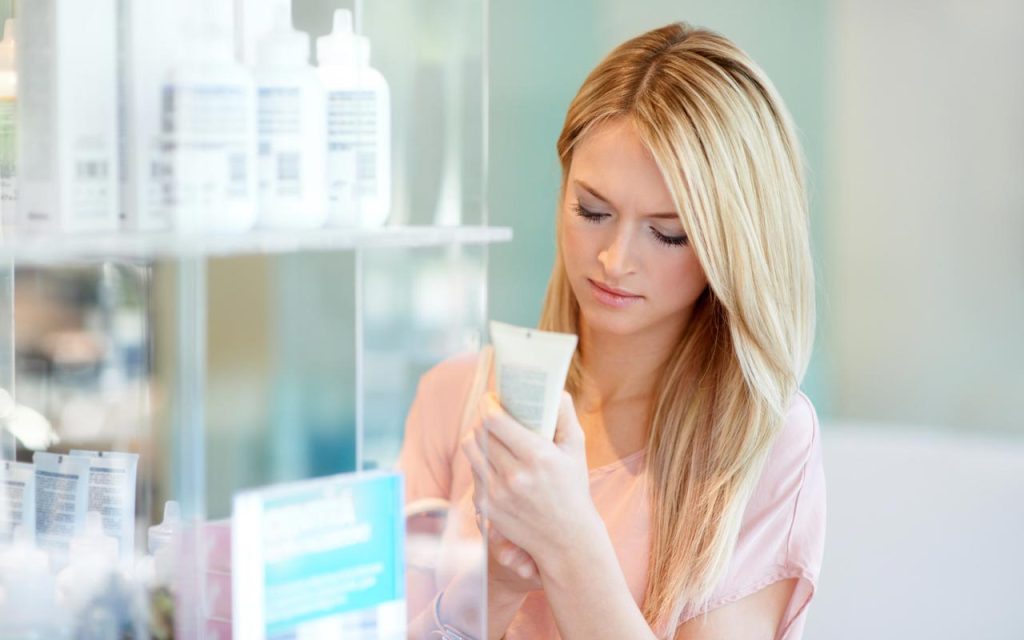
Instead of relying exclusively on brand messaging or certification logos, consumers often consult ingredient databases, beauty communities, social media discussions, product review platforms, independent creators, and specialized applications.
This trend aligns with broader global beauty industry research. Euromonitor International’s 2025 Voice of the Consumer: Beauty Survey found that Millennials and Gen Z increasingly prioritize ingredient transparency and scientific validation when evaluating beauty products. The report also noted that 26% of clean beauty consumers use beauty apps to scan ingredient labels and product information before purchasing.
The result is a more complex, paradoxical trust environment. Consumers now have access to more information than ever before. But at the same time, many also face information overload.
And this combination creates pressure on brands to communicate clearly, consistently, and transparently.
Korean Beauty Brands Have an Opportunity to Lead
The shift toward ingredient transparency does not necessarily place Korean beauty brands at a disadvantage. In many ways, it creates an opportunity for companies that are already investing heavily in formulation quality, product development, and ingredient innovation.
Lahreche believes Korean brands have built much of their global reputation on those strengths.
“K-beauty is extremely strong in innovation, formulation, and product storytelling.”
But the challenge is that consumers in markets such as Indonesia are increasingly asking different questions than they did a decade ago. Product performance and brand popularity remain important, but they are no longer the only factors shaping purchasing decisions.
Consumers now want greater visibility into ingredient sourcing, manufacturing processes, fragrance disclosure, safety considerations, and the reasoning behind product claims. As halal certification becomes more common across the market, transparency itself may become a more important differentiator.
“Popularity is not enough,”
Lahreche said.
For Korean exporters, that does not necessarily mean revealing proprietary formulas or sacrificing intellectual property. Instead, it means communicating ingredients more clearly, providing greater context around sourcing and formulation decisions, and helping consumers understand how certifications, safety assessments, and product claims connect to one another.
This may become particularly important as younger consumers increasingly compare information across certification bodies, ingredient databases, online communities, creators, and digital tools before making purchases.
Because brands that treat transparency as part of product development rather than compliance exercise may find themselves better positioned to build long-term trust in Southeast Asia’s increasingly sophisticated beauty market.
Trust Is Becoming Part of Market Entry Strategy
Indonesia’s halal certification deadline may represent a global regulatory milestone, but the broader lesson extends well beyond just mere compliance.
Consumers are increasingly evaluating products through multiple trust filters at the same time. And while certification remains important, it now sits alongside ingredient transparency, safety awareness, ethical considerations, and brand credibility.
Hence, for Korean beauty companies pursuing long-term growth in Southeast Asia, the challenge is no longer simply entering the market. It is building enough confidence that consumers continue choosing their products after the initial excitement fades.
The brands that understand this shift early may discover that trust has become one of the most valuable ingredients in the product itself.
Key Takeaway
- Indonesia’s 2026 halal certification requirement is raising the importance of transparency for Korean beauty exporters.
- K-beauty’s challenge is shifting from market entry to trust building, particularly in Muslim-majority markets.
- Halal should be integrated into product and communication strategy, not treated as a final compliance step.
- Younger consumers increasingly participate in verification, comparing certifications, ingredient information, communities, creators, and digital tools.
- Ingredient opacity around areas such as fragrance disclosure can create trust gaps, even when products comply with regulations.
- Korean beauty brands retain strong advantages in formulation and innovation, but ingredient-level transparency is emerging as a new competitive differentiator.
- The next phase of K-beauty expansion in Southeast Asia may dependless on popularity and more on sustained consumer confidence.
– Stay Ahead in Korea’s Startup Scene –
Get real-time insights, funding updates, and policy shifts shaping Korea’s innovation ecosystem.
➡️ Follow KoreaTechDesk on LinkedIn, X (Twitter), Threads, Bluesky, Telegram, Facebook, and WhatsApp Channel.
🤝 Looking to connect with verified Korean companies building globally?
Explore curated company profiles and request direct introductions through beSUCCESS Connect.