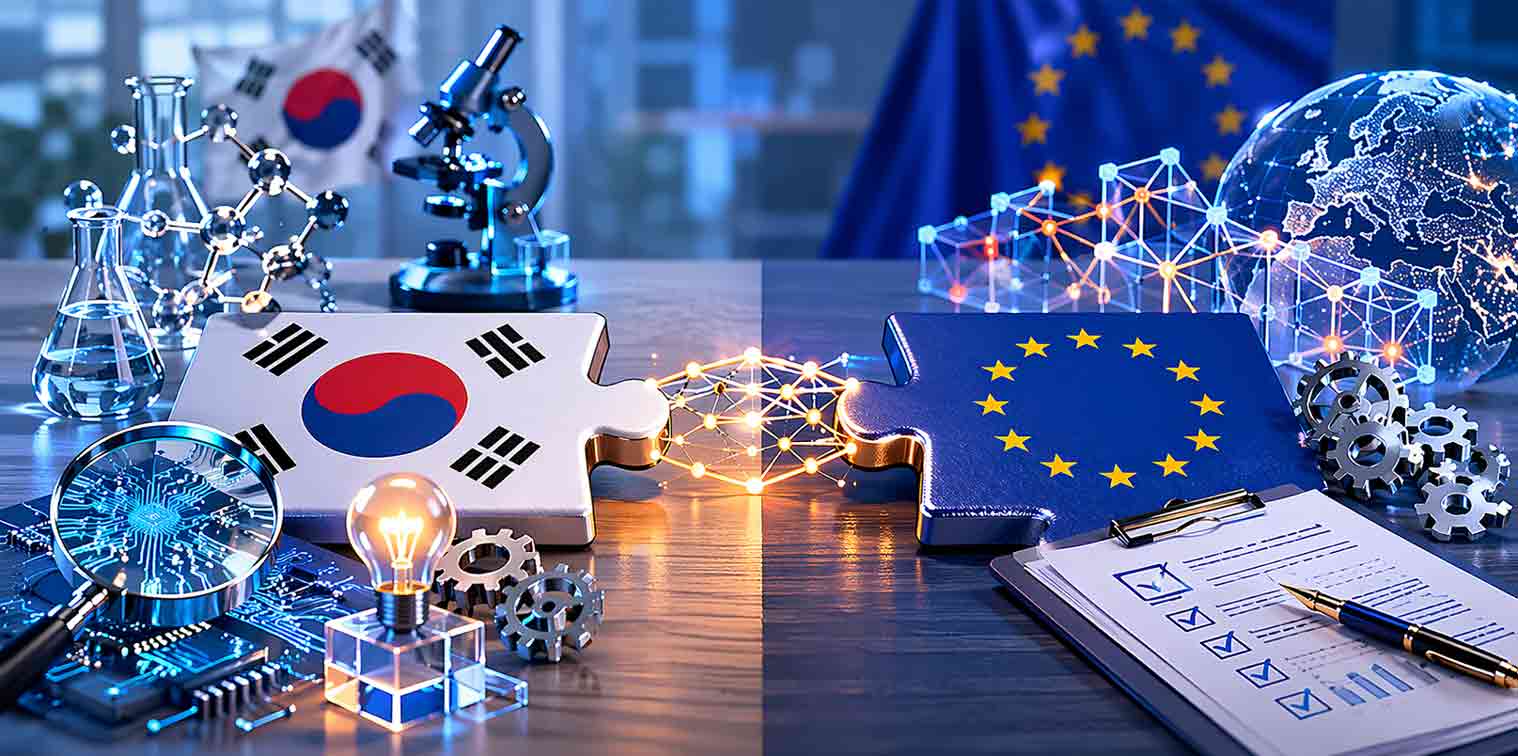
South Korea’s entry into Horizon Europe has expanded access and accelerated cross-border collaboration with Europe (EU). Partnerships are forming, institutions are engaging, and participation is rising. Yet beneath this progress, a deeper friction is becoming visible. The challenge is no longer access or connection. It lies in how Korean teams interpret a system that operates on structure, evaluation, and formal execution.
Horizon Europe Runs on Evaluation, Not Reputation
Horizon Europe is often described as a collaboration platform. In practice, it functions as a structured evaluation system.
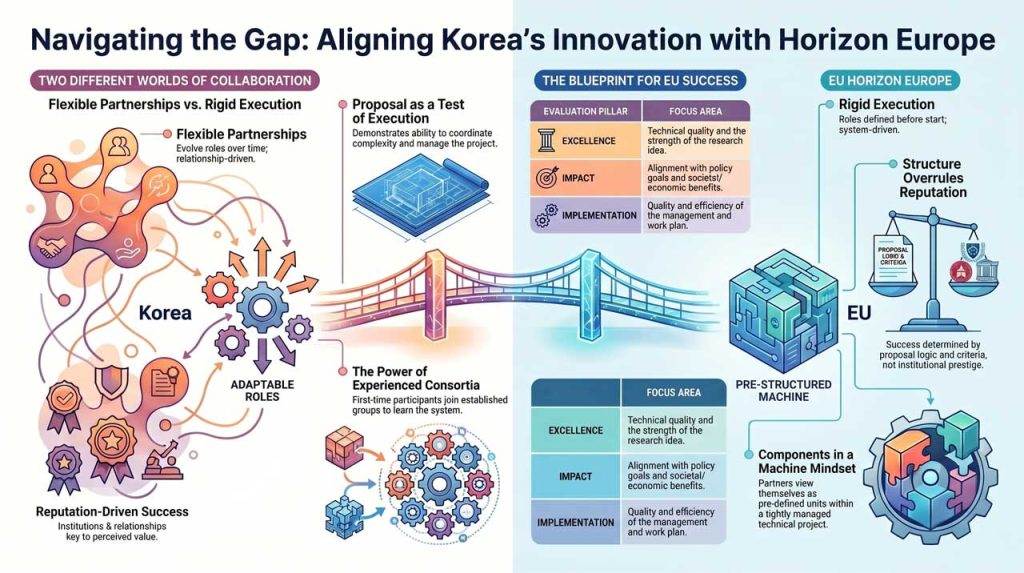
According to the European Commission, proposals are assessed based on three criteria: Excellence, Impact, and Quality and Efficiency of Implementation. Each is scored individually, typically on a five-point scale, with minimum thresholds required to proceed. Only proposals that meet both individual and overall thresholds are considered for funding.
The Commission’s guidance to evaluators is explicit. Proposals must be judged against the defined criteria and call scope, not on institutional reputation or informal signals.
This structure sets a clear boundary. Participation is not determined by who is involved, but by how the project is designed, justified, and executed on paper.
Collaboration Is Predefined Through Structure and Legal Frameworks
The Horizon Europe model requires collaboration to be formalized before funding decisions are made.
Standard consortia must include at least three independent entities from three different countries, with at least one organization based in an EU Member State. In practice, many projects involve significantly larger groups, often requiring coordination across multiple institutions.
Projects are built around defined components:
- Work packages that assign responsibilities
- Detailed timelines and deliverables
- Budget allocation across participants
- Accountability structures across the consortium
These elements are embedded within formal agreements.
The Grant Agreement defines project scope, duration, funding, and obligations. The Consortium Agreement governs internal coordination, decision-making, and dispute resolution among partners.
Korean-side participation reflects this structure. According to EURAXESS Korea, applicants must already be formally listed in project documentation such as the Description of Action or Grant Agreement at the application stage.
This means collaboration is not exploratory. It is pre-structured, documented, and evaluated before a project begins.
Where the Misalignment Begins
The structural nature of Horizon Europe creates a gap in how collaboration is approached.
Paul Conversy, Founder and CEO of InsightMatches, highlighted this difference in correspondence with KoreaTechDesk.
“There’s a structural misunderstanding around collaboration itself.
In an EU-funded project, you’re not just partners. You’re components in a tightly managed machine.”
He noted that many Korean organizations approach collaboration as a flexible partnership that evolves over time. Horizon Europe operates differently. Roles, deliverables, and responsibilities must be clearly defined at the proposal stage, often before relationships are fully developed.
This difference does not reflect a lack of capability. It reflects a mismatch in expectations about how collaboration is built and evaluated.

Execution Is Designed Before the Project Exists
In Horizon Europe, the proposal stage already mirrors project execution.
Teams must align on technical contributions, define responsibilities, and build a coherent work plan across multiple organizations before funding is secured. The proposal itself becomes a test of execution capability.
Conversy described the consequence of misalignment,
“Teams jump into writing before the project structure is solid. If that foundation isn’t clear, the whole proposal starts to feel incoherent.”
The issue is not idea quality. It is the ability to translate an idea into a structured, multi-party execution plan that meets evaluation criteria.
This requirement is reinforced by the scale of the program. The European Commission’s Horizon Europe work programme includes more than 1,000 topics across several thousand pages of documentation, reflecting the complexity of aligning projects with policy goals, funding priorities, and implementation standards.
Why Strong Teams Still Struggle
The mismatch between collaboration models becomes visible even among capable participants.
Structured Evaluation vs Concept-Driven Proposals
Horizon Europe rewards proposals that demonstrate clear methodology, measurable impact, and credible implementation. Teams that focus primarily on technical ideas without structuring them against these criteria face disadvantages.
Work Package and Role Definition Gaps
EU projects require detailed breakdowns of who does what, when, and at what cost. Teams unfamiliar with this structure often delay defining these elements or treat them as secondary.
Execution Credibility as a Selection Factor
Evaluation places strong weight on whether a consortium can realistically deliver the project. This includes coordination capability across partners, not just technical expertise.
Conversy pointed to a recurring pattern.
“European teams tend to start with an approximate idea and refine it as they go.
Korean teams sometimes wait until everything is perfect before committing, and by then the window has closed.”
This difference affects how quickly teams adapt to the structured demands of the system.
Prestige Does Not Replace Structure
Another misconception lies in how success is perceived.
Horizon Europe does not prioritize institutional prestige as a primary factor. Evaluation focuses on the strength of the proposal, its alignment with policy goals, and the feasibility of execution.
Conversy noted that many Korean institutions underestimate their position.
“There are far more organizations in Korea with competitive profiles than they realize. The barrier isn’t capability. It’s assumption.”
This reinforces a key point. Strong teams can compete, but only if they align with the system’s evaluation logic.
Why the EU Model Feels Different
The Horizon Europe system combines technical, administrative, and legal complexity.
Participation requires:
- Alignment with EU policy priorities
- Compliance with documentation and reporting standards
- Coordination across multiple institutions and jurisdictions
For organizations entering from outside established European networks, this creates a steep learning curve.
The European Commission has acknowledged this complexity in its program communications, noting the breadth of topics and documentation involved in Horizon Europe participation.
This environment favors teams that understand not only the technical domain, but also the operational structure of the system.
What This Means for Global Startup and Research Ecosystems
The implications extend beyond Korea and point to how cross-border R&D is evolving globally.
Korean startups and research institutions entering Horizon Europe face a shift in operating logic. Collaboration cannot remain flexible or exploratory. It must be structured from the outset, with clear roles, defined deliverables, and execution planning built into the proposal stage. Technical strength alone is no longer sufficient without operational clarity.
European consortia encounter a different challenge. Bringing in new partners, especially those outside established networks, requires early alignment on responsibilities, timelines, and expectations. Without that structure in place, even promising collaborations struggle to progress into viable proposals.
For global founders and investors, this highlights a broader distinction between regions. Expanding into Europe through R&D collaboration does not follow the same path as entering the US market. It demands engagement with a system built on formal coordination, strict evaluation criteria, and long-term project execution rather than speed or market-driven iteration.
From Misalignment to Adaptation
The path forward is not about increasing participation alone. It is about aligning with how the system operates.
Conversy emphasized a practical entry strategy,
“For teams entering this space for the first time, it’s far smarter to join an experienced consortium as an expert partner.
Build a track record, learn the system, and lead later.”
This approach reflects how participation evolves within Horizon Europe. Experience within the system becomes a prerequisite for scaling influence.
Understanding the System Defines Participation
South Korea has moved beyond access and connection in Horizon Europe.
The next phase depends on alignment.
Participation is not determined by the number of partnerships formed or the strength of technical ideas alone. It is defined by how well teams operate within a structured system of evaluation, documentation, and coordinated execution.
The gap is no longer about entering the ecosystem. It is about understanding the rules that govern it.
Key Takeaways
- Horizon Europe evaluates proposals using structured criteria: Excellence, Impact, and Implementation.
- Collaboration requires formal consortia, defined roles, and legal agreements before funding approval.
- Korean teams often approach partnerships flexibly, while the EU system demands predefined structure and accountability.
- Proposal success depends on execution design, not institutional prestige or informal relationships.
- The Horizon Europe framework involves high complexity, including large-scale documentation and multi-party coordination.
- Global participants must treat EU R&D collaboration as a system-driven process, not a relationship-driven one.
- Aligning with evaluation logic and execution structure is critical to successful participation.
– Stay Ahead in Korea’s Startup Scene –
Get real-time insights, funding updates, and policy shifts shaping Korea’s innovation ecosystem.
➡️ Follow KoreaTechDesk on LinkedIn, X (Twitter), Threads, Bluesky, Telegram, Facebook, and WhatsApp Channel.
🤝 Looking to connect with verified Korean companies building globally?
Explore curated company profiles and request direct introductions through beSUCCESS Connect.