


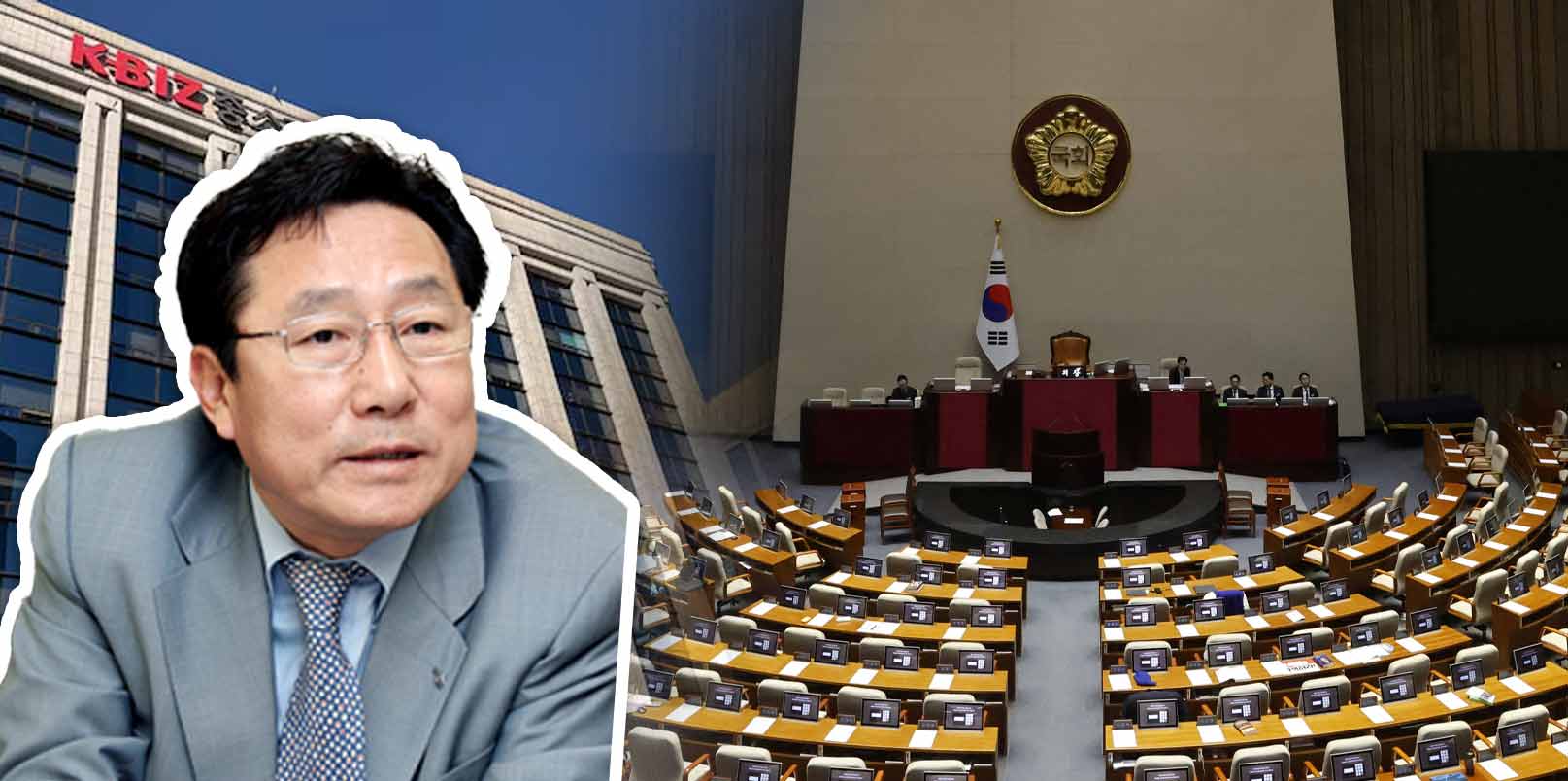
A legislative effort to remove leadership term limits at the Korea Federation of SMEs (KBIZ) has stalled in South Korea’s National Assembly, deepening a debate that now extends beyond one organization.
Lawmakers reviewing an amendment to the Small and Medium Enterprise Cooperatives Act postponed a decision after failing to reach agreement on governance rules for cooperative leadership.
The delay leaves the future of KBIZ leadership reform uncertain and highlights growing divisions within Korea’s SME representation system. The debate also raises broader questions about governance standards in institutions that influence SME and startup policy discussions.
National Assembly Delays KBIZ Chairman Term-Limit Reform
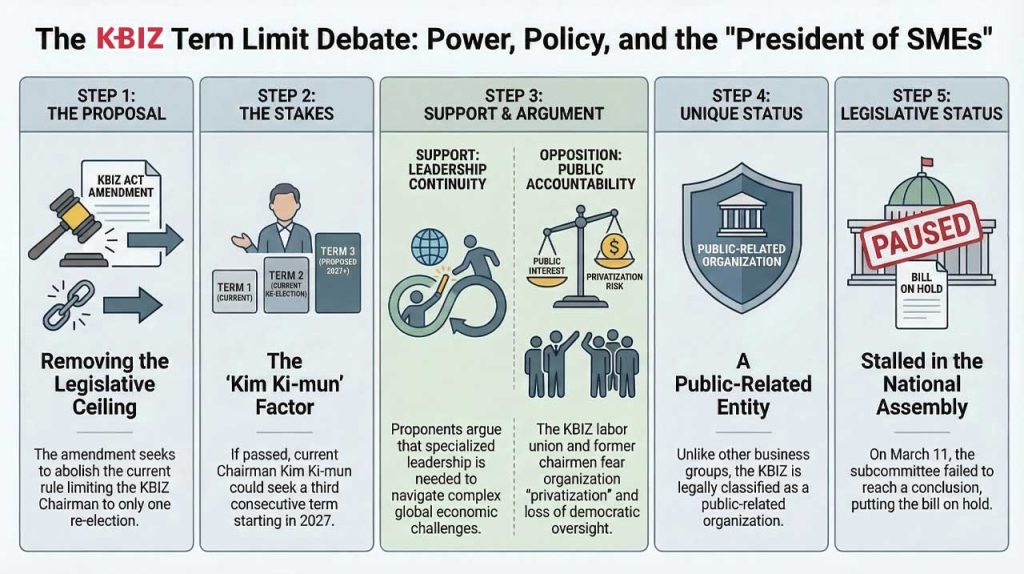
South Korea’s National Assembly Trade, Industry, Energy, SMEs and Startups Committee reviewed the amendment in its legislative review subcommittee on March 11 but did not reach a conclusion.
The bill was introduced by Democratic Party lawmaker Jung Jin-wook and proposes removing statutory limits on the number of consecutive terms that the KBIZ chairman and cooperative chairpersons can serve.
Under the current legal framework, the KBIZ chairman can serve one additional consecutive term, while cooperative chairpersons can serve up to two additional terms.
According to participants cited in Korean media reports, members of the subcommittee disagreed over the issue of leadership tenure. The committee decided to revisit the proposal at a later date rather than move it forward.
For now, the amendment remains under review within the legislative process.
Why the Bill Matters for KBIZ Chairman Kim Ki-moon
The proposal has drawn heightened attention because it could affect the future leadership eligibility of KBIZ Chairman Kim Ki-moon.
Kim previously served as the federation’s 23rd and 24th chairman between 2007 and 2014. He returned to office in 2019 as the 26th chairman and was re-elected in 2023 as the 27th chairman.
His current term ends in February 2027.
If the amendment does not pass, Kim will not be able to run in the next chairman election under the current law limiting consecutive terms. If the law were revised, another candidacy would become possible.
Because the KBIZ system does not limit non-consecutive terms, Kim has already served four terms in total, making the proposed change politically sensitive.
SME Sector Divided Over Leadership Reform
The proposed amendment has exposed clear divisions inside the SME community.
Opposition from Union and Former Leaders
The KBIZ labor union has publicly opposed the bill, calling it a “dictatorship bill” and warning that removing term limits could weaken democratic governance within the cooperative system.
Former KBIZ chairmen have also voiced concern. In statements reported by Korean media, they argued that term limits function as a safeguard against long-term concentration of authority.
They emphasized that the KBIZ chairman leads an organization with public policy responsibilities and warned that weakening leadership rotation could risk organizational privatization or reduce representation across industries and regions.
Support from Cooperative Federations
At the same time, several SME cooperative groups have expressed support for the amendment.
A coalition described as the Committee for Promoting Amendments to the SME Cooperatives Act, representing federations and cooperatives affiliated with KBIZ, submitted a petition supporting the reform.
According to reports, 480 cooperatives participated, representing more than 80 percent of KBIZ full member organizations.
Supporters argue that legal limits on leadership terms restrict the autonomy of cooperatives and prevent members from choosing experienced leaders through elections.
They also emphasize the need for leadership continuity to navigate rapidly changing economic conditions and maintain cooperation with government policy initiatives and large corporations.
Government Signals Caution Over Governance Risks
South Korea’s Ministry of SMEs and Startups (MSS) has taken a cautious stance toward the proposed reform.
In a review report submitted to the National Assembly committee, the ministry noted that current term-limit rules were introduced to prevent negative organizational effects caused by prolonged leadership tenure.
Officials also pointed out that other cooperative-related laws in Korea have recently strengthened restrictions on leadership reappointments. Amendments to the Agricultural Cooperatives Act, for example, tightened limits on cooperative leadership tenure.
The ministry additionally emphasized that KBIZ carries a public institutional character. Unlike many private industry associations, the federation has been designated as a public-service-related organization by the Ministry of Personnel Management.
Because of this status and the federation’s role in policy implementation, the ministry said the issue requires careful review.
Observers note that government ministries rarely express direct opposition to amendments involving laws under their jurisdiction. In this context, the ministry’s call for “careful review” has been widely interpreted as a signal of concern.
Why Governance at KBIZ Matters for Korea’s Startup and SME Policy System
Although the current debate centers on leadership rules, the issue extends beyond internal organizational governance.
KBIZ represents a large portion of South Korea’s small and medium-sized enterprises and participates in discussions related to SME policy, industrial programs, and economic development initiatives.
In Korea’s policy system, institutions like KBIZ often function as intermediaries between industry groups and government ministries. Their leadership structures can therefore influence how business interests are represented in national policy conversations.
For global founders, investors, and analysts observing the Asia-Pacific startup ecosystem, governance stability inside such organizations can affect the credibility and predictability of policy consultation processes.
The current dispute highlights a familiar governance dilemma seen across many economic institutions. Leadership continuity can provide policy consistency and accumulated expertise. At the same time, term limits are often designed to preserve accountability and leadership rotation.
South Korea’s debate around KBIZ leadership rules reflects this broader tension inside organizations that represent large segments of the SME economy.
Legislative Outcome Remains Uncertain
For now, the amendment to the Small and Medium Enterprise Cooperatives Act remains under review.
The National Assembly’s legislative subcommittee decided to postpone a decision after internal disagreements, and lawmakers indicated the proposal would be discussed again at a later stage.
Until the legislative process moves forward, the question of whether Korea will change the leadership rules governing its largest SME federation remains unresolved.
Signaling Korea’s Evolving Governance Standard
The stalled reform at KBIZ illustrates how governance debates inside industry institutions can evolve into broader policy questions.
Organizations representing millions of businesses must balance leadership continuity with safeguards that preserve institutional legitimacy.
How South Korea ultimately resolves the KBIZ term-limit debate will shape more than one federation’s leadership rules. It will also signal how governance standards are evolving inside institutions that participate in the country’s SME and startup policy ecosystem.
Key Takeaways on KBIZ Term-Limit Delayed Bill
- South Korea’s National Assembly has delayed a bill removing term limits for KBIZ leadership after disagreement within a legislative subcommittee.
- The amendment would eliminate statutory limits on the reappointment of the KBIZ chairman and cooperative chairpersons.
- The proposal has divided the SME community, with labor unions and former KBIZ leaders opposing it while cooperative federations support it.
- The Ministry of SMEs and Startups has urged caution, citing governance concerns and KBIZ’s status as a public-service-related organization.
- The legislative process remains ongoing, leaving the future of KBIZ leadership reform uncertain.
🤝 Looking to connect with verified Korean companies building globally?
Explore curated company profiles and request direct introductions through beSUCCESS Connect.
– Stay Ahead in Korea’s Startup Scene –
Get real-time insights, funding updates, and policy shifts shaping Korea’s innovation ecosystem.
➡️ Follow KoreaTechDesk on LinkedIn, X (Twitter), Threads, Bluesky, Telegram, Facebook, and WhatsApp Channel.


