K-Beauty’s global reputation was built on branding speed and product cycles. Now, Seoul is turning its attention to the factory floor. What began as a smart factory subsidy program is evolving into something more targeted: a sector-specific AI manufacturing strategy anchored in cosmetics — Korea’s top SME export category.
MSS Launches Sector-Tailored AI Manufacturing Initiative for K-Beauty
On February 26, Minister Han Seong-sook of the Ministry of SMEs and Startups (MSS) visited Yegreena, a cosmetics original development manufacturing (ODM) company in Incheon, as the first stop of the government’s “Smart Manufacturing Innovation Industry-Specific Field Tour.”
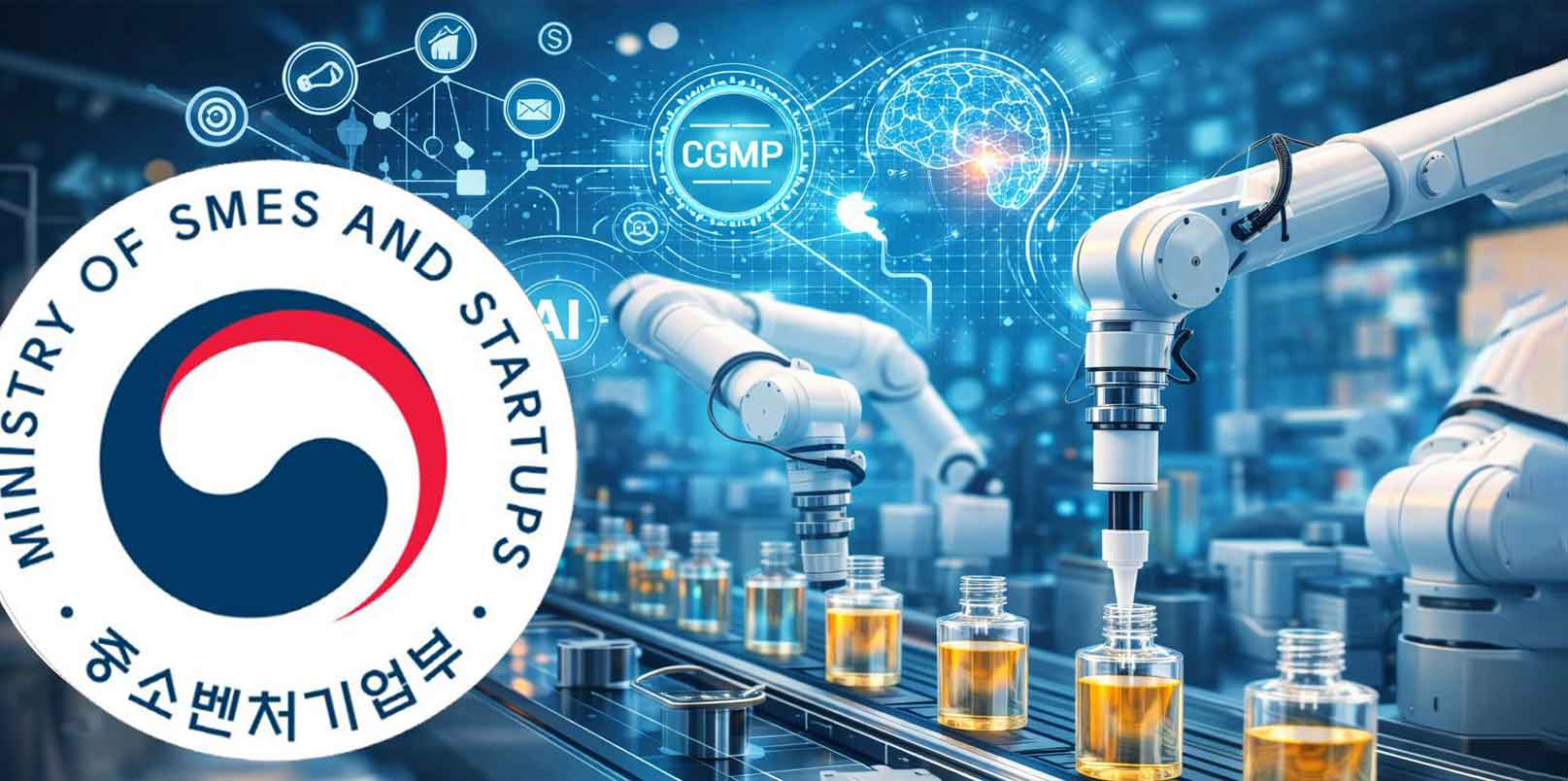
The visit centered on advancing AI-driven manufacturing in the K-Beauty sector. MSS confirmed plans to newly support the development of multi-AI agent technologies for process and quality optimization in cosmetics production and to establish AI transition guidelines tailored specifically to the beauty industry.
Minister Han Seong-sook said during the on-site roundtable,
“Cosmetics, the number one export item among SMEs, achieved record-high export performance last year. For K-Beauty’s sustainable global growth, smart manufacturing at production sites, AI adoption, and technology development investment are essential.”
MSS currently operates a smart factory support program across all manufacturing industries. However, beauty — alongside food and fashion — is being treated as a strategic export category eligible for intensified and coordinated support with other ministries and local governments.
In K-Beauty, MSS is working jointly with the Ministry of Food and Drug Safety (MFDS) to provide a package model that combines smart factory establishment with CGMP (Cosmetic Good Manufacturing Practice) certification consulting. Through the Chungbuk Manufacturing AI Center, the government is also supporting AI model development, validation, and workforce training in convergence bio sectors including cosmetics.
Last year, 18 cosmetics manufacturers received approximately KRW 3.2 billion in support under the inter-ministerial smart factory program. According to MSS, demand for participation has more than doubled this year.
Why Korea Is Reframing K-Beauty as a Manufacturing Intelligence Sector
The shift is subtle but meaningful. Beauty is no longer being positioned solely as a cultural export success. It is being treated as industrial infrastructure.
Unlike past smart factory initiatives that applied uniformly across sectors, MSS is now signaling that industry characteristics matter. Cosmetics production operates under multi-product, small-batch dynamics. Automation and standardization are more complex than in traditional mass manufacturing.
Industry participants made this explicit. Lee Jong-geuk, CEO of cosmetics solution firm Igemco, noted during the roundtable that the cosmetics industry’s production structure limits the extent of conventional automation. He called for phased support strategies distinguishing between firms that have already implemented smart systems and those that have not.
Jeong Do-hyun, CEO of Raphas, added that hardware upgrades must accompany software transformation,
“A data collection infrastructure must first be established in order to transition to an autonomous factory.”
These remarks reflect a broader recalibration: AI in cosmetics manufacturing is not a branding upgrade. It is a systems challenge.
The Execution Friction: Talent Gaps, Hardware Costs, and Operational Reality
The ambition is clear, but the constraints are equally visible.
Several executives pointed to a persistent shortage of specialized AI personnel. Han Seong-su, CEO of Yegreena, observed that many SMEs struggle not with adopting smart factory systems, but with embedding them into daily operations. Smaller manufacturers lack in-house expertise to manage and optimize AI systems once installed.
Minister Han acknowledged the difficulty of supporting all 4,000 cosmetics manufacturers simultaneously. She indicated that MSS would refine support by grouping firms according to size and characteristics and by matching them with specialized companies. She also mentioned the possibility of subscription-based models in which specialized firms provide ongoing AI services to SMEs.
This reflects a structural tension inside Korea’s SME digital transformation strategy. Public capital can fund initial deployment. Sustained operational capability depends on talent, integration discipline, and long-term incentives.
The industry’s request for hardware support adds another layer. Software-centered AI adoption without equipment modernization risks producing partial transformation. Yet hardware upgrades require heavier capital commitments, which is not easily absorbed by smaller firms.
Policy ambition is now confronting factory-level economics.
What Korea’s K-Beauty AI Manufacturing Push Actually Unlocks — and Where the Limits Remain
If executed carefully, the sector-specific approach enables three tangible shifts.
First, it allows MSS to test industry-tailored AI guidelines before expanding similar models to other SME export sectors such as food and fashion. Beauty becomes a pilot case.
Second, it creates structured entry points for AI solution providers targeting SME manufacturing. The ministry’s discussion of specialized firm matching and subscription-based support signals potential demand for industrial AI-as-a-service models.
Third, linking smart factories with CGMP certification embeds regulatory compliance into digital transformation, aligning quality control with export readiness.
What it does not do — at least not yet — is resolve structural workforce shortages or guarantee that smart factory investments translate into measurable productivity gains. Installing AI systems is not equivalent to operating AI-optimized factories.
Nor does the initiative imply a wholesale reindustrialization of K-Beauty. The policy remains targeted and phased. The scale will depend on sustained coordination between ministries, local governments, technology providers, and manufacturers.
Why Korea’s SME AI Manufacturing Model Matters for Global Industrial AI Startups and Investors
Global industrial AI startups should read this as an early signal. Korea is turning cosmetics manufacturing into a live testing ground for SME-focused AI deployment. Companies working on process optimization, predictive quality control, sensor integration, or factory analytics could find pilot openings inside a government-backed framework that lowers initial adoption barriers.
The message to international investors is subtler but equally important. Export resilience in Korea is no longer being framed purely through brand expansion or market access. It is increasingly tied to manufacturing intelligence. Beauty’s record export performance gives policymakers the political cover to push deeper industrial upgrading beneath the surface of consumer success.
Cross-border partners should also pay attention to the regulatory layer emerging here. By pairing CGMP certification consulting with smart factory deployment, the government is linking compliance, automation, and data systems into a single competitiveness narrative. In practice, regulatory alignment is becoming part of digital infrastructure — not a separate checklist.
In the end, this is Korea’s disciplined attempt to re-anchor a successful consumer sector in industrial capability.
K-Beauty’s Shift from Export Branding to AI-Driven Production Discipline
K-Beauty’s rise was often explained through trend velocity and brand storytelling. The government’s latest push reframes the narrative. The question is no longer how fast Korean cosmetics can enter new markets. It is whether the factories behind them can evolve into data-driven production systems without breaking under cost and talent pressure.
Sector-specific AI manufacturing is not glamorous policy. It is slow architecture. If it holds, it quietly reshapes the base of Korea’s SME export economy.
If it falters, it risks becoming another smart factory statistic.
Key Takeaway: Korea’s Sector-Specific AI Manufacturing Shift in K-Beauty
- Korea has launched its first sector-specific AI manufacturing initiative focused on K-Beauty.
- MSS will support multi-AI agent technology development and establish beauty-tailored AI transition guidelines.
- Smart factory deployment is being linked with CGMP certification and regulatory consulting.
- Execution friction centers on AI talent shortages, hardware investment burdens, and operational integration gaps.
- Beauty is serving as a pilot case for SME digital transformation before expansion to other export sectors.
🤝 Looking to connect with verified Korean companies building globally?
Explore curated company profiles and request direct introductions through beSUCCESS Connect.
– Stay Ahead in Korea’s Startup Scene –
Get real-time insights, funding updates, and policy shifts shaping Korea’s innovation ecosystem.
➡️ Follow KoreaTechDesk on LinkedIn, X (Twitter), Threads, Bluesky, Telegram, Facebook, and WhatsApp Channel.